China's AI Smart Glasses Market Surges with Specialized Designs
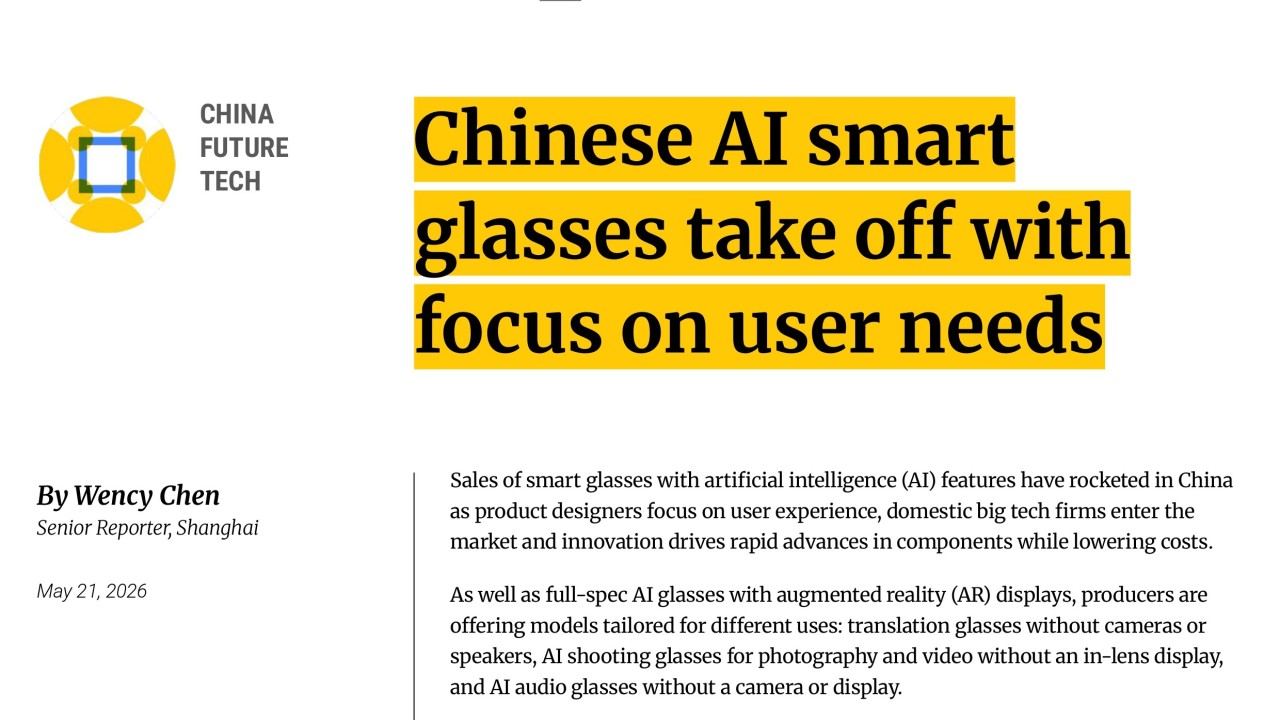
💡Learn how specialized AI hardware is gaining traction in China, signaling a shift toward practical, task-specific wearab
⚡ 30-Second TL;DR
What Changed
Rapid market growth driven by lower component costs and improved user experience design.
Why It Matters
The move toward specialized, low-cost AI hardware suggests a shift in the wearable AI landscape, moving away from bulky AR headsets toward practical, daily-use devices. This trend indicates a massive opportunity for developers to build lightweight, context-aware AI agents for specific verticals.
What To Do Next
Explore integrating your LLM backend with lightweight, low-latency edge SDKs to support specialized wearable hardware that lacks heavy onboard processing.
Key Points
- •Rapid market growth driven by lower component costs and improved user experience design.
- •Shift from generic AR headsets to specialized, task-specific AI eyewear.
- •Domestic Chinese tech firms are aggressively entering the smart glasses sector.
🧠 Deep Insight
Web-grounded analysis with 27 cited sources.
🔑 Enhanced Key Takeaways
- •Government subsidies, introduced in January 2026, are a significant driver of mass adoption in China, offering consumers up to a 15% discount on AI glasses purchases, capped at 500-800 yuan.
- •China's robust manufacturing strength and consolidated supply chain, particularly in the Pearl River Delta, provide a competitive edge, enabling rapid product development cycles and efficient sourcing of specialized components like chips and optical modules.
- •AI smart glasses are increasingly being positioned as the 'next generation personal computing platform' after smartphones and smartwatches, with companies aiming to secure a dominant position in this evolving computing era.
- •The market is experiencing a dual-track development, with parallel growth in both lightweight, consumer-oriented AI glasses and more professional-grade head-mounted displays, each catering to different user needs and application scenarios.
- •Despite rapid growth, significant challenges remain, including privacy concerns related to built-in cameras and microphones, the need for further technological breakthroughs in battery life and display components, and the development of unique use cases beyond smartphone replication.
📊 Competitor Analysis▸ Show
| Company/Brand | Key Features | Pricing (approx. USD) | Benchmarks/Notes |
|---|---|---|---|
| Xiaomi AI Glasses | 12MP ultra-wide camera (2K video), real-time translation, XiaoAI voice assistant, Qualcomm-based AR platform, Wi-Fi, Bluetooth, no display, Alipay QR payment. | $275 (1,999 yuan) | 8.6 hours mixed use battery. Focus on familiar, everyday use. |
| Alibaba Quark AI Glasses | Powered by Qwen LLM, translation, navigation, contextual assistance, integrated into Alibaba ecosystem, swappable batteries (S1). | G1: $268 (1,899 yuan); S1: $537 (3,799 yuan) | Positioned as infrastructure, not an experiment. |
| Huawei AI Eyewear | 35.5g, voice interaction, QR code payments, live streaming, first-person video calls, multimodal AI (calorie tracking), self-developed chip. | $367 (2,499 yuan) | Renewed push in smart eyewear, challenging Meta. |
| Rokid AI Glasses Style / Rokid Glasses | Style: 38.5g, 12MP camera, AI voice commands (translation, navigation), multi-language support, ~12 hours mixed use. Rokid Glasses (Q2 2025): 49g, 4K recording, real-time translation, space-grade durability, Qualcomm AR1 platform. | Style: $299; Rokid Glasses: $345 | Focus on combining AI utility with comfort and form factor. |
| RayNeo X2 / X3 Pro | X2: Dual micro-OLED waveguide displays, real-time translation, navigation, voice interaction. X3 Pro: Advanced display, onboard AI processing, eSIM, 4G connectivity. | Not explicitly stated, but a leading brand. | X3 Pro recognized by Time as a notable invention in late 2025. |
| XREAL One Pro | Binocular full HD display, spatial computing chip, 3DoF hover, 3D video shooting, spatial office work, Google partnership (Android XR). | $649 | Considered a 'cinematic powerhouse' for visual immersion. |
🛠️ Technical Deep Dive
- Chipsets: Many Chinese AI glasses utilize Qualcomm's AR1/AR2 platforms. Some, like Xiaomi AI Glasses, combine AR1 with a BES2700 Bluetooth/audio MCU for balanced performance and efficiency. Huawei uses its self-developed chip for its AI eyewear. Chinese semiconductor firms are also developing dedicated AI accelerators and Neural Processing Units (NPUs) for wearables to optimize battery life. Fuzhou Rockchip provides AI glasses chips with 10 TOPS for devices like Xiaomi AI Glasses.
- Display Technology: Common technologies include micro-OLED waveguide displays (e.g., RayNeo X2, INMO Air series) and diffractive waveguide optics (e.g., Rokid). Micro-LED technology is also being developed, with companies like JBD (Shanghai Jade Bird Display) producing Micro LED optical engines that are compact and power-efficient. Waveguide technology is considered a core technical barrier where China has achieved global leadership.
- Sensors: Devices typically integrate high-resolution cameras (e.g., 12MP in Xiaomi and Rokid glasses), multiple microphones (e.g., five in Xiaomi), inertial measurement units (IMUs), and light/proximity sensors. Some advanced models may include LiDAR.
- AI Models & Processing: Alibaba's Quark AI Glasses are powered by its Qwen large language model, while Xiaomi uses its XiaoAI assistant. There's a strong focus on on-device AI (edge computing) for real-time processing of computer vision and natural language processing (NLP) tasks to reduce latency and enhance privacy.
- Connectivity: Advanced models like the RayNeo X3 Pro feature integrated eSIM and 4G connectivity. Standard connectivity includes Wi-Fi and Bluetooth 5.3.
- Battery & Power Management: Innovations include silicon-carbon batteries (Xiaomi) and swappable battery temples (Alibaba S1) to address battery life challenges. Charging cases are also common to extend usage time.
🔮 Future ImplicationsAI analysis grounded in cited sources
⏳ Timeline
📎 Sources (27)
Factual claims are grounded in the sources below. Forward-looking analysis is AI-generated interpretation.
- chinadailyhk.com
- people.cn
- aibase.com
- asiae.co.kr
- sedaily.com
- yicaiglobal.com
- news.cn
- cgtn.com
- traxtech.com
- tmtpost.com
- reddit.com
- globaltimes.cn
- indiatimes.com
- macaonews.org
- roadtovr.com
- scmp.com
- registrationchina.com
- resident.com
- youtube.com
- scmp.com
- reddit.com
- inairspace.com
- topaiglasses.com
- made-in-china.com
- 36kr.com
- informa.com
- chinadaily.com.cn
Weekly AI Recap
Read this week's curated digest of top AI events →
👉Related Updates
AI-curated news aggregator. All content rights belong to original publishers.
Original source: SCMP Technology ↗