China Smartphone Sales Slide 8.6% as Huawei Leads
💡Memory and SoC inflation could reshape the cost and timing of mobile AI deployments.
⚡ 30-Second TL;DR
What Changed
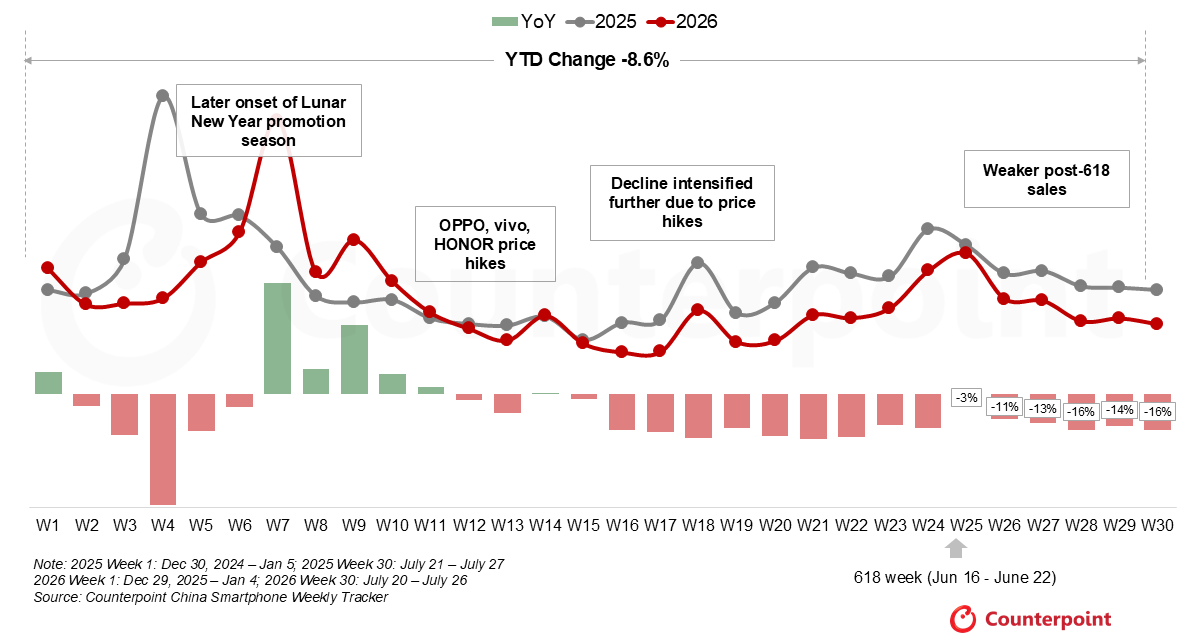
China’s smartphone sales declined 8.6% year over year through week 30 of 2026.
Why It Matters
Higher memory and SoC costs could raise the cost of edge AI devices, smartphones, and on-device inference hardware. AI teams planning mobile deployments should expect tighter hardware budgets and possible delays in device refresh cycles.
What To Do Next
Recalculate your 2026 edge-AI device budget using higher memory and SoC cost assumptions before committing to a smartphone-based deployment.
Key Points
- •China’s smartphone sales declined 8.6% year over year through week 30 of 2026.
- •Huawei remained the leading smartphone brand in the market.
- •Post-618 sales declines widened to double digits amid weak seasonal demand.
- •Rising memory and SoC costs are expected to drive additional price increases.
🧠 Deep Insight
AI-generated analysis for this event.
🔑 Enhanced Key Takeaways
- •The decline in the Chinese smartphone market is significantly impacted by a shift in consumer preference toward premium devices, which has lengthened replacement cycles beyond 30 months.
- •Huawei's market leadership is largely attributed to the successful integration of its proprietary HarmonyOS NEXT, which has reduced reliance on external ecosystems and boosted domestic consumer loyalty.
- •Supply chain constraints for advanced 5nm and 3nm process nodes have disproportionately affected mid-range smartphone manufacturers, limiting their ability to compete with Huawei's flagship pricing power.
- •Local government initiatives in several Tier-1 Chinese cities have introduced limited-time subsidies for AI-enabled hardware, though these have failed to offset the broader macroeconomic cooling effect on consumer electronics.
- •Inventory levels for major OEMs remain elevated, leading to aggressive discounting strategies that are compressing profit margins despite the rising costs of SoCs and memory components.
📊 Competitor Analysis▸ Show
| Feature/Metric | Huawei (Market Leader) | Xiaomi | OPPO/Vivo | Apple |
|---|---|---|---|---|
| OS Ecosystem | HarmonyOS NEXT | HyperOS (Android) | ColorOS/OriginOS | iOS |
| SoC Strategy | Proprietary Kirin | Qualcomm/MediaTek | Qualcomm/MediaTek | Apple A-Series |
| Pricing Strategy | Premium/Flagship Focus | Value-to-Performance | Mid-to-High Tier | Premium |
| 2026 Market Trend | Growth/Stability | Inventory Pressure | Inventory Pressure | Seasonal Decline |
🛠️ Technical Deep Dive
- Huawei's current flagship architecture utilizes the Kirin 9100 series, which leverages advanced multi-patterning lithography to achieve performance parity with 5nm-class chips despite export restrictions.
- HarmonyOS NEXT has transitioned to a fully native kernel architecture, removing support for Android Open Source Project (AOSP) code, which optimizes memory management and reduces background process overhead.
- Memory cost increases are driven by the industry-wide transition to LPDDR5X and UFS 4.1 standards, which require higher-grade silicon and more complex packaging techniques.
- AI-driven power management algorithms are being deployed at the firmware level to mitigate the thermal output of high-performance SoCs during intensive 5G data processing.
🔮 Future ImplicationsAI analysis grounded in cited sources
⏳ Timeline
Weekly AI Recap
Read this week's curated digest of top AI events →
👉Related Updates
AI-curated news aggregator. All content rights belong to original publishers.
Original source: cnBeta (Full RSS) ↗