China Robot Boom Hits Buyer Satisfaction Wall
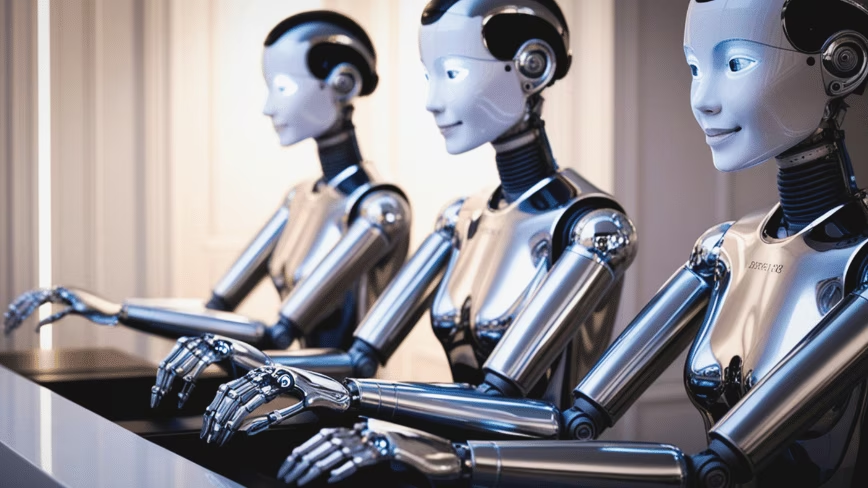
150 China robot firms, 23% satisfaction—spot winners in $13B boom
30-Second TL;DR
What Changed
Over 150 humanoid robot companies in China
Why It Matters
Rapid growth signals investment opportunities but low satisfaction hints at market consolidation. AI practitioners in embodied AI should watch for viable leaders amid hype.
What To Do Next
Evaluate Unitree prototypes for embodied AI pilots before IPO-driven price hikes.
Key Points
- •Over 150 humanoid robot companies in China
- •90% of world's 2025 humanoid shipments from China
- •Unitree and AgiBot IPOs to value $13B combined
- •Only 23% buyer satisfaction rate
- •Morgan Stanley doubles Chinese market forecast
Deep Insight
AI-generated analysis for this event — not the original article.
Enhanced Key Takeaways
- •The low satisfaction rate is primarily attributed to 'deployment-reality gaps,' where robots struggle with unstructured environments and battery longevity, failing to meet the industrial-grade reliability promised in marketing materials.
- •Chinese government subsidies for 'New Quality Productive Forces' have incentivized rapid prototyping and volume production over long-term software refinement, leading to a market saturated with hardware-capable but intelligence-deficient units.
- •Supply chain dominance is bolstered by China's localized production of high-torque actuators and harmonic drives, which has reduced the cost of humanoid robot components by approximately 40% compared to Western counterparts since 2023.
Competitor Analysis
- Unitree (China)
- Low-cost mass production
- AgiBot (China)
- Industrial/Logistics
- Tesla (Optimus)
- Consumer/General Purpose
- Boston Dynamics (Atlas)
- R&D/Advanced Mobility
- Unitree (China)
- $16,000 - $90,000
- AgiBot (China)
- $20,000 - $100,000
- Tesla (Optimus)
- Target <$20,000
- Boston Dynamics (Atlas)
- N/A (Research platform)
- Unitree (China)
- High agility/low weight
- AgiBot (China)
- High payload/precision
- Tesla (Optimus)
- AI/Neural integration
- Boston Dynamics (Atlas)
- Hydraulic power/stability
| Feature | Unitree (China) | AgiBot (China) | Tesla (Optimus) | Boston Dynamics (Atlas) |
|---|---|---|---|---|
| Primary Focus | Low-cost mass production | Industrial/Logistics | Consumer/General Purpose | R&D/Advanced Mobility |
| Estimated Pricing | $16,000 - $90,000 | $20,000 - $100,000 | Target <$20,000 | N/A (Research platform) |
| Key Benchmark | High agility/low weight | High payload/precision | AI/Neural integration | Hydraulic power/stability |
Technical Deep Dive
- Actuation Systems: Most Chinese units utilize custom-developed BLDC motors paired with planetary or harmonic gearboxes, prioritizing high power-to-weight ratios over extreme precision.
- Control Architecture: Shift toward end-to-end reinforcement learning (RL) models, though many current units still rely on traditional PID/MPC (Model Predictive Control) for basic locomotion.
- Sensor Fusion: Heavy reliance on low-cost LiDAR and depth cameras, often lacking the high-fidelity tactile sensing required for complex object manipulation in non-standardized environments.
- Compute: Integration of localized SoCs (System-on-Chips) optimized for edge AI, though thermal throttling remains a significant bottleneck during sustained operation.
Future ImplicationsAI analysis grounded in cited sources
Timeline
- 2023-08Unitree releases the H1 humanoid, marking a shift toward affordable, mass-producible bipedal robots.
- 2024-05AgiBot secures significant Series B funding to scale production of its 'Expedition' series robots.
- 2025-02China's Ministry of Industry and Information Technology releases guidelines to accelerate the humanoid robot industry.
- 2025-11Industry reports confirm China accounts for 90% of global humanoid robot shipments for the year.
Weekly AI Recap
Read this week's curated digest of top AI events →
Related Updates



AI-curated news aggregator. All content rights belong to original publishers.
Original source: The Next Web (TNW) ↗
This is a summary, not the original. Read the source, or get the weekly briefing.
The weekly digest
One email a week. Unsubscribe anytime.