China Bans AI Job Replacement Firings
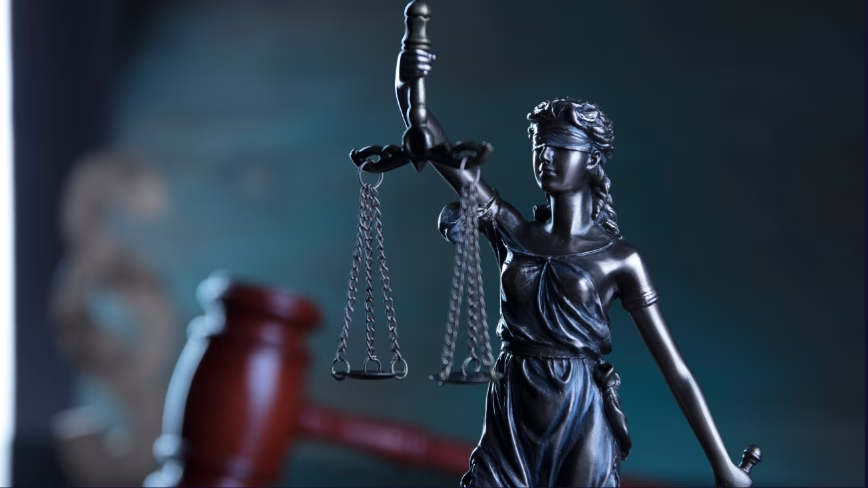
China's world-first AI firing ban reshapes hiring strategies for AI firms expanding there
30-Second TL;DR
What Changed
Chinese ruling makes AI-based firings illegal
Why It Matters
This policy may deter rapid AI deployment in Chinese firms to avoid legal risks, potentially slowing innovation but stabilizing workforce. AI practitioners in China must integrate human-AI hybrid roles. It could inspire global labor regulations amid AI job displacement fears.
What To Do Next
Audit China operations for AI automation clauses in employment contracts to ensure compliance.
Key Points
- •Chinese ruling makes AI-based firings illegal
- •Zhou joined Hangzhou firm in Nov 2022, earned 25k yuan/mo on LLM QA
- •Company fired him after AI improvements in 2024
- •First country to protect jobs from AI automation
- •No equivalent laws in Western nations
Deep Insight
AI-generated analysis for this event — not the original article.
Enhanced Key Takeaways
- •The ruling by the Hangzhou Internet Court emphasizes that while companies have the right to optimize operations, they must adhere to the 'Labor Contract Law' which requires a legitimate 'objective change in circumstances' that cannot be unilaterally defined by the employer's adoption of AI tools.
- •Legal experts note that this decision sets a precedent for 'algorithmic management' disputes, forcing companies to prove that AI-driven layoffs are not a pretext for avoiding severance obligations or discriminating against employees who previously trained the very models replacing them.
- •The ruling specifically highlights the distinction between 'technological advancement' and 'contractual breach,' suggesting that companies must offer retraining or alternative positions before resorting to termination when AI tools reach a specific performance threshold.
Future ImplicationsAI analysis grounded in cited sources
Timeline
- 2022-11Zhou is hired by the Hangzhou-based technology firm to manage LLM quality assurance.
- 2024-05The company implements significant AI model upgrades, leading to the decision to terminate Zhou's position.
- 2025-02Zhou files a lawsuit against the firm in the Hangzhou Internet Court challenging the legality of his dismissal.
- 2026-04The Hangzhou Internet Court issues the landmark ruling favoring Zhou, establishing the precedent against AI-solely-based firings.
Event Coverage
Weekly AI Recap
Read this week's curated digest of top AI events →
Related Updates



AI-curated news aggregator. All content rights belong to original publishers.
Original source: The Next Web (TNW) ↗
This is a summary, not the original. Read the source, or get the weekly briefing.
The weekly digest
One email a week. Unsubscribe anytime.