China AI Funding Surges to 300 Billion RMB in H1
💡Understand where 300 billion RMB is flowing in China's AI market to identify the next big industry shifts.
⚡ 30-Second TL;DR
What Changed
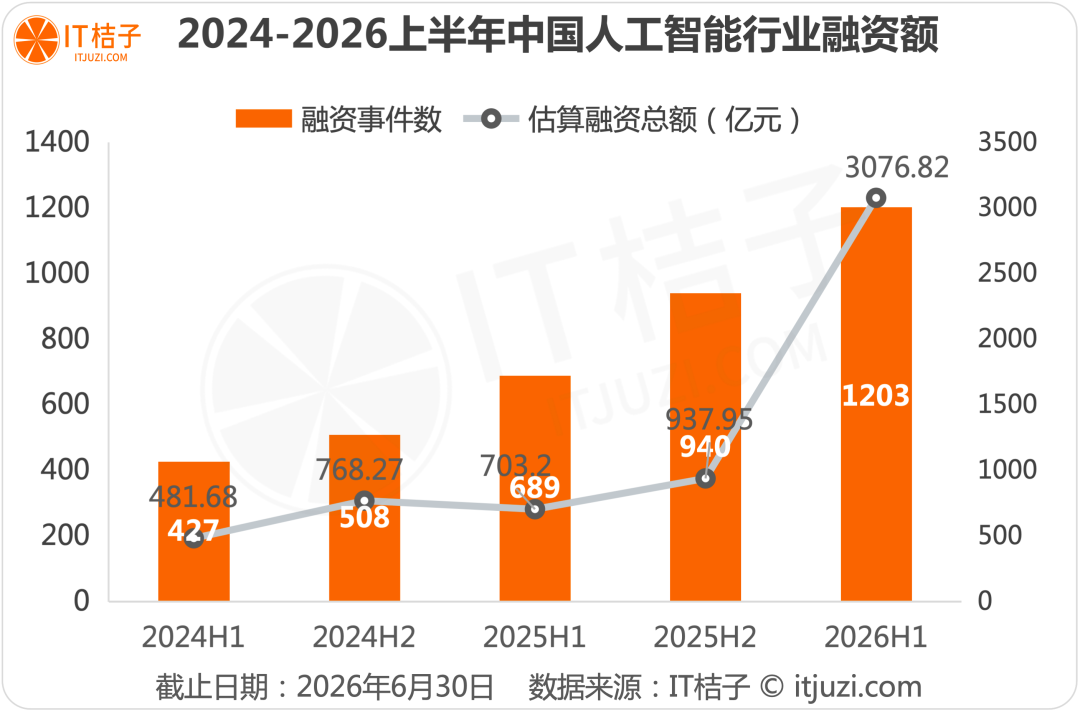
H1 2026 AI funding exceeded 300 billion RMB with over 1,200 deals.
Why It Matters
The shift toward embodied AI and world models indicates a transition from pure software LLMs to physical-world integration. Investors are prioritizing teams with strong academic backgrounds and clear commercialization paths.
What To Do Next
If building in AI, pivot focus from general-purpose LLMs to vertical applications or embodied AI hardware integration to align with current VC trends.
Key Points
- •H1 2026 AI funding exceeded 300 billion RMB with over 1,200 deals.
- •Large models dominate with over 50% of total funding.
- •Embodied AI is the second-largest growth sector with 312 funding events.
- •Beijing, Hangzhou, Shanghai, and Shenzhen account for 86% of total funding volume.
🧠 Deep Insight
AI-generated analysis for this event — not the original article.
🔑 Enhanced Key Takeaways
- •The surge in funding is heavily driven by state-backed 'Guidance Funds' (Government Guidance Funds) which have pivoted from traditional infrastructure to strategic AI sectors to counter international export controls.
- •A significant portion of the 300 billion RMB is being directed toward domestic GPU cluster construction and high-bandwidth memory (HBM) localization efforts to reduce reliance on NVIDIA hardware.
- •The 'Embodied AI' investment wave is specifically targeting the integration of multimodal large models into humanoid robot control systems, moving beyond simple automation to autonomous reasoning in physical environments.
- •Regulatory shifts in early 2026 have streamlined the approval process for generative AI services, encouraging venture capital to move from 'wait-and-see' to aggressive deployment in enterprise-grade applications.
- •Energy infrastructure investment has emerged as a hidden component of AI funding, with capital increasingly flowing into specialized data centers equipped with liquid cooling systems to support high-density AI training clusters.
🛠️ Technical Deep Dive
- Shift toward Mixture-of-Experts (MoE) architectures in domestic large models to optimize inference costs and reduce compute requirements compared to dense models.
- Increased adoption of heterogeneous computing frameworks that allow seamless switching between domestic NPU (Neural Processing Unit) architectures and legacy GPU clusters.
- Implementation of advanced model quantization techniques (INT4/INT8) specifically optimized for Chinese-language tokenization to improve efficiency on resource-constrained domestic hardware.
- Development of proprietary embodied AI middleware that bridges the gap between high-level LLM reasoning and low-level robotic motor control (ROS2 integration).
🔮 Future ImplicationsAI analysis grounded in cited sources
⏳ Timeline
Weekly AI Recap
Read this week's curated digest of top AI events →
👉Related Updates


AI-curated news aggregator. All content rights belong to original publishers.
Original source: 虎嗅 ↗
This is a summary, not the original. Read the source, or get the weekly briefing.
The weekly digest
One email a week. Unsubscribe anytime.