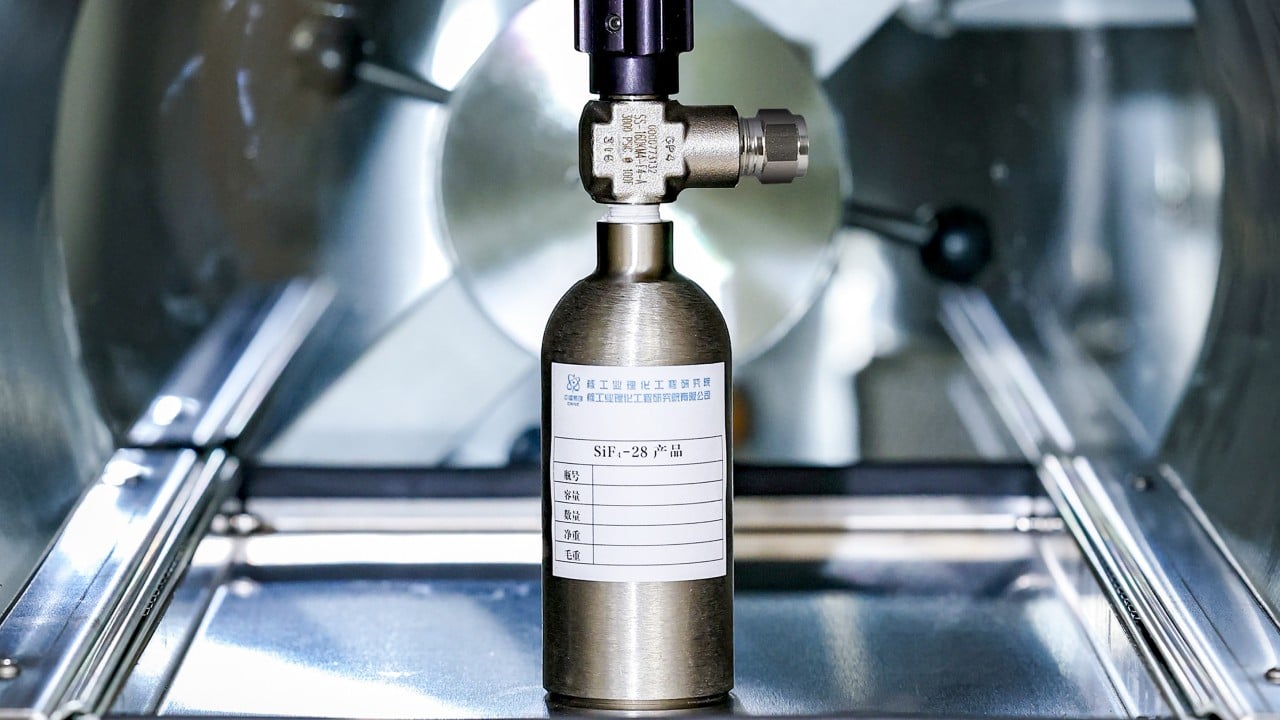
China achieves mass production of silicon-28 for quantum computing
💡Critical breakthrough in quantum hardware materials that could shift global supply chains for quantum processors.
⚡ 30-Second TL;DR
What Changed
CNNC achieved mass production of silicon-28 with >99.99% purity.
Why It Matters
This development could accelerate the development of domestic quantum hardware in China, potentially altering the global landscape for quantum computing infrastructure and supply chain independence.
What To Do Next
Monitor the availability of high-purity silicon-28 for your quantum research hardware procurement strategies.
Key Points
- •CNNC achieved mass production of silicon-28 with >99.99% purity.
- •Silicon-28 is a critical material for scaling silicon-based quantum processors.
- •The breakthrough aligns with China's strategic goal of technological self-reliance.
- •High-purity isotopes are essential for reducing decoherence in quantum bits.
🧠 Deep Insight
Background and context from public sources — not the original article. 15 sources cited.
🔑 Enhanced Key Takeaways
- •The mass production of high-purity silicon-28 was achieved by the Research Institute of Physical and Chemical Engineering of Nuclear Industry (IPCE), a subsidiary of China National Nuclear Corporation (CNNC).
- •Silicon-28 is often referred to as "the world's purest silicon" due to its zero nuclear spin, which significantly minimizes environmental noise that can interfere with quantum operations.
- •This domestic breakthrough addresses a critical supply bottleneck for silicon-based quantum computing in China, which previously relied on a limited number of overseas suppliers.
- •Beyond quantum computing, the high-purity silicon-28 material is also expected to support advancements in other frontier fields, including advanced semiconductor manufacturing, high-end navigation systems, and precision metrology standards.
- •Historically, the capabilities for producing ultra-pure silicon-28 were concentrated among a small group of international players, primarily in Russia, Europe, and US-linked supply chains.
🛠️ Technical Deep Dive
- Isotopic Purity Requirement: Natural silicon contains about 4.67% of the silicon-29 isotope, which has a nuclear spin (I=1/2). This nuclear spin acts as a source of magnetic noise, causing decoherence in quantum bits.
- Role of Silicon-28: Silicon-28, with its zero nuclear spin, creates an "ultra-quiet" or "semiconductor vacuum" environment, significantly reducing magnetic interference and extending qubit coherence times from microseconds to milliseconds or longer.
- Qubit Implementation: In silicon-based quantum computers, qubits are often created by precisely placing individual phosphorus atoms within isotopically pure silicon-28 wafers, leveraging the nuclear spin of these phosphorus atoms.
- Compatibility: Silicon spin qubits are considered a promising platform due to their compatibility with existing semiconductor manufacturing infrastructure (CMOS technology), offering a pathway to scalable quantum computing.
- Enrichment Methods: Techniques for isotopic enrichment of silicon include deposition of centrifuged SiF4 gas, bespoke ion implantation methods, and advanced processes like using ionized commercial silane gas with a magnetic sector analyzer to separate isotopes before deposition.
- Challenges: Key technical challenges in scaling silicon spin qubits include moving beyond few-qubit systems, improving the reliability and reproducibility of qubit fabrication, and developing integrated control electronics capable of operating at cryogenic temperatures.
🔮 Future ImplicationsAI analysis grounded in cited sources
📎 Sources (15)
Factual claims are grounded in the sources below. Forward-looking analysis is AI-generated interpretation.
Weekly AI Recap
Read this week's curated digest of top AI events →
👉Related Updates


AI-curated news aggregator. All content rights belong to original publishers.
Original source: SCMP Technology ↗
This is a summary, not the original. Read the source, or get the weekly briefing.
Weekly AI briefing
One email a week. Unsubscribe anytime.