Can Rate Hikes Save Long-term Yields?
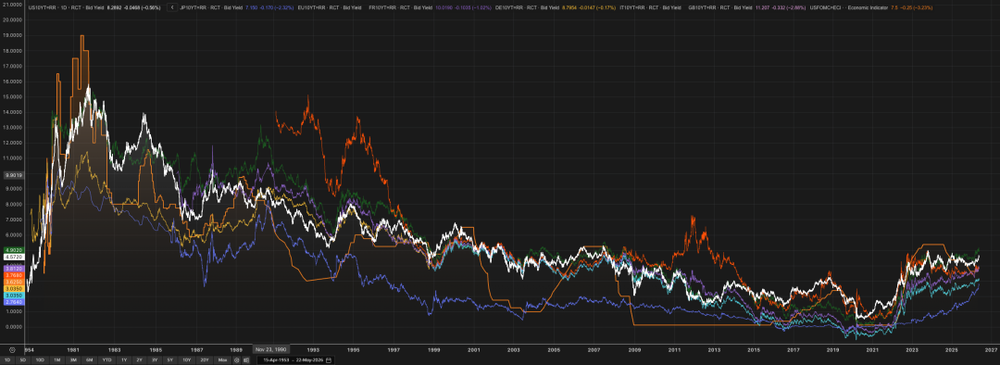
💡Understand how AI investment cycles are impacting global macro-economic stability and interest rates.
⚡ 30-Second TL;DR
What Changed
Global governance is shifting from 'efficiency' to 'security', leading to fiscal expansion.
Why It Matters
Provides a macro framework for understanding how AI investment cycles interact with global fiscal policy and interest rate environments.
What To Do Next
Monitor the 10-year Treasury yield and FOMC statements to adjust your risk-on/risk-off exposure for AI-heavy portfolios.
Key Points
- •Global governance is shifting from 'efficiency' to 'security', leading to fiscal expansion.
- •Long-term yields are currently driven by fiscal dominance and inflation expectations rather than just policy rates.
- •AI-driven productivity growth is a long-term deflationary force but currently increases capital expenditure and financing needs.
🧠 Deep Insight
Web-grounded analysis with 20 cited sources.
🔑 Enhanced Key Takeaways
- •The global economic shift from 'efficiency' to 'security' has been significantly catalyzed by recent global shocks, such as the COVID-19 pandemic and the Russia-Ukraine war, leading to widespread supply chain disruptions and a re-evaluation of economic priorities through a geopolitical lens.
- •Fiscal dominance, where monetary policy is compelled to accommodate government financing needs, poses a significant threat to central bank independence and can lead to higher inflation expectations, as evidenced by the U.S. experience with massive fiscal spending and Federal Reserve accommodation post-2020.
- •The re-emergence of 'bond vigilantes' in developed markets, particularly in 2025-2026, indicates that investors are increasingly demanding steeper premiums to fund deepening government deficits, potentially forcing governments to implement fiscal reforms to ensure debt sustainability.
- •AI's current economic impact is characterized by substantial capital deepening, with significant investments in semiconductors and data center infrastructure contributing to GDP growth, but this initial phase can lead to a 'productivity J-curve' where costs rise before full productivity gains are realized.
- •Well-anchored long-run inflation expectations are crucial for central bank credibility and effective monetary policy transmission; if these expectations de-anchor, the process of bringing down inflation becomes considerably more challenging and painful.
🔮 Future ImplicationsAI analysis grounded in cited sources
⏳ Timeline
📎 Sources (20)
Factual claims are grounded in the sources below. Forward-looking analysis is AI-generated interpretation.
Weekly AI Recap
Read this week's curated digest of top AI events →
👉Related Updates




AI-curated news aggregator. All content rights belong to original publishers.
Original source: 虎嗅 ↗