Cadence-Nvidia Close Robotics Sim Gap
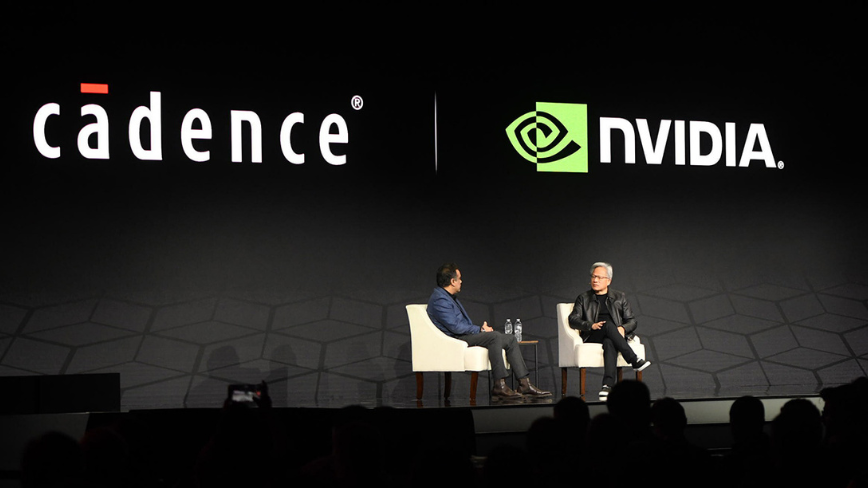
💡Nvidia-Cadence fix robotics' sim gap, slashing deploy time for embodied AI
⚡ 30-Second TL;DR
What Changed
Expanded partnership announced Wednesday at Cadence conference
Why It Matters
This bridges a key bottleneck in embodied AI, potentially speeding robotics adoption by making sim-to-real transfer more reliable.
What To Do Next
Integrate Cadence simulation tools with Nvidia GPUs for your robot training pipelines.
Key Points
- •Expanded partnership announced Wednesday at Cadence conference
- •Targets persistent simulation-reality gap in robotics
- •Enables faster training and deployment of physical AI robots
🧠 Deep Insight
AI-generated analysis for this event — not the original article.
🔑 Enhanced Key Takeaways
- •The integration leverages Cadence's Reality Digital Twin platform with Nvidia's Omniverse and Isaac Sim to create high-fidelity physics-based environments for training humanoid and industrial robots.
- •The collaboration focuses on closing the 'sim-to-real' gap by utilizing Cadence's computational fluid dynamics (CFD) and electromagnetic simulation tools to model complex environmental interactions that standard game-engine-based simulators often approximate.
- •This partnership is specifically designed to reduce the reliance on physical prototyping by enabling 'hardware-in-the-loop' testing within a unified digital environment, significantly shortening the development cycle for autonomous mobile robots (AMRs).
📊 Competitor Analysis▸ Show
| Feature | Cadence/Nvidia | Siemens Xcelerator | Ansys/Microsoft |
|---|---|---|---|
| Simulation Engine | Omniverse/Isaac Sim | Tecnomatix/Process Simulate | Ansys SimAI/Azure |
| Primary Focus | Physics-based AI/Robotics | Industrial Automation/PLM | Engineering Simulation/CFD |
| Pricing Model | Enterprise/Subscription | Enterprise/License | Enterprise/Consumption |
| Benchmarks | High-fidelity physics | High-fidelity manufacturing | High-fidelity engineering |
🛠️ Technical Deep Dive
- •Integration of Cadence's Fidelity CFD solver into the Nvidia Omniverse ecosystem allows for real-time simulation of airflow and thermal dynamics affecting robot sensors and actuators.
- •Utilizes Nvidia's Isaac Lab for reinforcement learning, with Cadence providing high-accuracy synthetic data generation for edge cases that are difficult to capture in physical testing.
- •Supports USD (Universal Scene Description) workflows, enabling seamless interoperability between Cadence's mechanical design tools and Nvidia's simulation environments.
- •Implementation of 'Digital Twin' synchronization, where real-time sensor telemetry from physical robots is fed back into the simulation to refine the digital model's accuracy iteratively.
🔮 Future ImplicationsAI analysis grounded in cited sources
⏳ Timeline
Weekly AI Recap
Read this week's curated digest of top AI events →
👉Related Updates

AI-curated news aggregator. All content rights belong to original publishers.
Original source: The Next Web (TNW) ↗
This is a summary, not the original. Read the source, or get the weekly briefing.
The weekly digest
One email a week. Unsubscribe anytime.