Build Multi-Agent Workflows with SageMaker and AgentCore
💡Learn how to mix models across SageMaker and AgentCore while gaining token-level observability.
⚡ 30-Second TL;DR
What Changed
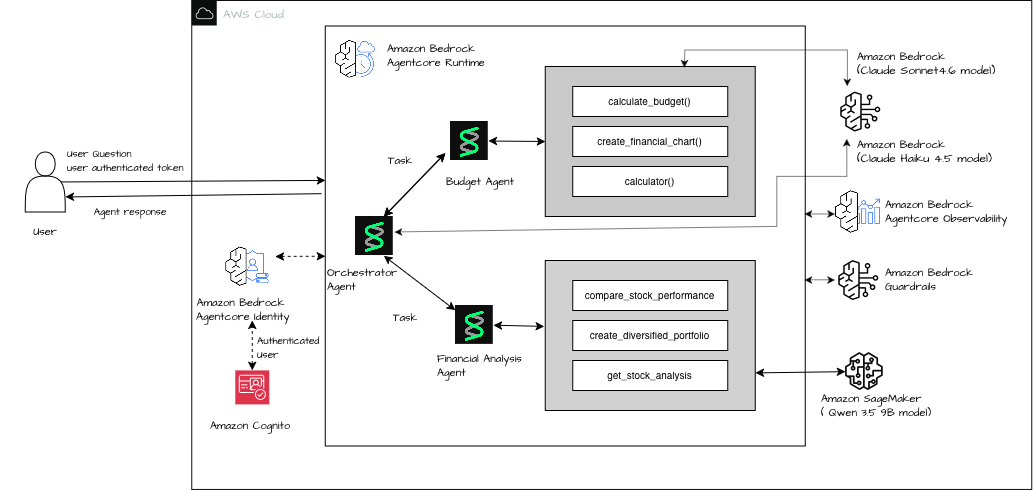
Combines OpenAI-compatible SageMaker AI endpoints with Bedrock AgentCore Runtime.
Why It Matters
The approach gives developers more flexibility to mix models and deployment environments within a single agentic system. Improved token-level telemetry can also make latency, usage, and behavior easier to diagnose in production.
What To Do Next
Prototype a two-agent workflow with Strands Agents, route each agent to an OpenAI-compatible SageMaker endpoint through Bedrock AgentCore Runtime, and add token-level telemetry.
Key Points
- •Combines OpenAI-compatible SageMaker AI endpoints with Bedrock AgentCore Runtime.
- •Enables specialized agents in one workflow to use different task-appropriate models.
- •Adds token-level observability for SageMaker endpoints that Strands Agents does not instrument by default.
🧠 Deep Insight
AI-generated analysis for this event.
🔑 Enhanced Key Takeaways
- •The integration leverages the Amazon Bedrock AgentCore Runtime to provide a standardized orchestration layer that abstracts the complexity of inter-agent communication and state management.
- •By utilizing OpenAI-compatible endpoints on SageMaker, developers can migrate existing applications built on OpenAI SDKs to AWS infrastructure with minimal code changes while retaining access to custom-tuned models.
- •The token-level observability feature is implemented via custom middleware that intercepts request/response payloads, enabling granular cost tracking and latency monitoring for non-Bedrock models.
- •This architecture supports a 'bring your own model' (BYOM) approach, allowing organizations to deploy specialized open-weights models (e.g., Llama 3 or Mistral) on SageMaker alongside proprietary models in Bedrock.
- •The workflow utilizes Amazon EventBridge for asynchronous event-driven communication between agents, reducing tight coupling in complex multi-agent systems.
📊 Competitor Analysis▸ Show
| Feature | AWS (SageMaker + AgentCore) | Google Cloud (Vertex AI Agents) | Microsoft Azure (AI Agent Service) |
|---|---|---|---|
| Orchestration | Bedrock AgentCore | Vertex AI Agent Builder | Azure AI Agent Service |
| Model Flexibility | High (BYOM + Bedrock) | Medium (Gemini focus) | High (OpenAI + Open Models) |
| Observability | Custom/SageMaker Native | Vertex AI Observability | Azure AI Monitor |
| Pricing | Pay-per-token/Instance | Pay-per-token/Instance | Pay-per-token/Instance |
🛠️ Technical Deep Dive
- The AgentCore Runtime utilizes a directed acyclic graph (DAG) execution model to manage agent dependencies and task sequencing.
- SageMaker endpoints are configured with the 'sagemaker-openai-adapter' container, which maps OpenAI API schemas to SageMaker InvokeEndpoint requests.
- Token-level observability is achieved by injecting a custom Python decorator into the inference handler, which logs metadata to Amazon CloudWatch Logs and X-Ray.
- State persistence between agents is handled via Amazon DynamoDB, providing low-latency access to shared context variables and conversation history.
🔮 Future ImplicationsAI analysis grounded in cited sources
⏳ Timeline
Weekly AI Recap
Read this week's curated digest of top AI events →
👉Related Updates

AI-curated news aggregator. All content rights belong to original publishers.
Original source: AWS Machine Learning Blog ↗