Brain Mechanism for Memory Completion Revealed
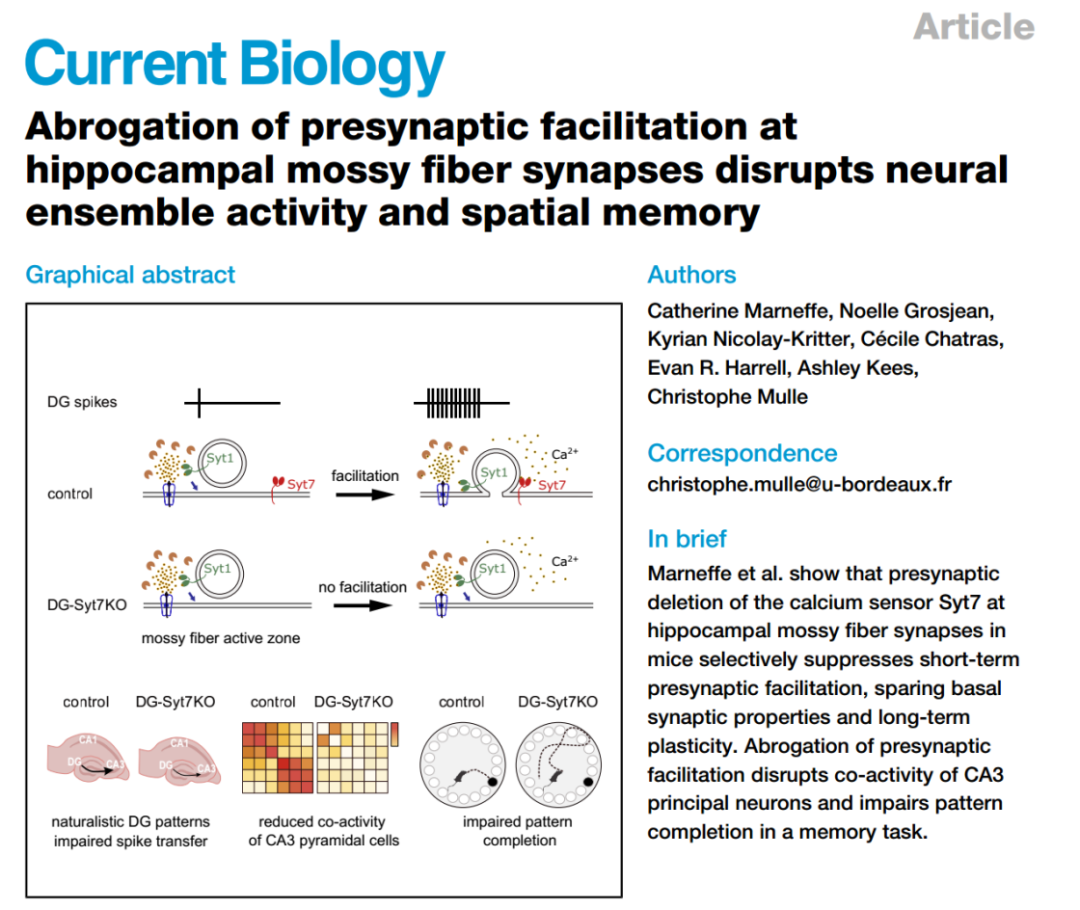
💡Neuroscience breakthrough on memory completion: ideas for AI memory architectures.
⚡ 30-Second TL;DR
What Changed
Presynaptic short-term facilitation at mossy fiber synapses pinpointed.
Why It Matters
Advances neuroscience understanding, potentially inspiring bio-mimetic memory systems in AI models.
What To Do Next
Study the Cell paper for bio-inspired techniques in transformer memory augmentation.
Key Points
- •Presynaptic short-term facilitation at mossy fiber synapses pinpointed.
- •Regulates hippocampal circuit for memory completion and emotion.
- •First study specifying its unique behavioral roles.
🧠 Deep Insight
Background and context from public sources — not the original article. 6 sources cited.
🔑 Enhanced Key Takeaways
- •Mossy fiber short-term facilitation occurs at low frequencies (as low as once every 40 seconds) and can reach up to 6-fold magnitude, driven by intraterminal Ca2+ rise and Ca2+/calmodulin-dependent kinase II activation[1].
- •Presynaptic NMDA receptors (preNMDARs) at mossy fiber boutons enhance short-term plasticity by increasing presynaptic calcium during physiologically relevant activity patterns, selectively at inputs to CA3 pyramidal cells and mossy cells[3].
- •cAMP signaling mediates presynaptic long-term potentiation at mossy fiber synapses, with short-term facilitation following high-frequency action potentials due to Ca2+ accumulation and increased release probability[2].
- •Activation of presynaptic metabotropic glutamate receptors (mGluRs) suppresses facilitation at mossy fiber synapses by inhibiting voltage-gated calcium channels during repetitive stimulation[4].
🛠️ Technical Deep Dive
- •Frequency facilitation at mossy fiber synapses develops slowly over ~20 seconds with repetitive low-frequency stimulation (e.g., every 40s), contrasting with associational/commissural synapses requiring >10s intervals for ~125% increase[1].
- •Short-term facilitation depends on residual presynaptic Ca2+ buildup, augmenting release probability (Pr); high-frequency trains cause 400-500% postsynaptic response increase via large releasable vesicle pool[2][4].
- •preNMDARs activated by low-frequency stimulation (LFF) boost facilitation; blocked by NMDAR antagonists, confirmed via focal stimulation in stratum lucidum and DCG-IV validation[3].
- •mGluR7 internalization switches synapse state: naive-state shows cAMP-independent LTD, post-internalization enables cAMP-dependent LTP on high-frequency stimulation[2].
🔮 Future ImplicationsAI analysis grounded in cited sources
⏳ Timeline
📎 Sources (6)
Factual claims are grounded in the sources below. Forward-looking analysis is AI-generated interpretation.
Weekly AI Recap
Read this week's curated digest of top AI events →
👉Related Updates


AI-curated news aggregator. All content rights belong to original publishers.
Original source: 钛媒体 ↗
This is a summary, not the original. Read the source, or get the weekly briefing.
Weekly AI briefing
One email a week. Unsubscribe anytime.