Brain Cells Play Doom in Petri Dish
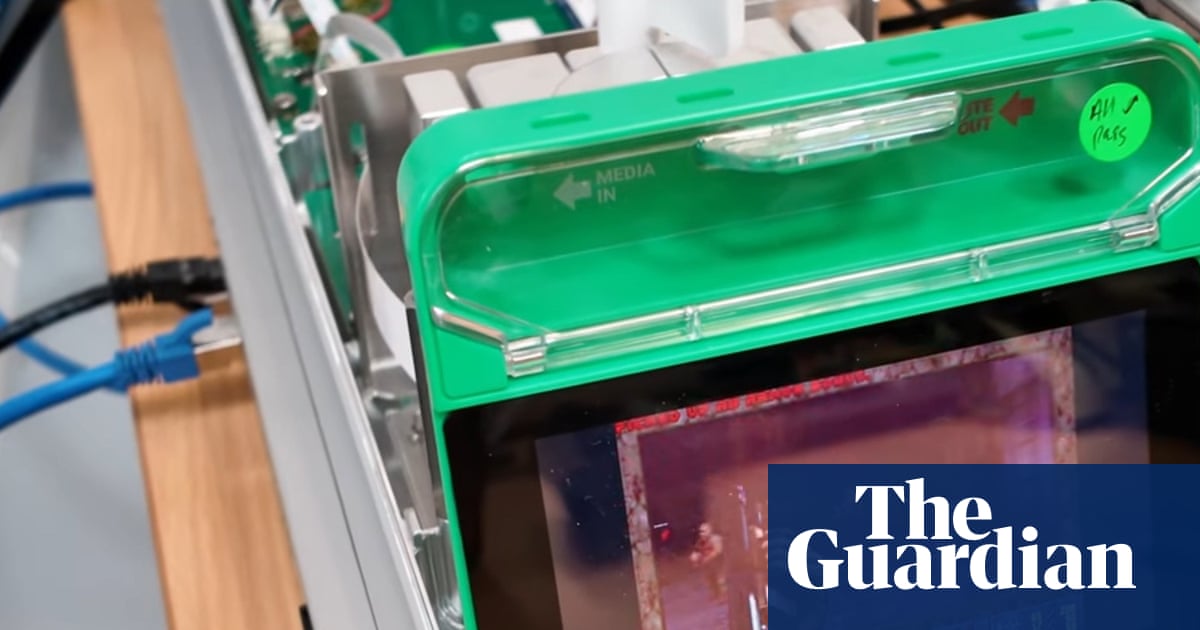
💡Neurons playing Doom: bio-AI hybrid breakthrough for efficient neuromorphic hardware
⚡ 30-Second TL;DR
What Changed
Eon Systems uploaded fruit fly brain to simulation for natural behaviors like walking and flying.
Why It Matters
Advances neuromorphic and bio-hybrid computing, offering paths to ultra-efficient AI beyond silicon. Intensifies ethical debates on biological consciousness and AI safety.
What To Do Next
Experiment with Norse library for spiking neural networks to model biological learning in your AI prototypes.
🧠 Deep Insight
Web-grounded analysis with 7 cited sources.
🔑 Enhanced Key Takeaways
- •Eon Systems' fruit fly brain emulation uses a leaky integrate-and-fire (LIF) neural model with ~140,000 neurons and 50 million synaptic connections derived from the FlyWire connectome, achieving 95% accuracy in predicting motor behavior[5].
- •The embodied fly simulation integrates NeuroMechFly v2, a physics-simulated body with 87 independent joints created from X-ray microtomography scans of biological fruit flies, running sensorimotor loops at 15 millisecond time steps[3].
- •Eon Systems' roadmap targets mouse brain emulation (~70 million neurons, 560× larger than fly) as an intermediate step before human-scale brain emulation, currently gathering connectomic and functional recording data via expansion microscopy and calcium/voltage imaging[5].
- •The fruit fly brain emulation was validated against real neurophysiology data (calcium imaging and electrophysiology recordings) to confirm that simulated neural activity matches biological responses to specific stimuli[1].
- •The demonstration represents the first whole-brain emulation producing multiple coordinated behaviors (walking, grooming, feeding) in a closed sensorimotor loop, distinguishing it from prior reinforcement learning approaches that mimicked rather than replicated neural dynamics[2][5].
🛠️ Technical Deep Dive
- •Neural Model: Leaky integrate-and-fire (LIF) model built from adult Drosophila central-brain connectome with inferred neurotransmitter identities determining synaptic sign (excitatory/inhibitory)[3]
- •Connectome Data: FlyWire connectome mapping ~130,000–140,000 neurons and ~50 million synaptic connections at nanoscale resolution[1][3]
- •Body Simulation: NeuroMechFly v2 framework featuring 87 independent joints, anatomically structured articulated body with physically simulated forces, contact, and actuation via MuJoCo physics engine[3]
- •Computational Optimization: GPU cluster distribution partitioning densely connected neural subregions to minimize cross-node communication; sparse matrix operations exploiting the connectome's sparsity (~50M synapses among ~140K neurons)[1]
- •Sensorimotor Loop: Four-part cycle—sensory input mapping to identified neurons, brain activity update via connectome-constrained model, motor output translation to body commands, and sensory feedback at 15 ms time steps[3]
- •Validation: Ground-truth comparison using real neurophysiology recordings (calcium imaging and electrophysiology) from living Drosophila brains under controlled conditions, matching neuron activation patterns, firing timing, and coordinated activity across brain regions[1]
🔮 Future ImplicationsAI analysis grounded in cited sources
⏳ Timeline
📎 Sources (7)
Factual claims are grounded in the sources below. Forward-looking analysis is AI-generated interpretation.
- mindstudio.ai — What Is Brain Emulation Fruit Fly Eon Systems
- futurism.com — Research Fly Brain Matrix
- eon.systems — Embodied Brain Emulation
- eon.systems — Updates
- theinnermostloop.substack.com — The First Multi Behavior Brain Upload
- nationaltoday.com — Eon Systems Claims to Have Uploaded a Fly but Experts Remain Skeptical
- cybernews.com — Digital Fruit Fly Brain Simulation
Weekly AI Recap
Read this week's curated digest of top AI events →
👉Related Updates

AI-curated news aggregator. All content rights belong to original publishers.
Original source: The Guardian Technology ↗