Bjarne Stroustrup on AI Coding Risks
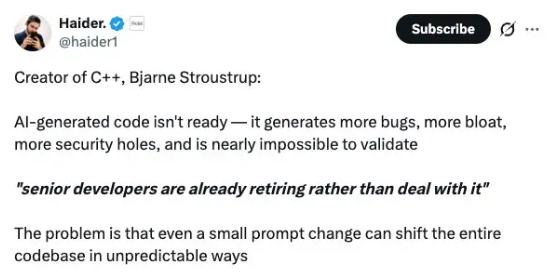
💡C++ creator warns that AI-generated code is creating a maintenance nightmare for senior engineers.
⚡ 30-Second TL;DR
What Changed
AI models trained on legacy code replicate old bugs and performance issues.
Why It Matters
This critique highlights a critical bottleneck in AI adoption: the 'verification gap' that could slow down enterprise-wide AI integration in mission-critical systems.
What To Do Next
Implement a mandatory, rigorous human-in-the-loop verification process for all AI-generated code before merging into production.
Key Points
- •AI models trained on legacy code replicate old bugs and performance issues.
- •The primary challenge of AI coding is verification and long-term system maintenance.
- •Senior developers are increasingly frustrated by the burden of auditing AI-generated output.
🧠 Deep Insight
Web-grounded analysis with 17 cited sources.
🔑 Enhanced Key Takeaways
- •AI-generated code frequently introduces specific vulnerabilities, such as insecure object references, improper password handling, and cross-site scripting (XSS) attacks, often due to models reusing patterns from public, potentially insecure repositories.
- •The 'verification bottleneck' is a significant challenge, where the rapid increase in AI-generated code volume outpaces human capacity for thorough review, leading to a 'trust gap' where developers don't fully trust AI code but often commit it without complete verification.
- •Studies indicate that AI-assisted pull requests have approximately 1.7 times more issues than human-authored ones, including logic errors, maintainability hiccups, and performance drags, with readability issues spiking more than threefold.
- •AI's probabilistic nature means it lacks inherent understanding of computational complexity or optimization instincts, often leading to over-engineered, verbose, and less optimized solutions with higher cyclomatic complexity.
- •The perceived productivity gains from AI coding tools often don't align with objective measurements; some studies show developers taking longer to complete tasks with AI, despite believing they are faster.
🛠️ Technical Deep Dive
- Probabilistic Nature: Large Language Models (LLMs) generate code based on next-token prediction, a probabilistic process that differs from human logical reasoning. This means they lack an inherent understanding of computational complexity or native optimization instincts, instead optimizing for pattern matching.
- Training Data Limitations: AI models are often trained on vast datasets of publicly available code, including repositories like GitHub and Stack Overflow, which are known to contain existing bugs and security issues. This can lead to the replication of flawed or insecure patterns in generated code.
- Functionality Over Elegance: AI prioritizes making code functional over making it elegant or optimized, often resulting in verbose solutions, increased cyclomatic complexity, and a tendency to copy-paste patterns rather than adapting them efficiently.
- Context Degradation: LLMs' performance can become unreliable as input length grows, leading to "context rot" where models may drop functions, repeat fixes, or generate increasingly verbose code to maintain context beyond a certain token limit (e.g., 500-1400 lines).
- Lack of Architectural Awareness: AI tools typically generate code without considering broader architectural implications, system invariants, undocumented assumptions, or long-term performance characteristics, making the resulting code harder to integrate and maintain.
🔮 Future ImplicationsAI analysis grounded in cited sources
⏳ Timeline
📎 Sources (17)
Factual claims are grounded in the sources below. Forward-looking analysis is AI-generated interpretation.
Weekly AI Recap
Read this week's curated digest of top AI events →
👉Related Updates




AI-curated news aggregator. All content rights belong to original publishers.
Original source: 虎嗅 ↗