Better Streams API for JavaScript
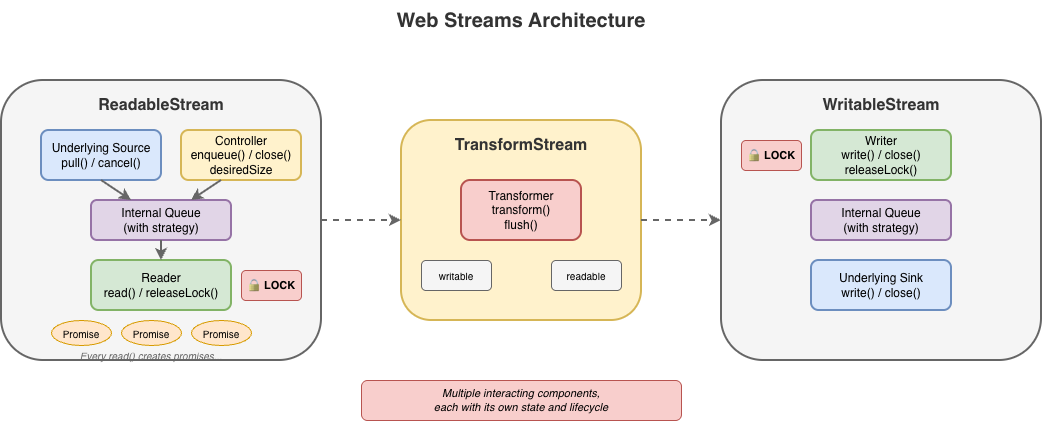
💡Modernize JS streaming for efficient AI web apps (outdated API hurts perf)
⚡ 30-Second TL;DR
What Changed
Web Streams API is outdated for modern JavaScript runtimes
Why It Matters
Improves streaming performance in web apps, benefiting AI inference streaming like real-time LLM responses.
What To Do Next
Review Cloudflare's proposed streaming API spec for your next JS project.
Key Points
- •Web Streams API is outdated for modern JavaScript runtimes
- •Designed originally for a different technical era
- •Proposal for a redesigned, more efficient streaming API
🧠 Deep Insight
Background and context from public sources — not the original article. 8 sources cited.
🔑 Enhanced Key Takeaways
- •Cloudflare's proposed API introduces a new 'Stream.push()' constructor for creating push-based streams with synchronous-like writer operations and built-in backpressure enforcement[1].
- •The design features 'Stream.pull()' for lazy, on-demand transform pipelines that defer execution until consumption begins, eliminating premature promise overhead[1].
- •Explicit multi-consumer support via 'Stream.share()' replaces the problematic 'tee()' method, requiring configurable highWaterMark and backpressure policies to prevent unbounded buffering[1].
- •'Stream.text()' provides a concise utility to consume any readable stream directly as text, simplifying common decoding workflows[1].
🛠️ Technical Deep Dive
- •Promise-heavy design in current Web Streams lacks synchronous fast paths, forcing overhead even for immediately available data, which compounds in TransformStream pipelines[1].
- •New API uses explicit lock management and avoids hidden resource retention; unconsumed streams release connections immediately without background machinery[1].
- •Pull-through transforms in 'Stream.pull(source, compress, encrypt)' execute lazily during iteration, with each chunk processed on-demand[1].
- •Drop mode allows silent discarding of writes after 'drop()' call, e.g., 'await dropNew.writer.write(chunk);' ignores data post-drop[1].
- •Readable streams in the new API are async iterables, enabling 'for await (const chunks of output)' for nested chunk iteration[1].
🔮 Future ImplicationsAI analysis grounded in cited sources
⏳ Timeline
📎 Sources (8)
Factual claims are grounded in the sources below. Forward-looking analysis is AI-generated interpretation.
- blog.cloudflare.com — A Better Web Streams API
- GitHub — 2409
- developers.cloudflare.com — Streams
- mux.com — The Best Video Apis Right Now
- developers.cloudflare.com — Workers Best Practices
- blog.cloudflare.com — Nodejs Workers 2025
- developers.cloudflare.com — 2026 02 15 Workers Best Practices
- youtube.com — Watch
Weekly AI Recap
Read this week's curated digest of top AI events →
👉Related Updates
AI-curated news aggregator. All content rights belong to original publishers.
Original source: Cloudflare Blog ↗
This is a summary, not the original. Read the source, or get the weekly briefing.
Weekly AI briefing
One email a week. Unsubscribe anytime.