Berkshire重押Alphabet,押注AI算力
💡Berkshire’s $17 billion Alphabet increase is a major market signal on the value of AI compute.
⚡ 30-Second TL;DR
What Changed
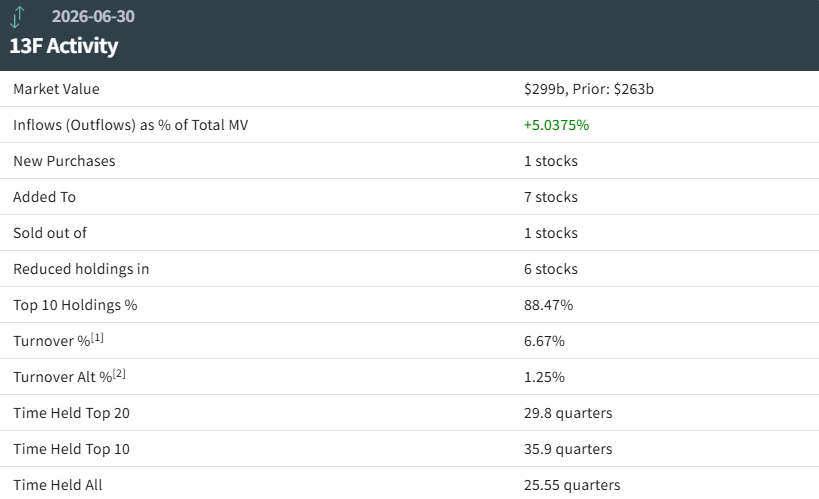
Berkshire bought $23.5 billion of stocks in Q2 and sold $3.7 billion, ending 14 consecutive quarters of net selling.
Why It Matters
The move signals growing confidence in Alphabet’s ability to monetize AI infrastructure and services, while giving AI investors a high-profile indication that large-scale compute remains strategically valuable. It may also increase scrutiny of Alphabet’s capital requirements, data-center expansion, and returns on AI investment.
What To Do Next
Benchmark your Gemini API or Google Cloud AI workload against alternative providers while tracking accelerator availability, latency, and per-token cost as Alphabet expands compute capacity.
Key Points
- •Berkshire bought $23.5 billion of stocks in Q2 and sold $3.7 billion, ending 14 consecutive quarters of net selling.
- •Its Alphabet position grew 83%, reaching approximately $37.8 billion and becoming the third-largest holding.
- •Berkshire agreed to subscribe to $10 billion of Alphabet shares linked to planned data-center and AI-compute investment.
- •Berkshire’s cash balance fell from $380.2 billion to $364.7 billion, while it repurchased about $4.5 billion of its own stock.
🧠 Deep Insight
AI-generated analysis for this event.
🔑 Enhanced Key Takeaways
- •Berkshire Hathaway's pivot to Alphabet marks a strategic departure from Warren Buffett's long-standing avoidance of pure-play technology stocks, signaling a shift toward valuing AI infrastructure as a utility-like asset.
- •The $10 billion subscription agreement is structured as a convertible debt-equity hybrid, providing Berkshire with downside protection while participating in Alphabet's long-term AI capital expenditure cycle.
- •Market analysts suggest the move is a hedge against the potential stagnation of Berkshire's traditional insurance and energy holdings, which face long-term disruption risks from AI-driven automation.
- •Alphabet's $80 billion capital raise is specifically earmarked for the 'Project Stargate' initiative, a massive data center expansion designed to reduce reliance on third-party GPU providers.
- •Regulatory filings indicate that Berkshire's investment team, led by Todd Combs and Ted Weschler, played a primary role in this allocation, reflecting their increasing influence over Berkshire's portfolio diversification.
📊 Competitor Analysis▸ Show
| Feature | Alphabet (Project Stargate) | Microsoft (Azure AI) | Amazon (AWS Bedrock) |
|---|---|---|---|
| Primary Focus | Custom TPU-based scaling | Hybrid Cloud/OpenAI integration | Custom Silicon/Managed Services |
| Compute Strategy | Vertical integration (TPU v6) | NVIDIA-heavy + Maia chips | Graviton/Trainium/Inferentia |
| Capital Intensity | Extremely High (New builds) | High (Retrofitting/Expansion) | High (Global footprint) |
🛠️ Technical Deep Dive
- Alphabet's AI infrastructure expansion centers on the deployment of TPU v6 (Trillium) chips, which offer a 4.7x improvement in performance-per-watt over previous generations.
- The data center architecture utilizes liquid cooling systems to support high-density racks exceeding 100kW per rack, necessary for training next-generation Gemini models.
- Implementation involves a proprietary optical interconnect fabric that reduces latency between GPU/TPU clusters, enabling massive-scale distributed training across geographically dispersed data centers.
🔮 Future ImplicationsAI analysis grounded in cited sources
⏳ Timeline
Weekly AI Recap
Read this week's curated digest of top AI events →
👉Related Updates


AI-curated news aggregator. All content rights belong to original publishers.
Original source: 虎嗅 ↗