Beijing-Shanghai High-Speed Rail price adjustment analysis
💡Understand the macro-economic shift in infrastructure pricing that will eventually impact AI data center operational cos
⚡ 30-Second TL;DR
What Changed
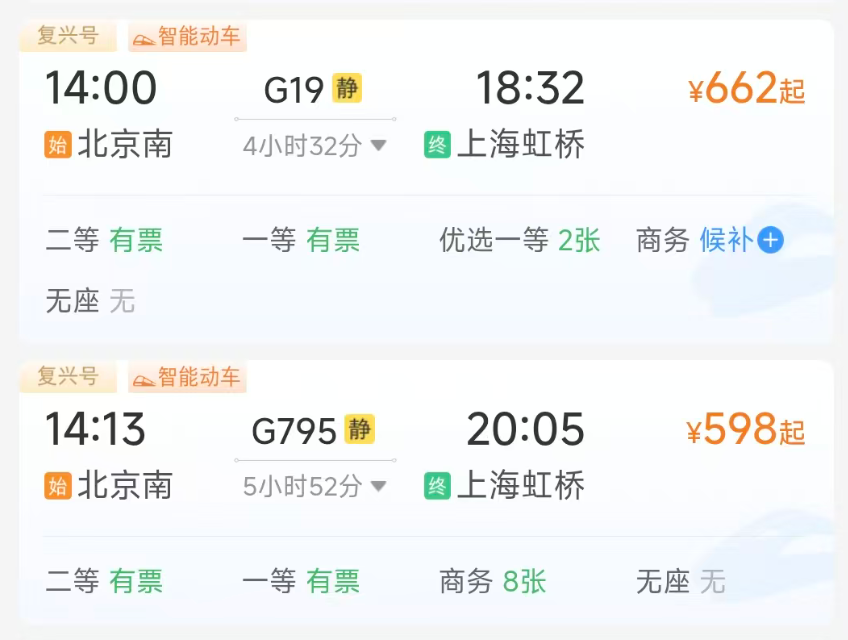
Beijing-Shanghai High-Speed Rail raised its price ceiling by 20%.
Why It Matters
This shift suggests that public infrastructure and services will face increasing pressure to become self-sustaining, impacting cost structures across various sectors.
What To Do Next
Monitor infrastructure and utility cost trends as they serve as a leading indicator for operational expenses in AI data center and cloud service planning.
Key Points
- •Beijing-Shanghai High-Speed Rail raised its price ceiling by 20%.
- •The move signals a transition from government-subsidized universal service to market-based pricing.
- •Rising operational costs (maintenance, management fees) are outpacing revenue growth.
- •Infrastructure projects are increasingly forced to rely on direct user fees rather than land-based fiscal subsidies.
🧠 Deep Insight
Web-grounded analysis with 14 cited sources.
🔑 Enhanced Key Takeaways
- •The recent 20% increase in the price ceiling marks the second such adjustment since the Beijing-Shanghai High-Speed Rail commenced operations in 2011, with the first occurring in late 2020.
- •The new pricing strategy introduces a dynamic discount mechanism, allowing ticket prices to vary based on factors such as season, day of the week, travel time, and train speed, rather than a uniform increase.
- •Despite its status as China's most profitable railway, the Beijing-Shanghai High-Speed Rail experienced a significant slowdown in revenue growth to 2.15% in 2025, with net profit growth also narrowing, indicating a flattening of its financial momentum.
- •The company's revenue is primarily derived from two main streams: passenger ticketing, which constituted approximately 45% of revenue in 2024-2025, and track usage fees, accounting for about 53%.
- •The fare adjustment is partly driven by the need to offset rising operational costs and to recoup losses from the recently acquired Jingfu-Anhui line, which only achieved a modest profit in 2025.
🛠️ Technical Deep Dive
- Length: The Beijing-Shanghai High-Speed Railway spans 1,318 kilometers (819 miles), making it the world's longest high-speed line constructed in a single phase.
- Speed: It was designed for a continuous operating speed of 350 km/h (217 mph), with a maximum speed capability of up to 380 km/h (236 mph). Commercial operation initially began at 300 km/h, with 350 km/h operation restored in September 2017.
- Rolling Stock: The line primarily utilizes CRH380 trains and the domestically developed Fuxing series (including CR400AF and CR400BF models).
- Fuxing Trains: These trains are entirely designed and manufactured in China, boasting an average operating speed of 350 km/h and a maximum design speed of 400 km/h. They feature an on-board monitoring system with approximately 2,500 monitoring ports, larger seats, power outlets, USB ports, Wi-Fi connectivity, automated doors, and a designed lifespan of 30 years.
- Infrastructure: Approximately 87% (1,140 km) of the railway is elevated, featuring 244 bridges, including the 164 km Danyang–Kunshan Grand Bridge, which is the longest bridge in the world. The line also includes 22 tunnels and 1,268 km of ballastless track.
- Control System: The railway employs a CTCS-3 based train control system, enabling a minimum train interval of 3 minutes.
- Capacity: The line was designed to accommodate an estimated 220,000 passengers per day.
🔮 Future ImplicationsAI analysis grounded in cited sources
⏳ Timeline
📎 Sources (14)
Factual claims are grounded in the sources below. Forward-looking analysis is AI-generated interpretation.
Weekly AI Recap
Read this week's curated digest of top AI events →
👉Related Updates
AI-curated news aggregator. All content rights belong to original publishers.
Original source: 虎嗅 ↗