Bedrock Reasoning Checks Boost AI Compliance
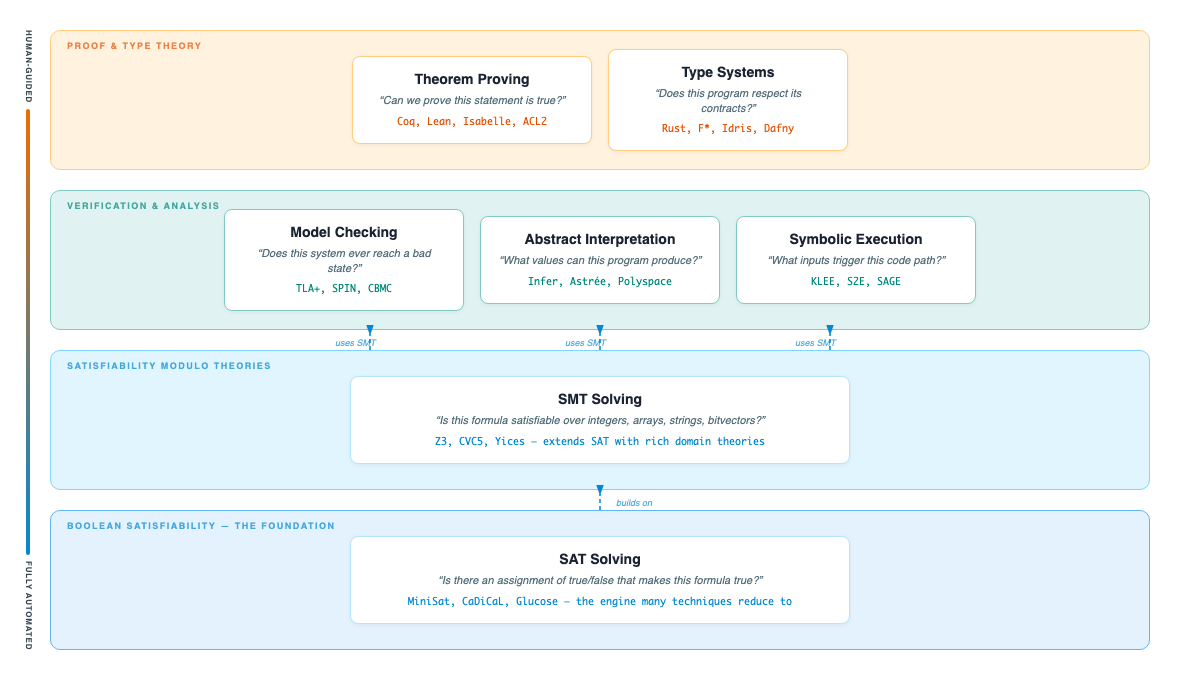
Achieve mathematically verified gen AI compliance in Bedrock—essential for enterprises
30-Second TL;DR
What Changed
Formal verification trumps probabilistic validation
Why It Matters
Enables regulated firms to deploy trustworthy gen AI with compliance guarantees, accelerating adoption in finance, healthcare, and beyond.
What To Do Next
Implement Automated Reasoning checks in Amazon Bedrock for your gen AI compliance testing.
Key Points
- •Formal verification trumps probabilistic validation
- •Mathematically proven, auditable AI outputs
- •Adopted by customers in six industries
- •Transforms compliance for gen AI in regulated sectors
Deep Insight
AI-generated analysis for this event — not the original article.
Enhanced Key Takeaways
- •Amazon Bedrock's formal verification utilizes automated theorem proving to mathematically guarantee that model outputs adhere to predefined safety and compliance constraints, effectively eliminating 'hallucinations' within the verified scope.
- •The integration of automated reasoning allows regulated entities to replace manual, sampling-based human audits of AI outputs with cryptographically signed, machine-verifiable compliance logs.
- •This capability specifically targets the 'black box' nature of LLMs by enforcing deterministic guardrails on top of probabilistic models, enabling deployment in high-stakes environments like financial risk assessment and medical diagnostics.
Competitor Analysis
- Amazon Bedrock (Reasoning Checks)
- Formal Verification / Theorem Proving
- Microsoft Azure AI (Content Safety)
- Probabilistic Filtering / Heuristics
- Google Cloud (Vertex AI Guardrails)
- Probabilistic Filtering / Heuristics
- Amazon Bedrock (Reasoning Checks)
- Mathematically Proven
- Microsoft Azure AI (Content Safety)
- Policy-based / Log-based
- Google Cloud (Vertex AI Guardrails)
- Policy-based / Log-based
- Amazon Bedrock (Reasoning Checks)
- Deterministic Safety
- Microsoft Azure AI (Content Safety)
- Content Moderation
- Google Cloud (Vertex AI Guardrails)
- Content Moderation
| Feature | Amazon Bedrock (Reasoning Checks) | Microsoft Azure AI (Content Safety) | Google Cloud (Vertex AI Guardrails) |
|---|---|---|---|
| Core Methodology | Formal Verification / Theorem Proving | Probabilistic Filtering / Heuristics | Probabilistic Filtering / Heuristics |
| Compliance Auditability | Mathematically Proven | Policy-based / Log-based | Policy-based / Log-based |
| Primary Focus | Deterministic Safety | Content Moderation | Content Moderation |
Technical Deep Dive
- •Utilizes a hybrid architecture combining Large Language Models with a symbolic reasoning engine (Automated Theorem Prover).
- •Implements 'Guardrail Verification' where the reasoning engine checks the model's output against a formal specification language (e.g., TLA+ or similar logic-based constraints) before the final response is rendered.
- •Supports 'Chain-of-Verification' (CoVe) patterns where the model is forced to verify its own claims against a trusted knowledge base or rule set before outputting.
- •Provides an API-level 'Reasoning Trace' that allows developers to inspect the logic path taken by the formal verifier to reach a compliant output.
Future ImplicationsAI analysis grounded in cited sources
Timeline
- 2023-04Amazon Bedrock announced as a fully managed service for building generative AI applications.
- 2023-11AWS introduces Guardrails for Amazon Bedrock to provide safety controls for generative AI applications.
- 2025-02AWS expands Bedrock capabilities to include advanced reasoning models and formal verification frameworks.
- 2026-04AWS formalizes 'Bedrock Reasoning Checks' as a core compliance feature for regulated industries.
Weekly AI Recap
Read this week's curated digest of top AI events →
Related Updates

AI-curated news aggregator. All content rights belong to original publishers.
Original source: AWS Machine Learning Blog ↗
This is a summary, not the original. Read the source, or get the weekly briefing.
The weekly digest
One email a week. Unsubscribe anytime.