Bedrock Adds Company-Wise Memory with Neptune & Mem0
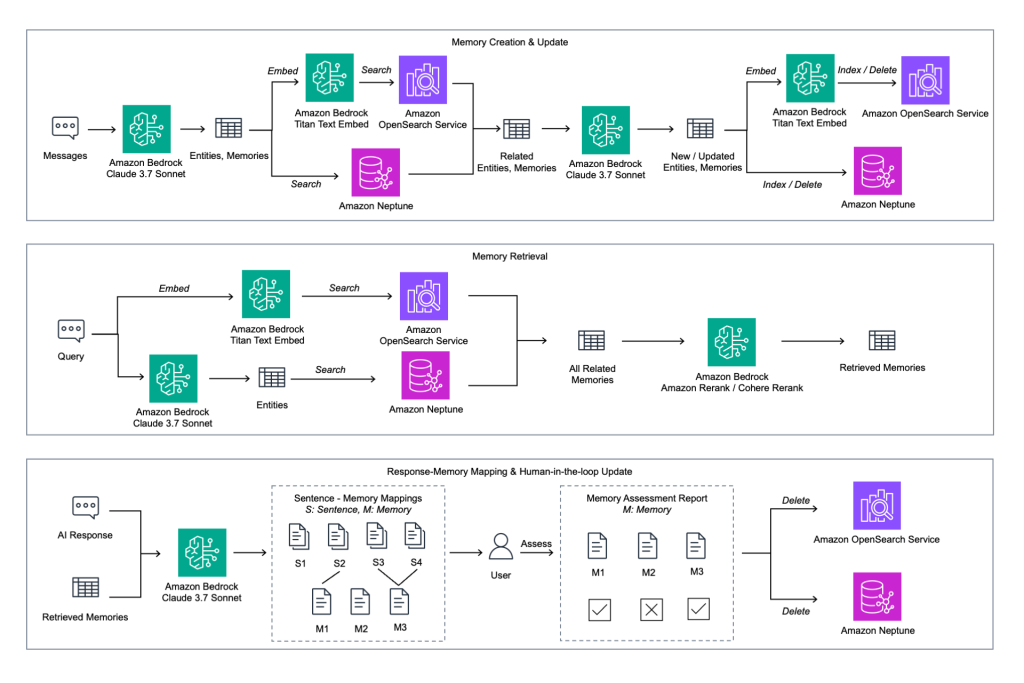
💡Persistent memory boosts Bedrock agents for enterprise chats—Neptune+Mem0 integration live
⚡ 30-Second TL;DR
What Changed
Persistent company-specific memory for Bedrock AI agents
Why It Matters
Enhances enterprise AI agents with long-term context retention, reducing need for custom memory solutions. Improves chatbot effectiveness for customer service like TrendMicro's implementation.
What To Do Next
Test company-wise memory by integrating Neptune and Mem0 in your Bedrock agent via AWS console.
Key Points
- •Persistent company-specific memory for Bedrock AI agents
- •Powered by Amazon Neptune graph database and Mem0 memory layer
- •Enables learning and adaptation across multiple interactions
- •TrendMicro example: Trend’s Companion chatbot for customer queries
🧠 Deep Insight
AI-generated analysis for this event — not the original article.
🔑 Enhanced Key Takeaways
- •The integration utilizes Mem0's 'Personalized AI' layer to manage long-term user and organizational state, which is then indexed within Amazon Neptune to allow for complex relationship mapping between entities, documents, and past user preferences.
- •This architecture addresses the 'context window' limitation by offloading historical state management to a graph-based retrieval system, significantly reducing the need for massive prompt injection in every turn.
- •The solution supports multi-tenant isolation, ensuring that company-specific memory remains siloed and compliant with enterprise data governance policies while allowing agents to perform cross-session reasoning.
📊 Competitor Analysis▸ Show
| Feature | Amazon Bedrock (w/ Neptune & Mem0) | OpenAI Assistants API (Memory) | LangChain/LangGraph Persistence |
|---|---|---|---|
| Storage Backend | Amazon Neptune (Graph) | Managed Proprietary | Flexible (SQL/Vector/Graph) |
| Customization | High (BYO Database) | Low (Managed) | Very High (Code-based) |
| Enterprise Focus | High (AWS Compliance) | Medium | Low (Developer-centric) |
🛠️ Technical Deep Dive
- •Mem0 acts as the orchestration layer that extracts, updates, and retrieves 'facts' from unstructured conversation history.
- •Amazon Neptune serves as the persistent knowledge graph, storing entities as nodes and their relationships as edges, enabling semantic traversal rather than simple vector similarity search.
- •The system employs a hybrid retrieval approach: vector search for semantic relevance and graph traversal for contextual relationship mapping.
- •Integration is facilitated through Bedrock's Knowledge Bases, allowing the memory layer to be treated as a dynamic data source for RAG (Retrieval-Augmented Generation) pipelines.
🔮 Future ImplicationsAI analysis grounded in cited sources
⏳ Timeline
Weekly AI Recap
Read this week's curated digest of top AI events →
👉Related Updates
AI-curated news aggregator. All content rights belong to original publishers.
Original source: AWS Machine Learning Blog ↗
This is a summary, not the original. Read the source, or get the weekly briefing.
The weekly digest
One email a week. Unsubscribe anytime.