Bank of England softens stance on stablecoin regulations
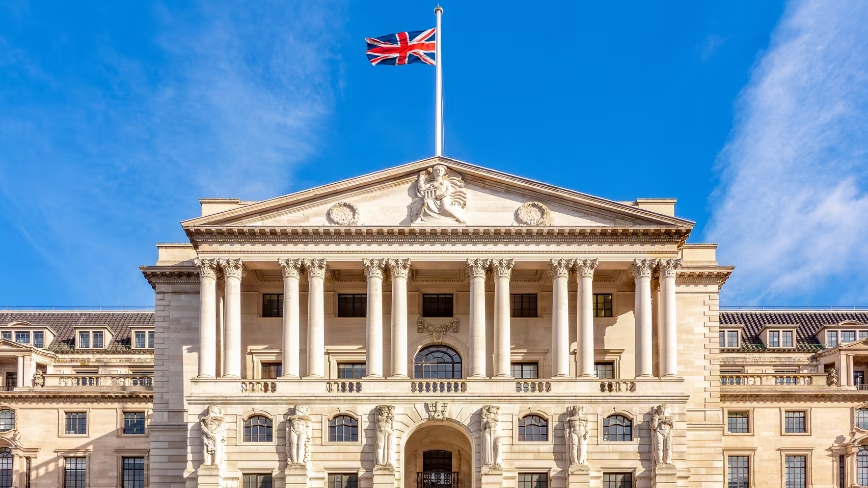
Regulatory changes in the UK could open new doors for stablecoin-based financial applications.
30-Second TL;DR
What Changed
Initial regulatory proposals faced heavy criticism for being overly restrictive.
Why It Matters
Regulatory clarity in the UK will likely encourage more fintech companies to develop stablecoin-based payment solutions within a legal framework.
What To Do Next
Monitor the updated Bank of England consultation papers if you are building cross-border payment infrastructure.
Key Points
- •Initial regulatory proposals faced heavy criticism for being overly restrictive.
- •The Bank of England is loosening caps on individual stablecoin holdings.
- •Revisions aim to balance financial stability with the need for digital asset innovation.
Deep Insight
AI-generated analysis for this event — not the original article.
Enhanced Key Takeaways
- •The Bank of England's revised framework aligns more closely with the Financial Services and Markets Act 2023, which granted the central bank and the FCA powers to regulate digital settlement assets.
- •Industry feedback specifically highlighted that the original 'one-size-fits-all' liquidity requirements would have made it economically unviable for smaller stablecoin issuers to operate in the UK.
- •The updated proposal introduces a tiered regulatory approach, allowing issuers with lower systemic risk profiles to adhere to less stringent capital reserve mandates.
- •The Bank of England is coordinating its revised stance with the Prudential Regulation Authority (PRA) to ensure that stablecoin issuers integrated into the banking system maintain high-quality liquid assets (HQLA).
- •This policy shift is part of a broader UK government strategy to position the country as a global hub for crypto-asset technology while maintaining the integrity of the sterling-denominated payment system.
Technical Deep Dive
- The revised regulatory framework mandates that stablecoin issuers must maintain a 1:1 backing ratio of high-quality liquid assets (HQLA) denominated in the same currency as the stablecoin.
- Issuers are now required to implement 'proof of reserve' mechanisms that undergo independent third-party audits on a quarterly basis to ensure transparency.
- The Bank of England has specified that stablecoin smart contracts must include 'kill-switch' or 'pause' functionality to mitigate systemic risks during extreme market volatility or security breaches.
- Technical standards for interoperability are being developed to ensure that stablecoins can interact seamlessly with the proposed Digital Pound (CBDC) infrastructure if and when it is deployed.
Future ImplicationsAI analysis grounded in cited sources
Timeline
- 2023-06Financial Services and Markets Act 2023 receives Royal Assent, establishing the legal basis for stablecoin regulation.
- 2023-11The Bank of England and FCA publish initial discussion papers outlining the proposed regulatory regime for stablecoins.
- 2024-05Industry consultation period concludes with significant pushback regarding liquidity and holding caps.
- 2025-09Bank of England releases a progress report acknowledging the need for a more flexible regulatory approach.
- 2026-06Bank of England officially announces the softening of stablecoin regulations following extensive stakeholder review.
Weekly AI Recap
Read this week's curated digest of top AI events →
Related Updates



AI-curated news aggregator. All content rights belong to original publishers.
Original source: The Next Web (TNW) ↗
This is a summary, not the original. Read the source, or get the weekly briefing.
The weekly digest
One email a week. Unsubscribe anytime.