Automakers pivot to robotics as a last resort
💡Understand why traditional automakers are betting on robotics as their survival strategy.
⚡ 30-Second TL;DR
What Changed
Automakers are facing a growth bottleneck in their core business.
Why It Matters
This signals a potential shift in capital allocation within the automotive sector, prioritizing speculative tech over core manufacturing.
What To Do Next
Monitor the R&D spending reports of major automakers to see if robotics investments are yielding tangible AI integration results.
Key Points
- •Automakers are facing a growth bottleneck in their core business.
- •Robotics is being treated as a desperate pivot rather than a core competency.
- •The move reflects a broader industry anxiety regarding future profitability.
🧠 Deep Insight
AI-generated analysis for this event — not the original article.
🔑 Enhanced Key Takeaways
- •Automakers are increasingly integrating humanoid robotics into manufacturing lines to mitigate rising labor costs and address aging workforce demographics in key markets like China and Germany.
- •The pivot is heavily influenced by the convergence of AI-driven foundation models and physical hardware, allowing car companies to leverage existing data silos from autonomous driving R&D.
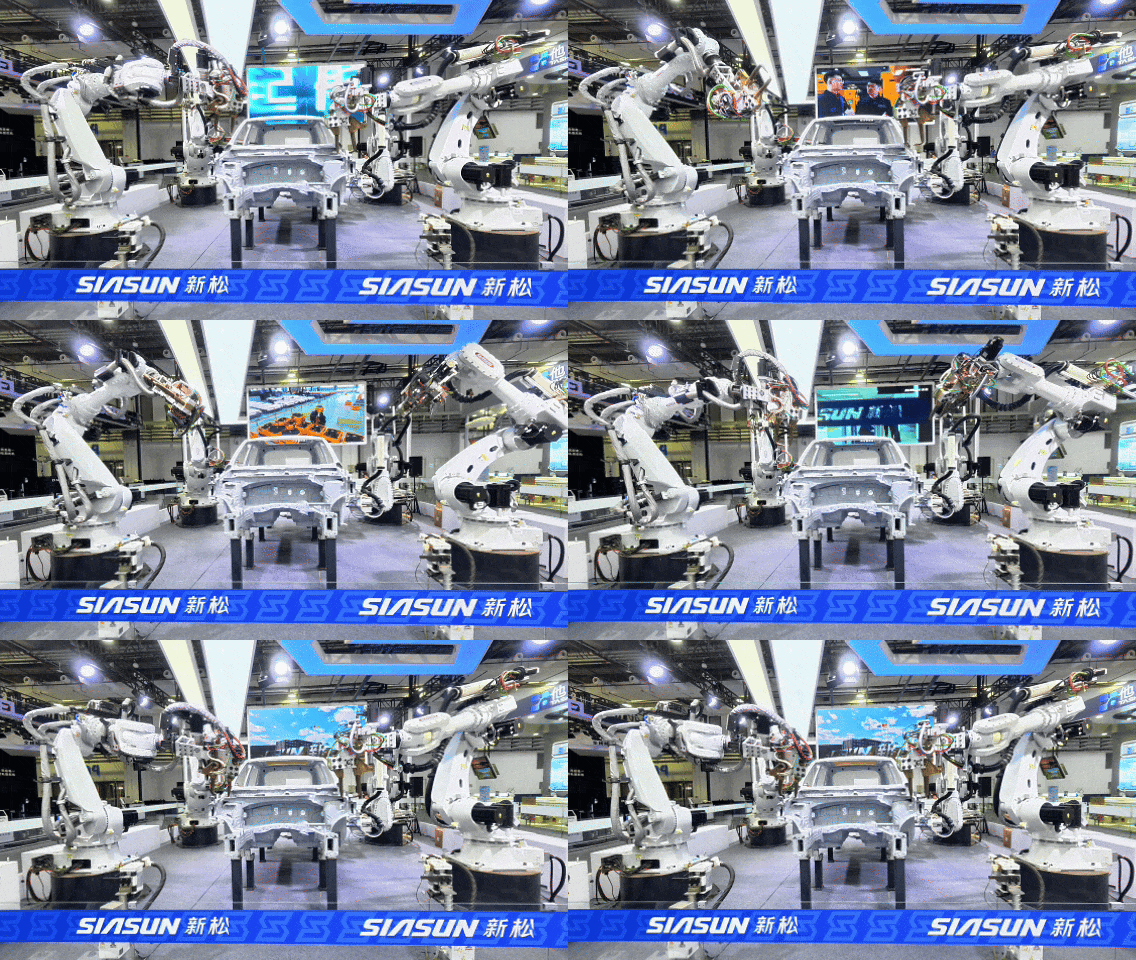
- •Major OEMs are shifting from traditional industrial robotic arms to general-purpose humanoid platforms to achieve greater flexibility in assembly tasks that previously required human dexterity.
- •Financial reports indicate that automotive R&D budgets are being reallocated from internal combustion engine development toward robotics and embodied AI to satisfy investor demands for 'tech-company' valuations.
- •Strategic partnerships between legacy automakers and robotics startups are often structured as 'co-development' deals, allowing car companies to retain IP while offloading the high-risk hardware engineering costs.
📊 Competitor Analysis▸ Show
| Feature | Tesla (Optimus) | Hyundai (Boston Dynamics) | BYD/Legacy OEMs |
|---|---|---|---|
| Primary Focus | Mass Production/Scale | R&D/Logistics/Mobility | Factory Floor Integration |
| Hardware Maturity | High (Iterative) | Very High (Advanced) | Emerging (Pilot) |
| AI Integration | FSD-derived Neural Nets | Proprietary/AI-ready | Third-party/Partnerships |
| Pricing Model | Internal/Cost-focused | Premium/Service-based | Cost-reduction/ROI-focused |
🛠️ Technical Deep Dive
- Utilization of end-to-end neural networks for motor control, replacing traditional hard-coded kinematic sequences.
- Implementation of vision-language-action (VLA) models to allow robots to interpret natural language instructions for assembly tasks.
- Integration of force-torque sensors in robotic joints to enable 'cobot' (collaborative robot) safety standards, allowing human-robot proximity without safety cages.
- Use of digital twin environments (e.g., NVIDIA Omniverse) to train robotic policies in simulation before deployment to physical factory floors.
🔮 Future ImplicationsAI analysis grounded in cited sources
⏳ Timeline
Weekly AI Recap
Read this week's curated digest of top AI events →
👉Related Updates

AI-curated news aggregator. All content rights belong to original publishers.
Original source: 虎嗅 ↗
This is a summary, not the original. Read the source, or get the weekly briefing.
Weekly AI briefing
One email a week. Unsubscribe anytime.