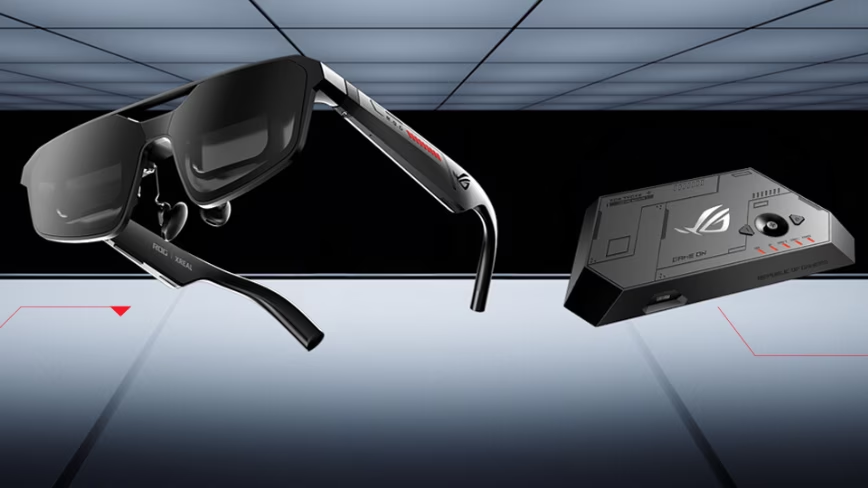
Asus and Xreal launch 240Hz AR gaming glasses
💡Hardware breakthrough in AR display latency; critical for developers building real-time AI spatial experiences.
⚡ 30-Second TL;DR
What Changed
World's first 240Hz refresh rate in AR glasses
Why It Matters
High-refresh-rate AR hardware is critical for reducing motion sickness and improving immersion in spatial computing and AI-driven gaming applications.
What To Do Next
Evaluate the integration of high-refresh-rate spatial displays for testing AI-driven real-time rendering workflows.
Key Points
- •World's first 240Hz refresh rate in AR glasses
- •Utilizes micro-OLED display technology
- •Pre-orders available now at $849
- •Global shipping commences June 1st
🧠 Deep Insight
Web-grounded analysis with 17 cited sources.
🔑 Enhanced Key Takeaways
- •The ROG Xreal R1 is specifically engineered for PC, console, and ROG Ally players, offering seamless plug-and-play with the ROG Ally via a single USB-C connection.
- •It features electrochromic dimming technology with three tint levels, allowing users to adjust lens transparency to ensure clarity in various ambient light conditions.
- •The ROG Xreal R1 includes a dedicated ROG Control Dock, which acts as a central hub for stationary setups, providing HDMI 2.0 and DisplayPort 1.4 inputs for PCs and consoles, and USB-A ports for peripherals.
- •The device incorporates Xreal's X1 spatial coprocessor, which enables 3DoF functionality (with 6DoF support), on-device 2D-to-3D conversion, and helps reduce latency and motion blur.
- •Audio is provided by built-in Bose-tuned speakers, designed to deliver a three-dimensional soundstage for enhanced immersion.
📊 Competitor Analysis▸ Show
| Feature/Product | Asus ROG Xreal R1 | Xreal Air 2 Ultra | Viture Pro XR | RayNeo Air 4 Pro |
|---|---|---|---|---|
| Refresh Rate | 240Hz (with Frame Rate Boost On) | Up to 120Hz (2D), 90Hz (3D spatial) | 120Hz | Not specified (HDR10 certified) |
| Resolution (per eye) | 1920x1080 (FHD) | 1920x1080 (FHD) | 1200p | Not specified (implied FHD or higher for HDR10) |
| Field of View (FOV) | 57° | 52° | Not specified (135-inch virtual display) | Not specified (201-inch virtual display) |
| Brightness (nits) | 700 (max) | 500 (peak) | Not specified (120% boost over previous gen) | Not specified (20 brightness levels) |
| Weight | 91g | 80g | Not specified | Not specified |
| Tracking | Native 3DoF (6DoF support via X1 chip) | Full 6DoF (dual 3D environment sensors) | Not specified | Not specified |
| Special Features | ROG Control Dock, Bose audio, Electrochromic dimming, X1 spatial coprocessor, 2D-to-3D conversion | Titanium frame, XREAL Nebula SDK support, Electrochromic dimming | Integrated myopia dials, Harman audio, Electrochromic dimming | HDR10 certification, Anti-glare coating |
| Price | $849 (with Control Dock) | Not explicitly stated in sources, positioned as developer-grade | $549 | $299 |
🛠️ Technical Deep Dive
- Display Technology: Sony Micro-OLED, 0.55-inch panel size per eye.
- Resolution: 1920x1080 pixels per eye (FHD).
- Refresh Rate: 240Hz (with Frame Rate Boost On), 120Hz native.
- Response Time: 0.01ms.
- Motion-to-Photon Latency: 3ms.
- Field of View (FOV): 57 degrees, covering 95% of focused vision.
- Virtual Screen Size: Up to 171 inches at 4 meters.
- Brightness: 700 nits (max).
- Color Gamut: 106% sRGB.
- Tracking: Native 3DoF (with support for 6DoF via X1 chip).
- Processor: Xreal X1 spatial coprocessor.
- Connectivity (Glasses): USB Type-C x 1 (DP Alt Mode).
- Connectivity (Control Dock): USB Type-C x 1 (Data+Power), USB Type-C x 1 (DC-IN / 5V), USB Type-C x 1 (DP alt Mode, Front), DisplayPort x 1, HDMI 2.0 x 2.
- Audio: Sound by Bose speakers, Mic-Array with noise-cancelling, Phase cancellation audio technology.
- Dimming: Electrochromic dimming with three tint levels and auto transparency in Anchor Mode.
- Weight: 91g (net weight of glasses).
- IPD (Interpupillary Distance): R1-N: 57-66 mm, R1-B: 66-75 mm.
- Certifications: TÜV flicker free, TÜV low blue light (hardware solution), TÜV Eye Comfort (AR).
🔮 Future ImplicationsAI analysis grounded in cited sources
⏳ Timeline
📎 Sources (17)
Factual claims are grounded in the sources below. Forward-looking analysis is AI-generated interpretation.
- Google Search Source
- Google Search Source
- Google Search Source
- Google Search Source
- Google Search Source
- Google Search Source
- Google Search Source
- Google Search Source
- Google Search Source
- Google Search Source
- Google Search Source
- Google Search Source
- Google Search Source
- Google Search Source
- Google Search Source
- Google Search Source
- Google Search Source
Weekly AI Recap
Read this week's curated digest of top AI events →
👉Related Updates
AI-curated news aggregator. All content rights belong to original publishers.
Original source: The Next Web (TNW) ↗