Apple’s Camera AirPods Could Rethink Wearable Privacy

💡Apple’s rumored camera AirPods offer a case study in designing AI wearables around privacy.
⚡ 30-Second TL;DR
What Changed
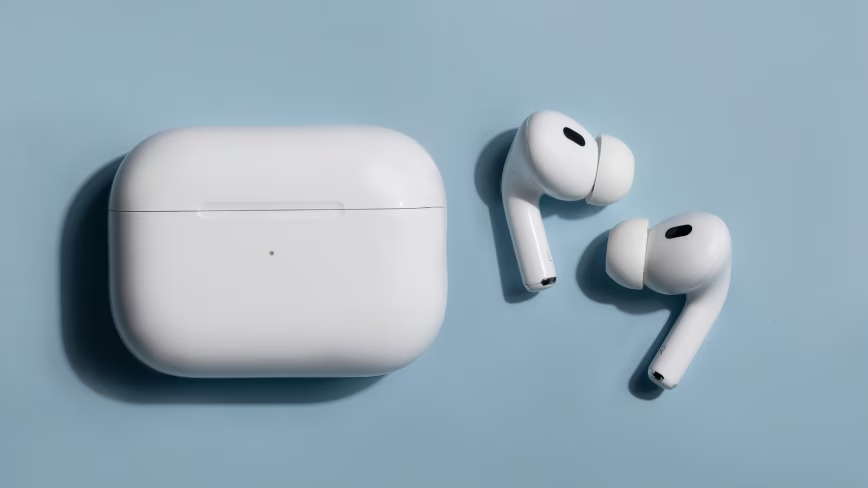
Apple is reportedly exploring AirPods equipped with cameras.
Why It Matters
If implemented, recording restrictions could become a meaningful privacy differentiator for AI-enabled wearables. However, developers would still need to assess risks from image sensing, inference, and data transmission even without user-controlled recording.
What To Do Next
Create a privacy threat model for camera-enabled earbuds that covers sensing, on-device inference, cloud transmission, and recording prevention.
Key Points
- •Apple is reportedly exploring AirPods equipped with cameras.
- •The rumored product may block photo and video recording entirely.
- •The approach is intended to reduce privacy risks associated with AI wearables.
🧠 Deep Insight
AI-generated analysis for this event.
🔑 Enhanced Key Takeaways
- •The camera-equipped AirPods are reportedly part of a broader internal initiative codenamed 'B798' aimed at exploring next-generation wearable form factors.
- •Industry analysts suggest the cameras are primarily intended for 'multimodal AI' data collection, allowing the device to analyze the user's environment to provide context-aware assistance rather than capturing media for storage.
- •Apple is investigating the use of low-resolution, power-efficient sensors to minimize the thermal footprint and battery drain, which are significant constraints for the AirPods form factor.
- •Privacy safeguards are expected to include a hardware-level 'privacy light' or physical indicator that activates whenever the camera sensors are processing visual data to ensure transparency.
- •The project leverages Apple's proprietary 'Apple Intelligence' framework, aiming to process visual data locally on the device or via a secure enclave to avoid cloud-based privacy vulnerabilities.
📊 Competitor Analysis▸ Show
| Feature | Apple Camera AirPods (Rumored) | Meta Ray-Ban Smart Glasses | Humane AI Pin |
|---|---|---|---|
| Form Factor | In-ear Audio | Eyewear | Wearable Brooch |
| Primary Input | Visual/Audio AI | Visual/Audio/Voice | Voice/Gesture/Laser |
| Privacy Focus | Hardware-blocked recording | LED indicator | Privacy light/Manual control |
| Pricing | N/A (Rumored) | $299 - $379 | $699 + Subscription |
🛠️ Technical Deep Dive
- Sensor Integration: Utilization of miniature CMOS image sensors designed for ultra-low power consumption to fit within the existing AirPods chassis.
- Processing Architecture: Integration with the H-series or next-generation Apple Silicon chips, utilizing a dedicated Neural Engine for real-time computer vision tasks.
- Data Handling: Implementation of on-device processing to ensure visual data is ephemeral and not stored in the cloud, adhering to Apple's 'Privacy by Design' framework.
- Power Management: Use of advanced power-gating techniques to ensure the camera system only activates during specific AI-driven context-awareness tasks.
🔮 Future ImplicationsAI analysis grounded in cited sources
⏳ Timeline
Weekly AI Recap
Read this week's curated digest of top AI events →
👉Related Updates



AI-curated news aggregator. All content rights belong to original publishers.
Original source: TechCrunch AI ↗