📋TestingCatalog•Stalecollected in 14h
Anthropic Launches Dreams for Claude Agents
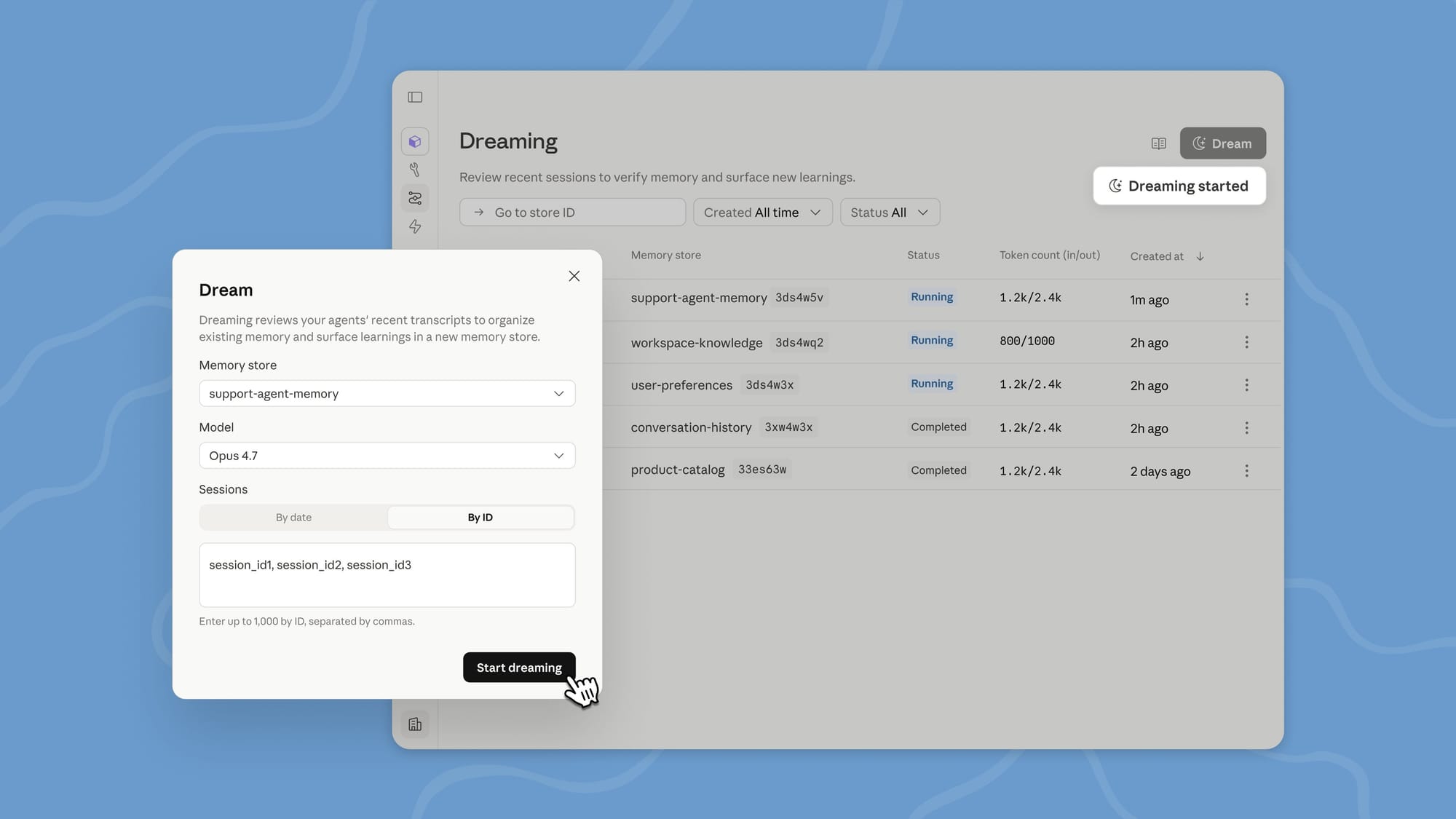
💡Anthropic's Dreams supercharges Claude agents with session-based memory restructuring for complex multi-agent tasks.
⚡ 30-Second TL;DR
What Changed
Dreams feature debuted for Claude Managed Agents
Why It Matters
This enhances agent reliability by improving memory management, enabling better handling of long-term tasks. Multiagent support could accelerate development of sophisticated AI workflows.
What To Do Next
Test Dreams in Claude's agent console to optimize memory for multi-session tasks.
Who should care:Developers & AI Engineers
Key Points
- •Dreams feature debuted for Claude Managed Agents
- •Dreaming reviews past sessions to restructure agent memory
- •Outcomes define task criteria
- •Multiagent orchestration handles complex tasks
🧠 Deep Insight
AI-generated analysis for this event.
🔑 Enhanced Key Takeaways
- •Dreams utilizes a proprietary 'Reflective Consolidation' algorithm that runs during agent idle time to compress long-context interaction logs into structured semantic knowledge graphs.
- •The multiagent orchestration layer employs a hierarchical 'Supervisor-Worker' architecture, allowing a primary agent to dynamically spawn and delegate sub-tasks to specialized sub-agents based on the defined 'Outcomes'.
- •Anthropic has introduced a new 'Memory Governance' dashboard alongside Dreams, allowing enterprise users to audit, prune, or lock specific memory segments to ensure compliance with data privacy regulations.
📊 Competitor Analysis▸ Show
| Feature | Anthropic Dreams (Claude Agents) | OpenAI Operator | Google Gemini Agents |
|---|---|---|---|
| Memory Management | Reflective Consolidation (Graph-based) | Episodic Buffer (Vector-based) | Context Window Caching |
| Orchestration | Hierarchical Supervisor-Worker | Sequential Chain-of-Thought | Parallel Tool Execution |
| Pricing | Per-agent/month + Token usage | Per-request/usage | Integrated into Vertex AI pricing |
🛠️ Technical Deep Dive
- •Reflective Consolidation: An asynchronous process that triggers when agent idle time exceeds 300 seconds, utilizing a smaller, high-speed model to summarize session logs into JSON-LD formatted memory nodes.
- •Outcome-Driven Architecture: Uses a constrained generation framework where the agent must satisfy a set of Boolean logic gates (the 'Outcomes') before marking a task as complete.
- •Multiagent Orchestration: Implements a shared 'Blackboard' pattern where sub-agents write intermediate results to a common, encrypted memory space accessible by the Supervisor agent.
- •Latency Optimization: Dreams are stored in a tiered architecture, with active session data in high-speed RAM and historical 'dreamed' knowledge in a vector database with semantic indexing.
🔮 Future ImplicationsAI analysis grounded in cited sources
Agentic workflows will shift from stateless API calls to stateful, long-lived autonomous entities.
The ability to restructure memory allows agents to maintain continuity across weeks of interaction, moving beyond the limitations of current context windows.
Enterprise adoption of AI agents will accelerate due to the introduction of memory governance tools.
The ability to audit and prune agent memory addresses the primary security and compliance concerns that have previously stalled enterprise-wide agent deployment.
⏳ Timeline
2024-03
Anthropic releases Claude 3 family with expanded context window capabilities.
2024-10
Anthropic introduces 'Computer Use' capability, allowing agents to interact with desktop interfaces.
2025-06
Anthropic launches Managed Agents platform for enterprise workflow automation.
2026-05
Anthropic debuts Dreams feature for memory restructuring and multiagent orchestration.
📰
Weekly AI Recap
Read this week's curated digest of top AI events →
👉Related Updates
AI-curated news aggregator. All content rights belong to original publishers.
Original source: TestingCatalog ↗