Amodei Says AI Firms Haven’t Delivered
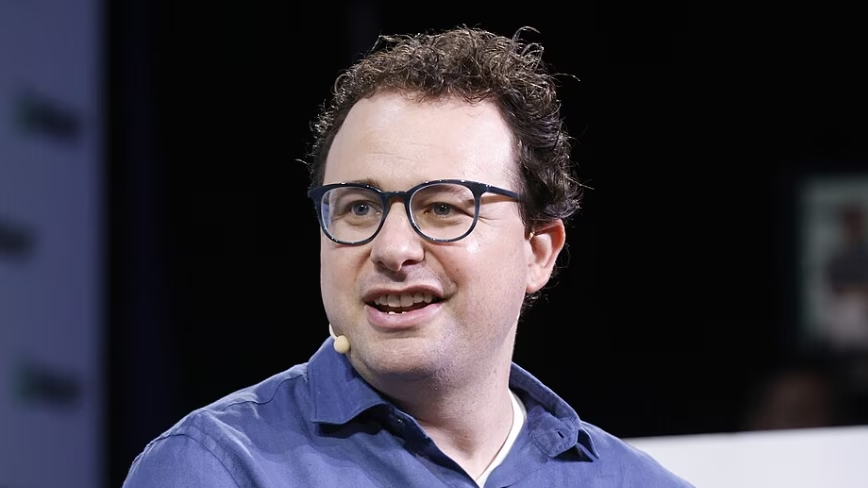
💡Amodei’s candid admission signals tougher scrutiny for AI claims, roadmaps, and investor expectations.
⚡ 30-Second TL;DR
What Changed
Dario Amodei said AI companies have not yet fulfilled their public promises.
Why It Matters
For AI founders and practitioners, the comments reinforce the need to tie product claims to measurable capabilities and user outcomes. Heightened scrutiny could make investors, customers, and regulators less tolerant of speculative roadmaps.
What To Do Next
Audit your AI product roadmap and replace broad capability claims with benchmarked, user-facing metrics that can be independently verified.
Key Points
- •Dario Amodei said AI companies have not yet fulfilled their public promises.
- •He argued that only genuine AI breakthroughs can restore public trust.
- •The remarks come as Anthropic reportedly prepares for a listing valued at up to $2 trillion.
- •The statement highlights a widening gap between AI industry expectations and delivered results.
🧠 Deep Insight
AI-generated analysis for this event.
🔑 Enhanced Key Takeaways
- •Amodei's comments were delivered during a keynote at a major industry summit where he emphasized the 'scaling hypothesis' as a primary driver for future model performance despite current plateau concerns.
- •Anthropic has shifted its internal focus toward 'Constitutional AI' refinements to address safety concerns that critics argue have slowed the deployment of more capable, autonomous agents.
- •The $2 trillion valuation target is reportedly tied to Anthropic's integration efforts with major cloud providers, specifically aiming to monetize enterprise-grade agentic workflows by late 2026.
- •Industry analysts note that Amodei's admission mirrors a broader 'AI disillusionment' phase, where capital expenditure on GPU clusters has significantly outpaced measurable productivity gains in the enterprise sector.
- •Anthropic is currently facing increased regulatory scrutiny regarding the transparency of its training data, which Amodei acknowledged as a hurdle to achieving the 'genuine breakthroughs' required for public trust.
📊 Competitor Analysis▸ Show
| Feature | Anthropic (Claude) | OpenAI (GPT) | Google (Gemini) |
|---|---|---|---|
| Primary Focus | Constitutional AI / Safety | AGI / Multimodal Agents | Ecosystem Integration |
| Pricing Model | Usage-based / Enterprise | Tiered Subscription | Cloud-integrated |
| Benchmark Focus | Reasoning / Long Context | Creative / Coding | Multimodal / Speed |
🛠️ Technical Deep Dive
- Anthropic's current architecture relies on a proprietary variant of the Transformer model optimized for high-context window processing (up to 2M tokens).
- The Constitutional AI framework utilizes a Reinforcement Learning from AI Feedback (RLAIF) pipeline to minimize human labeling bias.
- Recent model iterations have focused on 'System 2' thinking capabilities, allowing models to perform multi-step reasoning before generating output tokens.
- Implementation involves a distributed training infrastructure leveraging specialized high-bandwidth memory (HBM) clusters to manage massive parameter counts.
🔮 Future ImplicationsAI analysis grounded in cited sources
⏳ Timeline
Weekly AI Recap
Read this week's curated digest of top AI events →
👉Related Updates

AI-curated news aggregator. All content rights belong to original publishers.
Original source: The Next Web (TNW) ↗