AMIE Demonstrates Real-Time Clinical Video Consultations
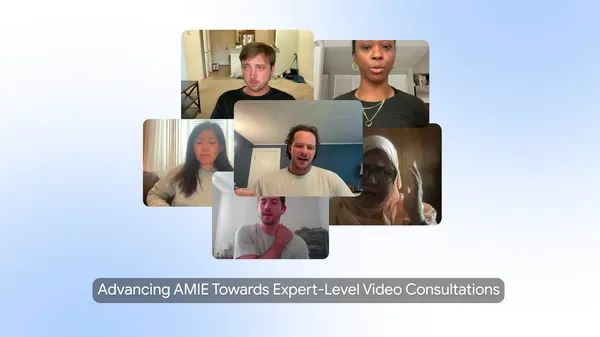
💡See how Google is testing medical AI in real-time video consultations beyond text chat.
⚡ 30-Second TL;DR
What Changed
AMIE is Google’s research medical AI system.
Why It Matters
Real-time video interaction could expand how medical AI systems assess and communicate with patients, particularly when visual and conversational cues matter. However, the simulated setting means further validation is needed before clinical adoption.
What To Do Next
Review the full AMIE study and reproduce its simulated consultation evaluation protocol before designing a medical video-AI prototype.
Key Points
- •AMIE is Google’s research medical AI system.
- •The study evaluates real-time clinical video consultation capabilities.
- •The consultations were conducted in simulated settings, not routine clinical deployment.
🧠 Deep Insight
AI-generated analysis for this event.
🔑 Enhanced Key Takeaways
- •AMIE stands for Articulate Medical Intelligence Explorer and is built upon a large language model architecture optimized for diagnostic reasoning and empathetic communication.
- •The system utilizes a self-play reinforcement learning framework where the AI acts as both the clinician and the patient to refine its diagnostic accuracy and bedside manner.
- •In randomized controlled trials, clinicians rated AMIE as superior to human primary care physicians across several axes, including diagnostic accuracy, clinical reasoning, and empathy.
- •The research highlights a 'diagnostic dialogue' capability, where the model actively asks clarifying questions and summarizes findings to ensure patient understanding during the consultation.
- •The study specifically addressed potential biases by evaluating performance across diverse patient demographics and clinical scenarios to ensure equitable care delivery.
📊 Competitor Analysis▸ Show
| Feature | AMIE (Google) | Med-PaLM 2 (Google) | GPT-4o (OpenAI) | Clinical Utility |
|---|---|---|---|---|
| Modality | Multimodal (Video/Audio/Text) | Text-based | Multimodal (Text/Vision) | High (Specialized) |
| Primary Focus | Diagnostic Dialogue | Medical QA | General Purpose | Research/Clinical |
| Benchmarks | Superior to PCP in trials | MedQA (USMLE) SOTA | High performance | Varies by task |
🛠️ Technical Deep Dive
- Architecture: Built on a foundation of large language models (LLMs) fine-tuned specifically for medical reasoning and conversational flow.
- Training Methodology: Employs a simulated environment where the model undergoes iterative training through self-play, allowing it to practice history-taking and diagnostic synthesis.
- Evaluation Framework: Uses a multi-dimensional rubric assessing diagnostic accuracy, clinical management, communication quality, and empathy.
- Input Processing: Capable of processing multimodal inputs, including transcribed speech and visual cues from video consultations to inform clinical decision-making.
- Safety Mechanisms: Incorporates guardrails to identify and flag high-risk clinical scenarios that require immediate human intervention.
🔮 Future ImplicationsAI analysis grounded in cited sources
⏳ Timeline
Weekly AI Recap
Read this week's curated digest of top AI events →
👉Related Updates
AI-curated news aggregator. All content rights belong to original publishers.
Original source: Google AI Blog ↗