AMD brings FSR 4.1 upscaling to older GPUs
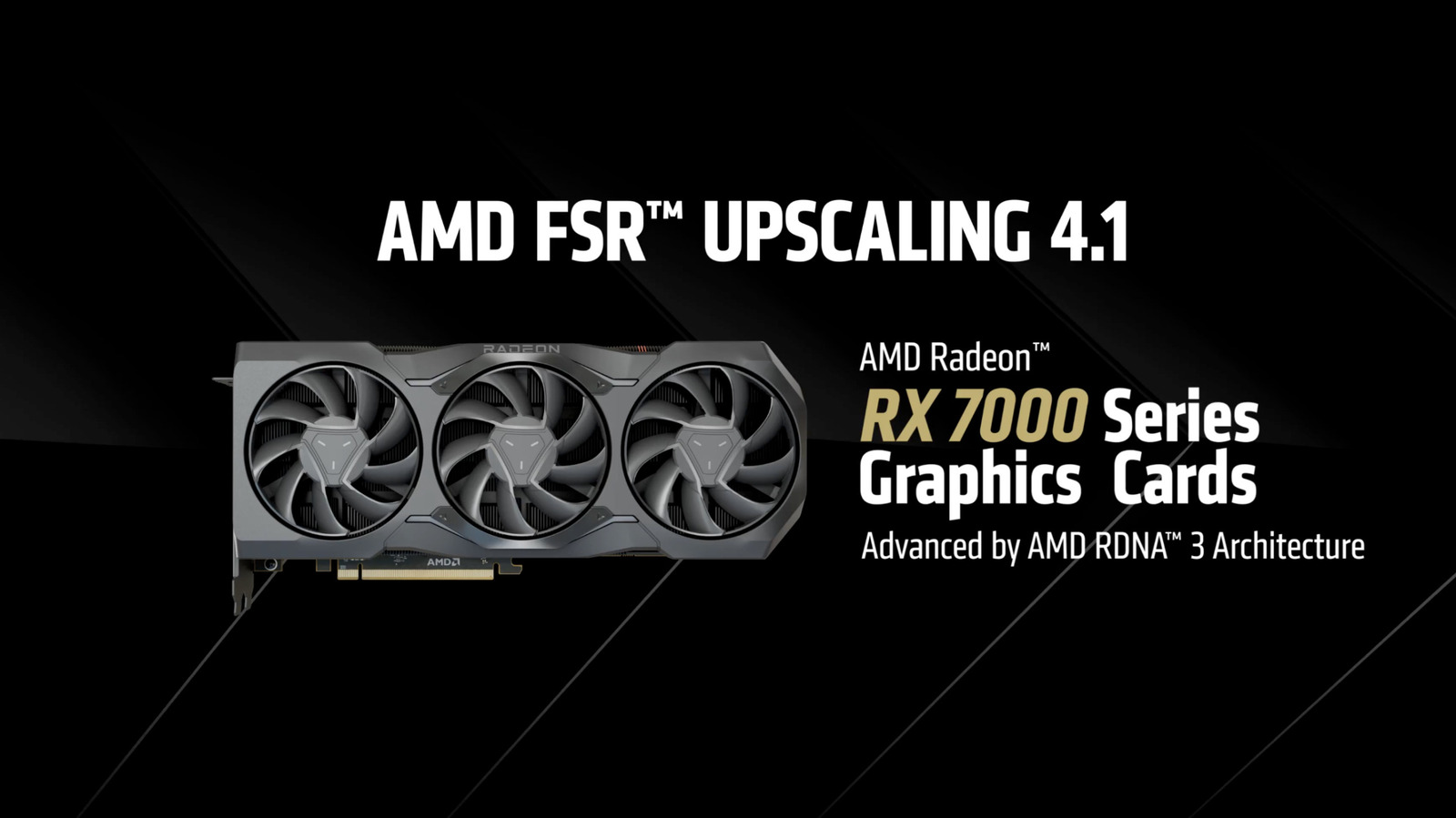
💡Learn how AMD is using AI-driven upscaling to extend the lifecycle of older hardware.
⚡ 30-Second TL;DR
What Changed
FSR 4.1 introduces advanced upscaling capabilities for broader hardware compatibility.
Why It Matters
By democratizing high-end upscaling, AMD is lowering the barrier for AI-driven visual enhancement. This allows developers to target a wider install base for performance-intensive applications.
What To Do Next
If you are building graphics-intensive apps, evaluate AMD's FSR SDK to optimize performance for users with older hardware.
Key Points
- •FSR 4.1 introduces advanced upscaling capabilities for broader hardware compatibility.
- •Support extends to older GPU architectures, not just the latest hardware.
- •Over 300 games will feature integration starting in July.
🧠 Deep Insight
Web-grounded analysis with 21 cited sources.
🔑 Enhanced Key Takeaways
- •FSR 4.1 is an ML-powered upscaling solution, marking a significant shift towards AI-assisted processing for AMD's upscaling technology.
- •While RDNA 3 (RX 7000 series) GPUs are slated to receive FSR 4.1 support in July 2026, RDNA 2 (RX 6000 series) GPUs are scheduled for an update in early 2027.
- •The adaptation of FSR 4.1 for RDNA 3 required specific optimization for the INT8 data format, as RDNA 3 architecture lacks the FP8 processing units found in RDNA 4.
- •FSR 4.1 introduces notable improvements over FSR 4.0, including sharper visuals for objects in motion, enhanced denoising for ray tracing, and a more performant Ultra Performance mode.
- •The initial exclusivity of FSR 4.0 to RDNA 4 (RX 9000 series) GPUs upon its debut had previously generated considerable dissatisfaction within the gaming community.
📊 Competitor Analysis▸ Show
| Feature/Aspect | AMD FSR 4.1 | NVIDIA DLSS 4.5 | Intel XeSS 2.1/3 |
|---|---|---|---|
| Technology Type | ML-powered upscaling, leveraging temporal and spatial information with neural networks. | Neural rendering, utilizing dedicated Tensor Cores for AI acceleration. | ML-based upscaling, optimized for Intel Arc GPUs with XMX units, offering a DP4a fallback for broader hardware. |
| Key Features | Upscaling, Frame Generation (via FSR 3.1 fallback/integration), Ray Regeneration 1.1, improved denoising, sharper visuals in motion, and a more efficient Ultra Performance mode. | Upscaling, Frame Generation, Multi-Frame Generation, and Ray Reconstruction. | Upscaling, Frame Generation, Multi-Frame Generation, and Xe Low Latency. |
| Hardware Support | RDNA 4 (RX 9000 series), RDNA 3 (RX 7000 series) in July 2026, and RDNA 2 (RX 6000 series) in early 2027. Its open-source nature allows for broad compatibility, including some older NVIDIA GPUs via unofficial methods. | Requires NVIDIA RTX 20-series GPUs or newer, as it relies on dedicated Tensor Cores for full functionality. | Primarily optimized for Intel Arc GPUs, but also supports a wide range of other GPUs (AMD, NVIDIA) through its DP4a fallback path. |
| Image Quality (Benchmarks) | Shows significant improvement over FSR 4.0, generally trailing DLSS 4.5 in overall visual quality, though it surpassed DLSS 4.5 in one specific game (Resident Evil Requiem) in a blind test. It delivers sharper image quality and reduced smearing in motion. | Generally leads in image quality, particularly with its Ray Reconstruction feature, and is often preferred over native rendering in blind tests. | Can achieve visual quality comparable to or approaching DLSS in certain titles, though results can vary depending on the game. |
| Pricing | Free with compatible AMD Radeon graphics hardware. | Free with compatible NVIDIA GeForce RTX graphics hardware. | Free with compatible Intel Arc graphics hardware. |
🛠️ Technical Deep Dive
- FSR 4.1 is an advanced upscaling solution that leverages state-of-the-art machine learning algorithms and neural networks to reconstruct high-quality, high-resolution frames from lower-resolution inputs.
- The algorithm analyzes both temporal and spatial information from multiple frames to enhance detail and improve image quality.
- For RDNA 3 GPUs, FSR 4.1's latest ML algorithm has been specifically optimized and ported for the INT8 data format, as RDNA 3 lacks the FP8 processing units available in RDNA 4 architecture.
- Key objectives of FSR 4.1 include reducing visual artifacts such as shimmering, ghosting, and instability, especially in fast-moving scenes.
- The technology incorporates updated inference mechanisms to produce a sharper overall image and includes additional optimizations for its Ultra Performance and Dynamic Resolution Scaling (DRS) modes.
- Integration of FSR 4.1 requires developers to use the FSR API and adhere to specific guidelines, including providing input color in a LINEAR COLORSPACE, with an option for non-linear colorspace if necessary.
- FSR 4.1 also features Ray Regeneration 1.1, which contributes to enhanced reflections and global illumination in ray-traced scenes.
- The implementation requires additional GPU local memory, which is allocated during the creation of the FSR context.
🔮 Future ImplicationsAI analysis grounded in cited sources
⏳ Timeline
📎 Sources (21)
Factual claims are grounded in the sources below. Forward-looking analysis is AI-generated interpretation.
- Google Search Source
- Google Search Source
- Google Search Source
- Google Search Source
- Google Search Source
- Google Search Source
- Google Search Source
- Google Search Source
- Google Search Source
- Google Search Source
- Google Search Source
- Google Search Source
- Google Search Source
- Google Search Source
- Google Search Source
- Google Search Source
- Google Search Source
- Google Search Source
- Google Search Source
- Google Search Source
- Google Search Source
Weekly AI Recap
Read this week's curated digest of top AI events →
👉Related Updates
AI-curated news aggregator. All content rights belong to original publishers.
Original source: Engadget ↗