Alook launches open-source platform for AI team orchestration
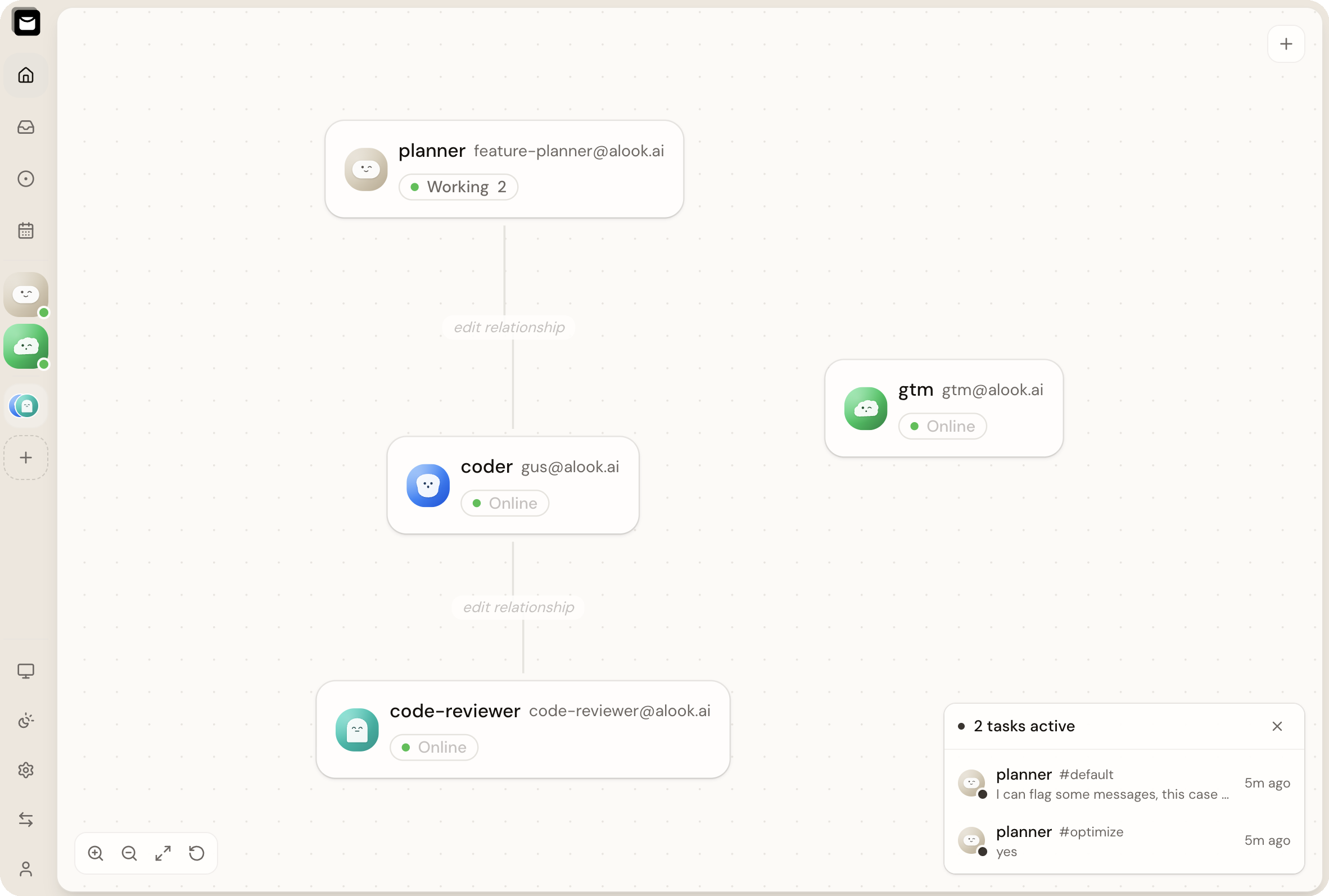
💡A new open-source framework for orchestrating multi-agent systems with persistent memory and email integration.
⚡ 30-Second TL;DR
What Changed
Enables single-user orchestration of multiple AI agents
Why It Matters
This tool lowers the barrier for solo developers to build and manage complex agentic workflows. It shifts the focus from managing individual prompts to orchestrating collaborative agent systems.
What To Do Next
Clone the Alook repository and test the daemon setup to see if it can automate your current email-based task workflows.
Key Points
- •Enables single-user orchestration of multiple AI agents
- •Includes real email integration for agent communication
- •Features shared memory and an always-on daemon architecture
🧠 Deep Insight
Web-grounded analysis with 8 cited sources.
🔑 Enhanced Key Takeaways
- •Alook is a self-hosted platform designed to run locally, ensuring data privacy and full access to the user's tools and codebase.
- •It provides a visual 'Org Chart' for defining agent roles and facilitating automatic coordination, alongside Kanban boards for task management and calendars for scheduling.
- •The platform supports a 'Bring Your Own Agent' (BYOA) model, acting as an orchestration layer for various AI coding agents such as Claude Code, Codex, and OpenCode.
- •Alook incorporates self-learning capabilities, where agents build context from completed tasks, remember decisions, and learn user preferences, ensuring continuous improvement.
- •It offers full traceability, recording every instruction, decision, and reply for accountability and debugging.
📊 Competitor Analysis▸ Show
Competitor Analysis
| Feature / Platform | Alook | LangGraph | CrewAI | Dify | Composio Agent Orchestrator |
|---|---|---|---|---|---|
| Primary Focus | AI Team Orchestration, Personal AI Company | Complex State Machines & DAGs for Agent Workflows | Role-Based Multi-Agent Systems | All-in-One RAG & Agent Pipelines | Autonomous PR Handling & Parallel Execution |
| Open Source | Yes | Yes | Yes | Yes | Yes |
| Hosting | Self-hosted, Local-first | Self-hosted (Python framework) | Self-hosted (Python framework) | Cloud + Self-hosted | Self-hosted (via isolated git worktrees) |
| Key Features | Email-native communication, visual Org Chart, Kanban, Calendar integration, shared memory, always-on daemon, BYOA | Graph-based orchestration, subgraphs, checkpoints, resumability, tight integration with LangSmith | Role-based agents, explicit task assignment, flexible memory (ChromaDB, SQLite3), knowledge ingestion pipelines | Agentic workflow builder, RAG pipeline support, built-in observability, marketplace for workflows/tools | Multiple agents in isolated worktrees, autonomous PR handling, human-on-the-loop, web dashboard with Kanban view |
| Primary Language | TypeScript | Python | Python | Python (implied by RAG/agent focus) | (Implied Python/TypeScript for agent interaction) |
| Pricing | Open-source (free to self-host) | Open-source (free to self-host), managed cloud option for LangSmith | Open-source (free to self-host), Enterprise version available | Open-source (free to self-host), cloud option | Open-source (free to self-host) |
| Benchmarks | Null | Null | Null | Null | Null |
🛠️ Technical Deep Dive
- Primary Development Language: TypeScript (97.1%)
- Deployment Model: Open-source, self-hosted, and local-first architecture, allowing agents to run directly on the user's machine with full access to local tools and codebase.
- Agent Isolation: While not explicitly stated for Alook, similar open-source agent orchestrators for coding agents commonly utilize git worktrees for isolating parallel agent execution environments to prevent conflicts.
- Agent Compatibility: Functions as an orchestration layer, supporting integration with various existing AI coding agents such as Claude Code, Codex, and OpenCode.
- Communication & Collaboration: Features email-native communication for agents (each agent gets its own email address), and integrates with dashboards, Kanban boards, and calendars for task management and scheduling.
- Memory & Learning: Incorporates self-learning capabilities where agents build context from completed tasks, remember past decisions, and adapt to user preferences.
- Operational Architecture: Designed with an 'always-on daemon' for continuous, 24/7 operation of the AI agent team.
- Traceability: Provides full traceability by recording every instruction, decision, and reply made by agents.
🔮 Future ImplicationsAI analysis grounded in cited sources
📎 Sources (8)
Factual claims are grounded in the sources below. Forward-looking analysis is AI-generated interpretation.
Weekly AI Recap
Read this week's curated digest of top AI events →
👉Related Updates

AI-curated news aggregator. All content rights belong to original publishers.
Original source: TestingCatalog ↗