AI to drive UPI to one billion daily transactions
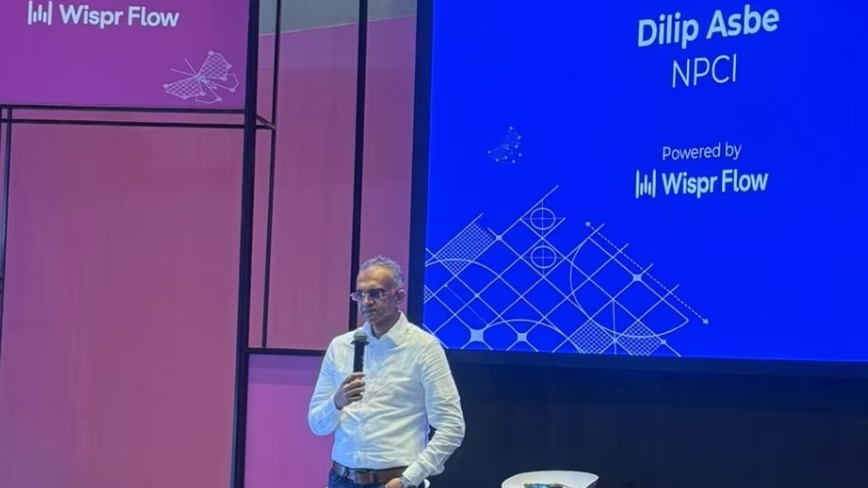
See how AI is being deployed at a national scale to handle massive, high-frequency financial transaction loads.
30-Second TL;DR
What Changed
UPI currently processes over 750 million daily transactions.
Why It Matters
Scaling to a billion transactions requires massive infrastructure optimization, positioning India as a global leader in AI-driven financial systems.
What To Do Next
Analyze NPCI's public technical whitepapers on AI-driven payment routing to understand large-scale transaction optimization.
Key Points
- •UPI currently processes over 750 million daily transactions.
- •NPCI identifies AI as the primary catalyst for scaling to 1 billion transactions.
- •Strategic focus on AI integration to optimize payment infrastructure efficiency.
Deep Insight
AI-generated analysis for this event — not the original article.
Enhanced Key Takeaways
- •NPCI is leveraging AI-driven 'Conversational Payments' via platforms like Hello! UPI to enable voice-based transactions in multiple regional languages, lowering the barrier for entry for non-tech-savvy users.
- •The integration of AI is being used to enhance fraud detection systems, specifically by analyzing real-time transaction patterns to identify and block suspicious activities before they settle.
- •NPCI has introduced 'UPI Circle,' a delegated payment feature that uses AI-based risk scoring to allow primary users to set spending limits for secondary users, expanding the user base.
- •The scaling strategy includes the deployment of AI-powered credit underwriting models within the UPI ecosystem to facilitate 'Credit on UPI,' allowing users to access small-ticket loans instantly.
- •To handle the surge to 1 billion transactions, NPCI is upgrading its backend infrastructure to a cloud-native architecture that utilizes AI for predictive load balancing and automated resource allocation.
Technical Deep Dive
- Implementation of AI-based risk engines that utilize machine learning classifiers to detect anomalies in transaction velocity and geolocation data.
- Integration of Natural Language Processing (NLP) models for voice-based payment authentication and intent recognition in diverse linguistic environments.
- Utilization of predictive analytics for infrastructure scaling, allowing the UPI switch to dynamically allocate compute resources based on historical transaction spikes.
- Deployment of federated learning techniques to improve fraud detection models across different member banks without compromising sensitive user data privacy.
Future ImplicationsAI analysis grounded in cited sources
Timeline
- 2016-04NPCI launches UPI in a pilot phase with 21 member banks.
- 2022-05UPI crosses the milestone of 5 billion monthly transactions.
- 2023-09NPCI introduces 'Hello! UPI' for conversational payments at the Global Fintech Fest.
- 2024-08NPCI launches 'UPI Circle' to enable delegated payments for family and friends.
- 2025-03UPI daily transaction volume consistently exceeds 500 million.
Weekly AI Recap
Read this week's curated digest of top AI events →
Related Updates


AI-curated news aggregator. All content rights belong to original publishers.
Original source: The Next Web (TNW) ↗
This is a summary, not the original. Read the source, or get the weekly briefing.
The weekly digest
One email a week. Unsubscribe anytime.