AI Reliance Erodes Human Grit, Study Warns
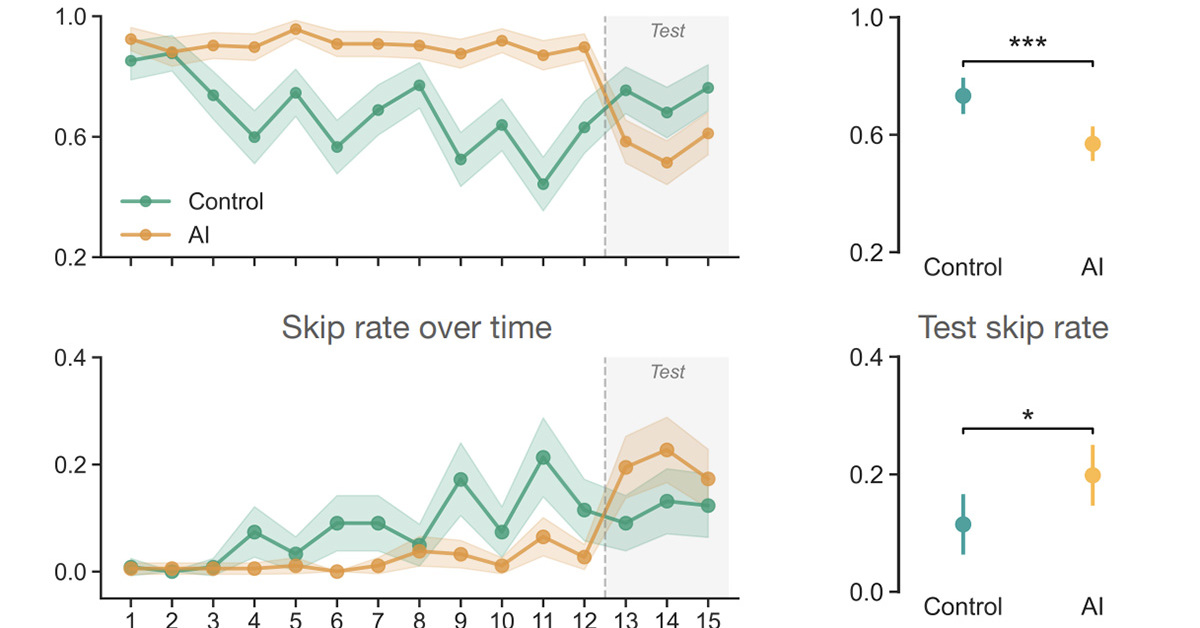
💡Study proves AI kills grit—design AIs that sometimes say no
⚡ 30-Second TL;DR
What Changed
AI use reduces opportunities for self-reliant problem-solving
Why It Matters
Encourages balanced AI integration to preserve cognitive skills in education and work. May influence AI design for ethical human development.
What To Do Next
Incorporate weekly no-AI coding challenges to build team perseverance.
Key Points
- •AI use reduces opportunities for self-reliant problem-solving
- •Short-term gains lead to long-term performance decline off-AI
- •Researchers recommend AI make 'no-help' judgments
🧠 Deep Insight
AI-generated analysis for this event — not the original article.
🔑 Enhanced Key Takeaways
- •Cognitive offloading to LLMs has been linked to 'cognitive atrophy,' where users experience reduced retention of domain-specific knowledge and decreased critical thinking capacity over longitudinal periods.
- •The 'AI-dependency trap' is exacerbated by feedback loops where AI models are trained on human-generated content that was itself produced with AI assistance, leading to model collapse and reduced human skill diversity.
- •Educational psychology frameworks are shifting toward 'AI-augmented scaffolding,' where systems are designed to withhold direct answers to force 'productive struggle'—a pedagogical method proven to improve long-term neural pathway consolidation.
🔮 Future ImplicationsAI analysis grounded in cited sources
Weekly AI Recap
Read this week's curated digest of top AI events →
👉Related Updates
AI-curated news aggregator. All content rights belong to original publishers.
Original source: ITmedia AI+ (日本) ↗
This is a summary, not the original. Read the source, or get the weekly briefing.
The weekly digest
One email a week. Unsubscribe anytime.