AI Prototypes Kill Lengthy PRDs
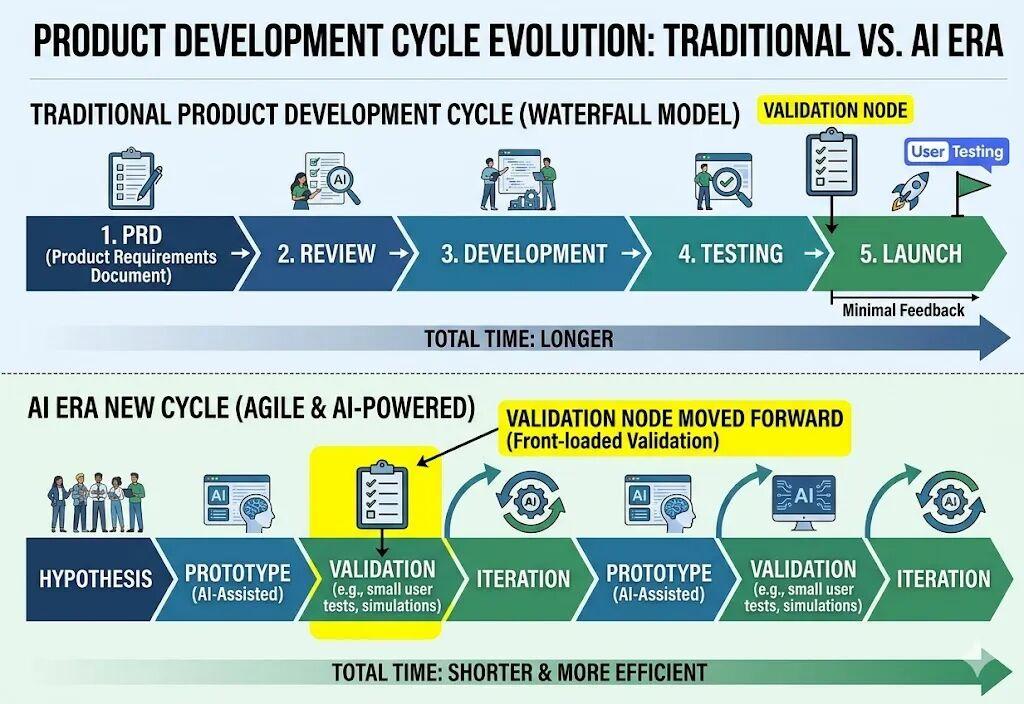
💡AI prototypes slash PM docs; learn hypothesis testing for 10x faster validation.
⚡ 30-Second TL;DR
What Changed
Claude Code prototypes user feedback feature in 2 hours vs 6-week PRD cycle
Why It Matters
Accelerates product validation 10x, reduces waste on unvalidated docs. PMs must pivot to hypothesis-driven workflows. Enables non-devs to prototype, shortening feedback loops.
What To Do Next
Prototype your next PM assumption with Claude Code and test with 5 users.
Key Points
- •Claude Code prototypes user feedback feature in 2 hours vs 6-week PRD cycle
- •Anthropic PMs: short sprints, demos over docs, simplify per model updates
- •Zapier uses real-time AI prototypes in user interviews for instant iteration
- •Key skills: verifiable hypotheses, stop-iteration judgment, no-code MVP building
🧠 Deep Insight
AI-generated analysis for this event — not the original article.
🔑 Enhanced Key Takeaways
- •The shift toward 'PRD-less' development is being accelerated by the integration of agentic coding environments that allow for real-time code execution and deployment directly from natural language prompts, bypassing traditional staging environments.
- •Industry data suggests that while PRDs are shrinking, the demand for 'AI-native' product managers is rising, specifically for those who can manage the non-deterministic nature of LLM outputs during the prototyping phase.
- •Companies adopting this 'prototype-first' methodology report a significant reduction in 'technical debt' during the early discovery phase, as AI-generated code is often discarded entirely after hypothesis validation rather than being integrated into a legacy codebase.
📊 Competitor Analysis▸ Show
| Feature | Claude Code (Anthropic) | Cursor (Anysphere) | GitHub Copilot Workspace |
|---|---|---|---|
| Primary Focus | Agentic CLI/Terminal workflow | IDE-integrated coding assistant | Issue-to-PR automation |
| Prototyping Speed | High (CLI-driven) | High (IDE-driven) | Medium (Task-driven) |
| Pricing Model | Usage-based (API) | Subscription/Enterprise | Subscription/Enterprise |
| Deployment | Direct execution/testing | Requires IDE environment | Requires GitHub integration |
🛠️ Technical Deep Dive
- •Claude Code utilizes a multi-step agentic loop: it reads the local repository context, plans the implementation, executes shell commands to install dependencies or run tests, and iterates based on terminal output errors.
- •The architecture relies on high-context window models (e.g., Claude 3.5 Sonnet or newer) to maintain state across complex file structures without needing to manually re-upload documentation.
- •It leverages 'Tool Use' (Function Calling) to interact with the host machine's filesystem, allowing it to perform tasks like 'grep', 'sed', and 'npm install' autonomously to validate if a prototype is functional.
🔮 Future ImplicationsAI analysis grounded in cited sources
⏳ Timeline
Weekly AI Recap
Read this week's curated digest of top AI events →
👉Related Updates




AI-curated news aggregator. All content rights belong to original publishers.
Original source: 虎嗅 ↗
This is a summary, not the original. Read the source, or get the weekly briefing.
The weekly digest
One email a week. Unsubscribe anytime.