AI Powers Boundaryless Digital Teams
💡How AI+platforms remake teams: fluid, hybrid human-AI for enterprises
⚡ 30-Second TL;DR
What Changed
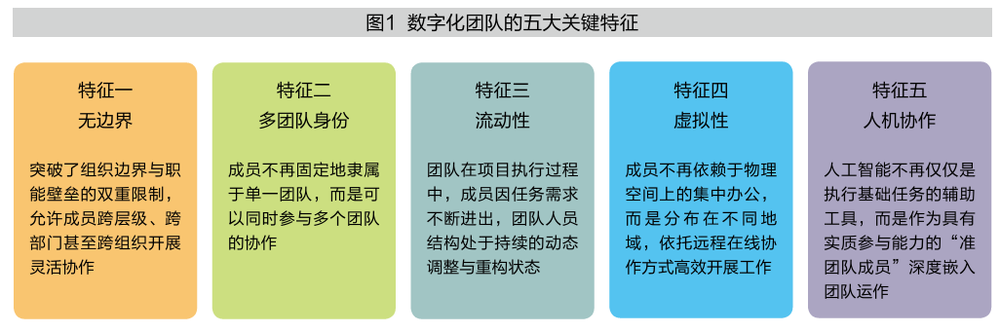
Platforms enable cross-org collab via skill tags and dynamic scheduling.
Why It Matters
Shifts orgs to agile 'online whole' from siloed teams, boosting efficiency in dynamic tasks. Redefines management with real-time data and AI intervention.
What To Do Next
Set up Feishu with Huoshan LLM to auto-match team members on a pilot project.
Key Points
- •Platforms enable cross-org collab via skill tags and dynamic scheduling.
- •AI as 'quasi-member': e.g., Feishu with Huoshan LLM for knowledge summary.
- •Flash Teams: algo-matched temp groups for short-cycle projects.
- •Multi-team dashboards manage priorities across projects.
🧠 Deep Insight
AI-generated analysis for this event — not the original article.
🔑 Enhanced Key Takeaways
- •The shift toward 'boundaryless' teams is increasingly driven by the integration of agentic workflows, where AI agents autonomously execute sub-tasks and hand off results to human counterparts, moving beyond simple knowledge summarization.
- •Data privacy and governance frameworks are evolving to support cross-organizational collaboration, with platforms implementing 'federated identity' and 'zero-trust' access controls to allow external contributors to join secure, temporary workspaces without compromising internal data.
- •The economic model of digital teams is transitioning from fixed-salary structures to 'skill-based micro-contracting,' where AI-driven platforms facilitate automated billing and reputation scoring for transient, project-based contributors.
📊 Competitor Analysis▸ Show
| Feature | Feishu (Lark) | Microsoft Teams + Copilot | Slack + Salesforce Agentforce |
|---|---|---|---|
| Core Focus | Integrated 'All-in-One' Suite | Enterprise Ecosystem | Communication-Centric |
| AI Integration | Deeply embedded (Huoshan LLM) | Office 365 native | CRM/Workflow automation |
| Pricing Model | Tiered/Enterprise | Per-user subscription | Per-user/Usage-based |
| Benchmarking | High speed/Agile focus | High stability/Compliance | High extensibility |
🛠️ Technical Deep Dive
- Architecture: Utilizes a micro-services-based 'Platform-as-a-Service' (PaaS) model where LLMs act as middleware for API orchestration between disparate enterprise tools.
- Task Matching: Employs vector-based semantic search to map project requirements against employee skill embeddings stored in a centralized knowledge graph.
- Agentic Framework: Implements ReAct (Reasoning + Acting) patterns within the chat interface, allowing the LLM to trigger external API calls (e.g., Jira, GitHub) based on natural language intent.
- Data Handling: Uses RAG (Retrieval-Augmented Generation) pipelines that enforce strict RBAC (Role-Based Access Control) at the document level to ensure cross-org data isolation.
🔮 Future ImplicationsAI analysis grounded in cited sources
⏳ Timeline
Weekly AI Recap
Read this week's curated digest of top AI events →
👉Related Updates




AI-curated news aggregator. All content rights belong to original publishers.
Original source: 虎嗅 ↗
This is a summary, not the original. Read the source, or get the weekly briefing.
The weekly digest
One email a week. Unsubscribe anytime.