AI Music Enters the Mainstream
💡AI music is no longer experimental: artists, labels, and chart hits are openly adopting it.
⚡ 30-Second TL;DR
What Changed
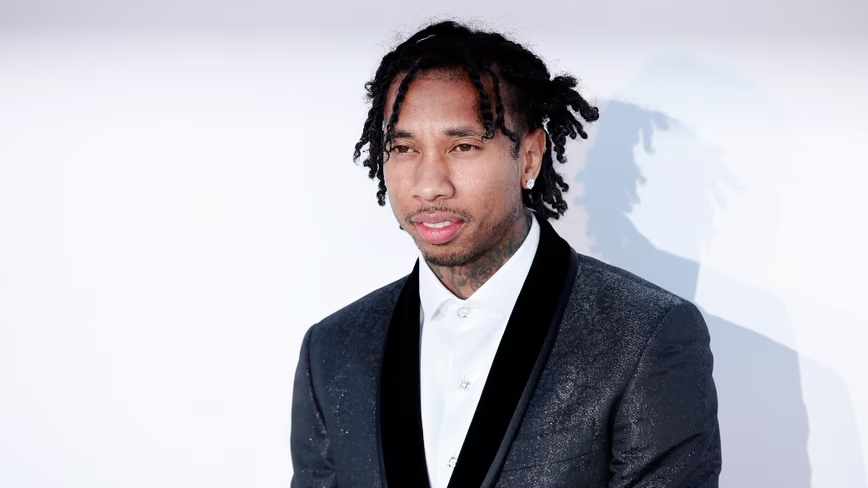
Tyga said AI generated the retro synths featured on his new album.
Why It Matters
The normalization of AI-assisted music could accelerate adoption among professional artists and labels. It also increases the importance of disclosure, licensing, attribution, and audience trust in commercial music workflows.
What To Do Next
Audit the disclosure, attribution, and licensing controls in your generative-music toolchain before releasing any AI-assisted track commercially.
Key Points
- •Tyga said AI generated the retro synths featured on his new album.
- •Timbaland signed a fully AI-created pop star.
- •A machine-assisted summer hit reached the Billboard Hot 100.
- •Artists are becoming more open about using generative music tools.
🧠 Deep Insight
AI-generated analysis for this event.
🔑 Enhanced Key Takeaways
- •The integration of AI in music production has sparked significant legal debates regarding copyrightability, specifically whether AI-generated compositions can be registered with the U.S. Copyright Office.
- •Major record labels, including Universal Music Group, have begun establishing formal partnerships with AI companies to develop 'ethical' AI models trained on licensed music catalogs to prevent unauthorized voice cloning.
- •The rise of AI music has led to the development of sophisticated deepfake detection tools specifically designed to identify AI-synthesized vocals in radio and streaming content.
- •Streaming platforms like Spotify and Apple Music have implemented new metadata requirements to disclose when AI tools are used in the creation of tracks to ensure transparency for listeners.
- •AI music generation tools are increasingly moving from cloud-based platforms to edge computing, allowing artists to run high-fidelity generative models locally on their own hardware for privacy and creative control.
🛠️ Technical Deep Dive
- Generative music models typically utilize Transformer-based architectures, similar to LLMs, but adapted for MIDI or audio waveform prediction.
- Latent Diffusion Models (LDMs) are increasingly used to generate high-fidelity audio by iteratively refining noise into coherent sound structures based on text prompts.
- Many modern AI music tools employ Variational Autoencoders (VAEs) to compress audio into latent spaces, enabling efficient manipulation of timbre, pitch, and rhythm.
- RVC (Retrieval-based Voice Conversion) technology is the primary driver behind AI voice cloning, allowing users to map a source voice's prosody onto a target voice model with minimal latency.
🔮 Future ImplicationsAI analysis grounded in cited sources
⏳ Timeline
Weekly AI Recap
Read this week's curated digest of top AI events →
👉Related Updates


AI-curated news aggregator. All content rights belong to original publishers.
Original source: The Next Web (TNW) ↗