AI Leaders Discuss OpenClaw Token Economics
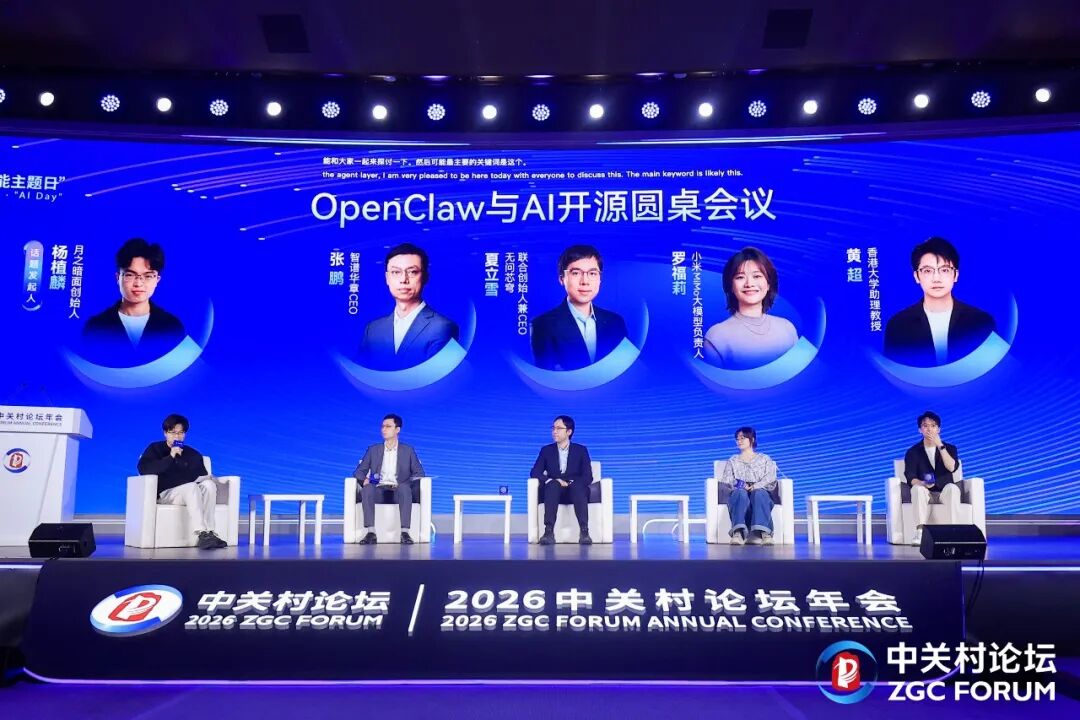
💡OpenClaw Token surge: 10x calc demand, Agent-native future revealed by AI CEOs
⚡ 30-Second TL;DR
What Changed
OpenClaw shifts AI from chatbots to task-completing Agents, exploding Token demand 10x in weeks.
Why It Matters
Sparks Token economy boom, forcing calc optimizations and Agent-specific innovations. Levels playing field for Chinese open models against closed giants.
What To Do Next
Deploy OpenClaw with Zhipu GLM models to benchmark Agent task completion vs Claude.
Key Points
- •OpenClaw shifts AI from chatbots to task-completing Agents, exploding Token demand 10x in weeks.
- •Enables non-coders to leverage top models; pulls up open model ceilings via Harness/Cache/Skills.
- •Challenges: Massive calc force needs; solutions in MoE long-context efficiency and Agent infra.
- •Consensus: Future AI must be Agent-native across models, data, software, and Token factories.
🧠 Deep Insight
AI-generated analysis for this event — not the original article.
🔑 Enhanced Key Takeaways
- •OpenClaw's architecture utilizes a proprietary 'Recursive Token-Budgeting' (RTB) protocol that dynamically throttles agent reasoning depth based on real-time compute availability, a feature currently absent in standard LLM frameworks.
- •The Zhongguancun Forum panel revealed that OpenClaw is being integrated into the 'Beijing AI Compute Grid,' a state-backed initiative aimed at pooling GPU resources from multiple domestic providers to mitigate the specific infrastructure bottlenecks identified by Moonshot and Zhipu.
- •Data from the OpenClaw developer ecosystem indicates that the 10x token surge is primarily driven by 'autonomous loop-back' processes, where agents generate and execute sub-tasks without human intervention, necessitating a shift toward 'Agent-native' billing models rather than traditional per-token pricing.
📊 Competitor Analysis▸ Show
| Feature | OpenClaw | AutoGPT (Legacy) | LangChain Agents |
|---|---|---|---|
| Core Architecture | Agent-Native/RTB | Task-Looping | Wrapper-based |
| Compute Efficiency | High (Dynamic Throttling) | Low (High Overhead) | Medium |
| Target User | Non-coders/Enterprise | Developers | Developers |
| Pricing Model | Agent-Native/Usage-based | N/A (Open Source) | N/A (Open Source) |
🛠️ Technical Deep Dive
- •Recursive Token-Budgeting (RTB): A middleware layer that intercepts model output tokens to calculate the 'utility-to-cost' ratio, automatically pruning non-essential reasoning chains.
- •Harness/Cache/Skills Framework: A modular repository system where 'Skills' are pre-compiled function calls stored in a vector-indexed cache, reducing the need for models to re-generate common API interaction logic.
- •MoE Long-Context Integration: OpenClaw utilizes a Mixture-of-Experts (MoE) routing mechanism specifically optimized for long-context windows, allowing agents to maintain state across 1M+ token sessions without full-context re-processing.
🔮 Future ImplicationsAI analysis grounded in cited sources
⏳ Timeline
Weekly AI Recap
Read this week's curated digest of top AI events →
👉Related Updates
AI-curated news aggregator. All content rights belong to original publishers.
Original source: 36氪 ↗
This is a summary, not the original. Read the source, or get the weekly briefing.
The weekly digest
One email a week. Unsubscribe anytime.