AI Giants Prepare for Historic IPO Wave
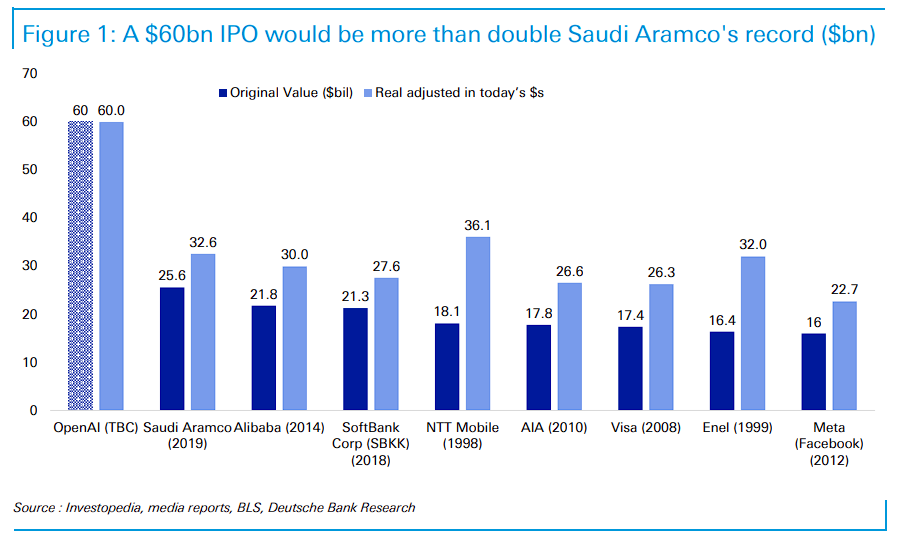
💡Understand how the potential $1T IPOs of OpenAI and Anthropic will shift capital allocation in the AI sector.
⚡ 30-Second TL;DR
What Changed
OpenAI plans a $1 trillion valuation IPO, aiming to raise $60 billion.
Why It Matters
The IPOs of these AI giants will act as a stress test for AI investment logic and significantly impact market liquidity for existing big tech stocks.
What To Do Next
Monitor the upcoming S-1 filings for these companies to analyze their unit economics and infrastructure cost-to-revenue ratios.
Key Points
- •OpenAI plans a $1 trillion valuation IPO, aiming to raise $60 billion.
- •Anthropic projects $10.9 billion in Q2 revenue with operational profit.
- •OpenAI reports a -122% operating margin, relying on massive infrastructure spending.
- •Passive fund rebalancing could force significant shifts in existing tech stock holdings.
🧠 Deep Insight
Web-grounded analysis with 30 cited sources.
🔑 Enhanced Key Takeaways
- •OpenAI's latest funding round in April 2026 closed at $122 billion in committed capital, valuing the company at $852 billion, with Amazon, SoftBank, and Nvidia as lead investors. Its annualized revenue rate exceeded $20 billion by the end of 2025, driven by ChatGPT subscriptions and enterprise adoption.
- •Anthropic's secondary market valuation reached approximately $1 trillion by April 2026, surpassing OpenAI's $880 billion on the same platforms, reflecting intense investor demand and a 163% premium over its February 2026 Series G valuation of $380 billion. The company's annualized revenue run rate surged from $9 billion at the end of 2025 to $30 billion by March 2026, primarily due to enterprise adoption of its Claude Code tool.
- •The simultaneous IPOs of OpenAI, Anthropic, and SpaceX, coupled with Nasdaq's "fast-track index inclusion" mechanism, are expected to trigger a "siphoning effect," forcing passive funds to sell significant holdings in existing "Magnificent Eight" tech stocks (e.g., Nvidia, Apple, Microsoft) to rebalance portfolios. JPMorgan estimates that if SpaceX achieves a $2 trillion valuation and floats 50% of its shares, passive funds might sell around $95 billion from these top tech stocks.
- •OpenAI has committed to investing approximately $1.4 trillion in infrastructure by 2033, including projects like the "Stargate" supercomputer, highlighting the immense capital requirements for scaling advanced AI.
- •Anthropic projects breaking even by 2028, two years ahead of OpenAI's estimated 2030 profitability target, a distinction public market investors are likely to price as a premium.
📊 Competitor Analysis▸ Show
| Feature/Category | OpenAI (GPT-4.1, GPT-5.4, o-series) | Anthropic (Claude 3 Opus, Sonnet, Haiku) |
|---|---|---|
| Model Lineup | Broadest, includes GPT-4.1, GPT-5.4, o-series reasoning models, Nano tiers, DALL-E 3, Whisper, TTS, Realtime API | Tighter lineup: Haiku, Sonnet, Opus families |
| Multimodality | Accepts image and text inputs, generates text outputs (GPT-4, GPT-4o handles text, audio, images natively) | Claude 3 family introduces vision capabilities alongside text processing |
| Context Window | Up to 128K tokens (GPT-4 Turbo), 32K tokens (original GPT-4) | Up to 200K tokens (Claude 3 Opus), with dynamic scaling up to 1 million tokens |
| Code Generation | Strong | Best in class (SWE-bench) |
| Reasoning Models | Dedicated o1, o3, o4-mini SKUs; uses hidden "thinking tokens" that are billed | Extended thinking mode integrated into standard API; bills thinking tokens at standard output rates |
| Cheapest Input Price (per 1M tokens) | GPT-4.1 Nano at $0.10; GPT-5.4 Nano at $0.20 | Claude Haiku 3.5 at $0.25 (legacy); Claude Haiku 4.5 at $1.00 |
| Flagship Model Input Price (per 1M tokens) | GPT-5.4 at $2.50; GPT-4.1 at $2.00 | Claude Opus 4.6 at $5.00 |
| Flagship Model Output Price (per 1M tokens) | GPT-5.4 at $15.00; GPT-4.1 at $8.00 | Claude Opus 4.6 at $25.00 |
| Prompt Caching Discount | Automatic (50% discount) | Explicit (90% discount) |
| Long Context Pricing | Triggers at 272K tokens for some models. GPT-4.1 supports 1M tokens at flat rates. | Claude Opus 4.7 and Sonnet 4.6 support 1M tokens at flat standard rates; input price doubles for Opus/Sonnet if input exceeds 200K tokens for some versions. |
| API Ecosystem | Largest third-party integration library, more generous entry-tier rate limits (500 RPM) | Growing fast, but less ubiquitous; entry-tier rate limits start at 50 RPM |
🛠️ Technical Deep Dive
- OpenAI GPT-4 Architecture:
- Transformer-based neural network architecture.
- Large multimodal model (LMM) capable of accepting image and text inputs and emitting text outputs.
- Utilizes an encoder-decoder structure with an attention mechanism to understand relationships between words and focus on relevant parts of inputs/outputs.
- Employs Reinforcement Learning from Human Feedback (RLHF) for fine-tuning model responses to align with user expectations.
- Believed to have a Mixture of Experts (MoE) model with approximately 1.8 trillion parameters across 120 layers, utilizing 16 experts where 2 are routed per forward pass.
- GPT-4o handles text, audio, and images natively within a single model, removing the connector layer used in previous multimodal GPT-4 versions.
- Anthropic Claude 3 Architecture:
- Transformer-based models, built on the "Attention Is All You Need" concept.
- Incorporates Constitutional AI to embed ethical guidelines directly into its training process, enhancing safety and efficiency.
- Features dynamic context window scaling, supporting up to 200,000 tokens (Claude 3 Opus) and potentially up to 1 million tokens, and hierarchical attention to prioritize critical segments of long inputs.
- Utilizes adaptive computation layers to optimize resource allocation for complex or high-stakes queries.
- Employs a two-stage training process and innovations like contrastive decoding for improved factual accuracy.
- The Claude 3 family introduces native vision capabilities alongside text processing, allowing it to analyze images, charts, and visual content.
🔮 Future ImplicationsAI analysis grounded in cited sources
⏳ Timeline
📎 Sources (30)
Factual claims are grounded in the sources below. Forward-looking analysis is AI-generated interpretation.
- wikipedia.org
- clay.com
- investing.com
- ig.com
- cmcmarkets.com
- mlq.ai
- thenextweb.com
- businessinsider.com
- qz.com
- incredibleroots.com
- bitget.com
- moomoo.com
- futunn.com
- thestreet.com
- forbes.com
- finout.io
- pecollective.com
- vantage.sh
- medium.com
- acecloud.ai
- speechmatics.com
- scribd.com
- solvimon.com
- plainconcepts.com
- semianalysis.com
- medium.com
- reddit.com
- exa.ai
- issarice.com
- wikipedia.org
Weekly AI Recap
Read this week's curated digest of top AI events →
👉Related Updates


AI-curated news aggregator. All content rights belong to original publishers.
Original source: 虎嗅 ↗