Africa's electric mobility shifts from venture bets to infrastructure
💡Understand how emerging market infrastructure is shifting from venture capital to debt, impacting future tech deployment
⚡ 30-Second TL;DR
What Changed
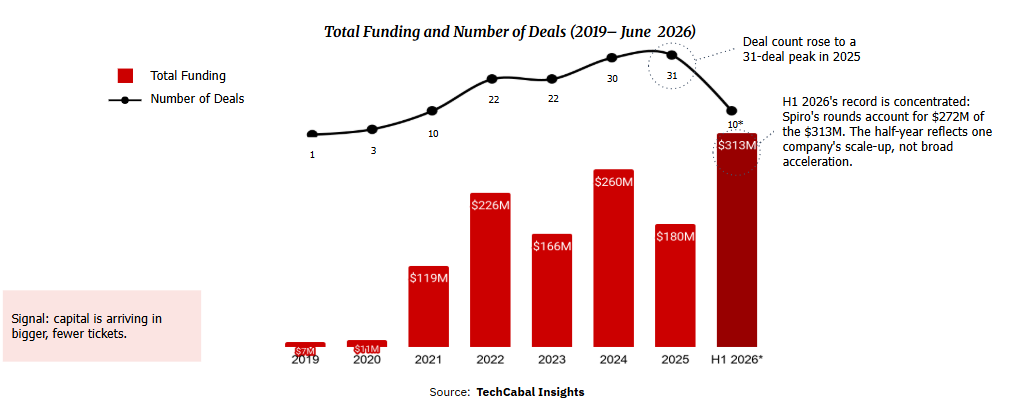
Over $1.28 billion raised by African e-mobility startups since 2019.
Why It Matters
This shift indicates a maturing market that requires more stable, long-term capital models. For AI practitioners, this suggests potential opportunities in building fleet management and grid optimization software for emerging infrastructure.
What To Do Next
Analyze the data requirements for infrastructure-grade EV fleet management to identify gaps where AI-driven predictive maintenance can lower operational risk.
Key Points
- •Over $1.28 billion raised by African e-mobility startups since 2019.
- •One-third of recent capital is structured as debt rather than venture equity.
- •The sector is increasingly viewed as critical infrastructure rather than speculative venture bets.
🧠 Deep Insight
Background and context from public sources — not the original article. 23 sources cited.
🔑 Enhanced Key Takeaways
- •Many African countries are actively developing national electric vehicle (EV) strategies and implementing incentives such as VAT reductions and import duty exemptions to accelerate adoption.
- •Africa possesses substantial reserves of critical minerals like cobalt, lithium, nickel, and graphite, which are vital for EV battery production, positioning the continent to move beyond raw material export to local manufacturing and value chain capture.
- •The rapid growth of electric two- and three-wheelers (E2/3W) is a significant driver of e-mobility in Africa, particularly for urban logistics and ride-hailing services, due to their lower capital investment and energy consumption compared to four-wheelers.
- •Inadequate and non-standardized charging infrastructure remains a primary impediment to widespread EV adoption across Africa, with the continent's charging network being significantly smaller than those in other major regions.
- •Ethiopia implemented a pioneering policy in 2023 by becoming the first country globally to ban imports of internal combustion engine (ICE) passenger vehicles, complemented by tax reductions for EVs, aiming for a rapid transformation of its national vehicle fleet.
🛠️ Technical Deep Dive
- Charging Standards: Africa's EV charging landscape is characterized by a mix of international protocols, primarily CCS (Combined Charging System), CHAdeMO, and Type 2, influenced by vehicle imports from Europe and Asia.
- Type 2 connectors are prevalent for AC charging, supporting both single-phase (typically 3.7kW to 7.4kW) and three-phase (up to 22kW, sometimes 43kW) power, suitable for overnight charging at homes or workplaces.
- CHAdeMO is a DC fast-charging standard known for its bidirectional charging capabilities.
- CCS supports both AC and DC charging, offering versatility for various charging needs but often incurring higher installation costs.
- A significant challenge is the lack of harmonized charging standards and technical regulations across different African countries, which complicates cross-border EV use and infrastructure development.
- Battery Manufacturing & Raw Materials: The continent holds critical minerals like cobalt, lithium, nickel, and graphite, essential for EV battery production.
- Morocco is developing Africa's first EV battery gigafactory, a $5.6 billion project with China's Goan High-Tech, aiming for an initial annual production capacity of 20 GWh and eventually 100 GWh. This facility will also produce critical components like cathodes and anodes, enabling vertical integration.
- South Africa is investing in advancing high-purity manganese sulphate monohydrate (HPMSM) demonstration plants in Johannesburg, a key precursor material for lithium-ion batteries.
- Grid Integration: Fragile national power grids and frequent load-shedding in many African countries pose a critical challenge to widespread EV charging without substantial modernization. However, there is growing interest in decentralized energy ecosystems where EVs can integrate with off-grid solar charging solutions.
🔮 Future ImplicationsAI analysis grounded in cited sources
⏳ Timeline
📎 Sources (23)
Factual claims are grounded in the sources below. Forward-looking analysis is AI-generated interpretation.
- energiccharge.com
- africaema.org
- discoveryalert.com.au
- leadventgrp.com
- un.org
- forbesafrica.com
- fmo.nl
- marketdataforecast.com
- shellfoundation.org
- ecofinagency.com
- feyree.com
- energyforgrowth.org
- gggi.org
- ev24.africa
- evcharge.co.za
- sustmob.org
- youtube.com
- businessinsider.com
- energyforgrowth.org
- techcabal.com
- cnbcafrica.com
- businessincameroon.com
- launchbaseafrica.com
Weekly AI Recap
Read this week's curated digest of top AI events →
👉Related Updates
AI-curated news aggregator. All content rights belong to original publishers.
Original source: TechCabal ↗
This is a summary, not the original. Read the source, or get the weekly briefing.
Weekly AI briefing
One email a week. Unsubscribe anytime.