7 Flaws in US AI Great Divergence Narrative
💡Exposes US AI report flaws; China open models thrive despite bans.
⚡ 30-Second TL;DR
What Changed
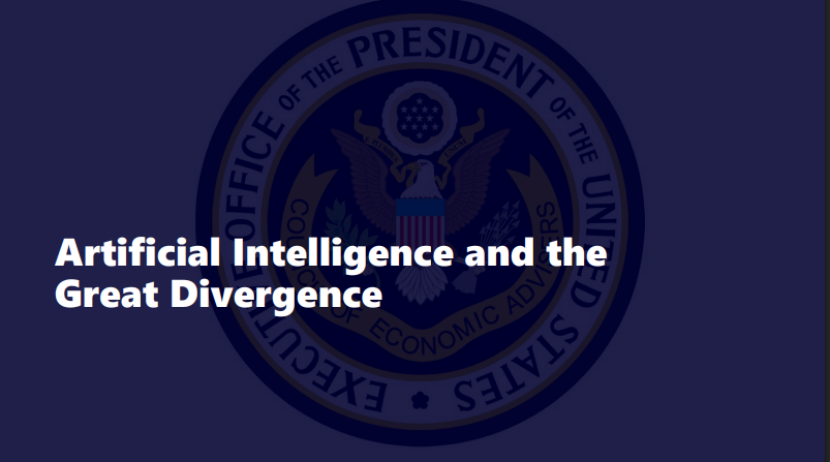
Report misuses Pomeranz's 'Great Divergence' for AI hegemony narrative
Why It Matters
Undermines US zero-sum AI view, validates China's innovation under sanctions. Accelerates global open-source shift, reducing US model dominance.
What To Do Next
Download DeepSeek R1 from Hugging Face and benchmark against OpenAI for cost savings.
Key Points
- •Report misuses Pomeranz's 'Great Divergence' for AI hegemony narrative
- •DeepSeek R1 matches OpenAI at fraction of US training cost despite bans
- •Chinese open models overtook US on Hugging Face downloads 2024-2025
- •Acemoglu: AI productivity boost only 0.5-0.7%, not revolutionary
- •AI as 'mediocre tech' risks job replacement without Jevons rebound
🧠 Deep Insight
AI-generated analysis for this event — not the original article.
🔑 Enhanced Key Takeaways
- •The US CEA report's reliance on the 'Great Divergence' framework has been criticized by economic historians for ignoring the role of institutional path dependency and the non-linear nature of technological diffusion in globalized markets.
- •Recent empirical studies suggest that the 'compute-to-intelligence' ratio is shifting; Chinese labs are achieving comparable reasoning capabilities to frontier US models by optimizing data quality and algorithmic efficiency rather than relying solely on massive GPU clusters.
- •The 'Jevons Paradox' in AI is manifesting as increased automation of routine cognitive tasks, which, contrary to the CEA's productivity growth projections, is leading to wage stagnation in sectors where AI-augmented labor supply outpaces demand.
🛠️ Technical Deep Dive
- •DeepSeek R1 architecture utilizes a Mixture-of-Experts (MoE) approach with dynamic routing, allowing for high-performance reasoning while activating only a fraction of total parameters per token.
- •Chinese open-source models have increasingly adopted 'Knowledge Distillation' techniques, where smaller, efficient models are trained on the outputs of larger, proprietary frontier models to bypass hardware limitations.
- •Implementation of 'Grouped Query Attention' (GQA) and 'Multi-Head Latent Attention' (MLA) in recent Chinese models has significantly reduced KV cache memory requirements, enabling inference on consumer-grade hardware despite US export restrictions on high-end H100/A100 chips.
🔮 Future ImplicationsAI analysis grounded in cited sources
⏳ Timeline
Weekly AI Recap
Read this week's curated digest of top AI events →
👉Related Updates



AI-curated news aggregator. All content rights belong to original publishers.
Original source: 虎嗅 ↗
This is a summary, not the original. Read the source, or get the weekly briefing.
The weekly digest
One email a week. Unsubscribe anytime.