2026 China AIGC Industry Summit: Agent and Multimodal Trends
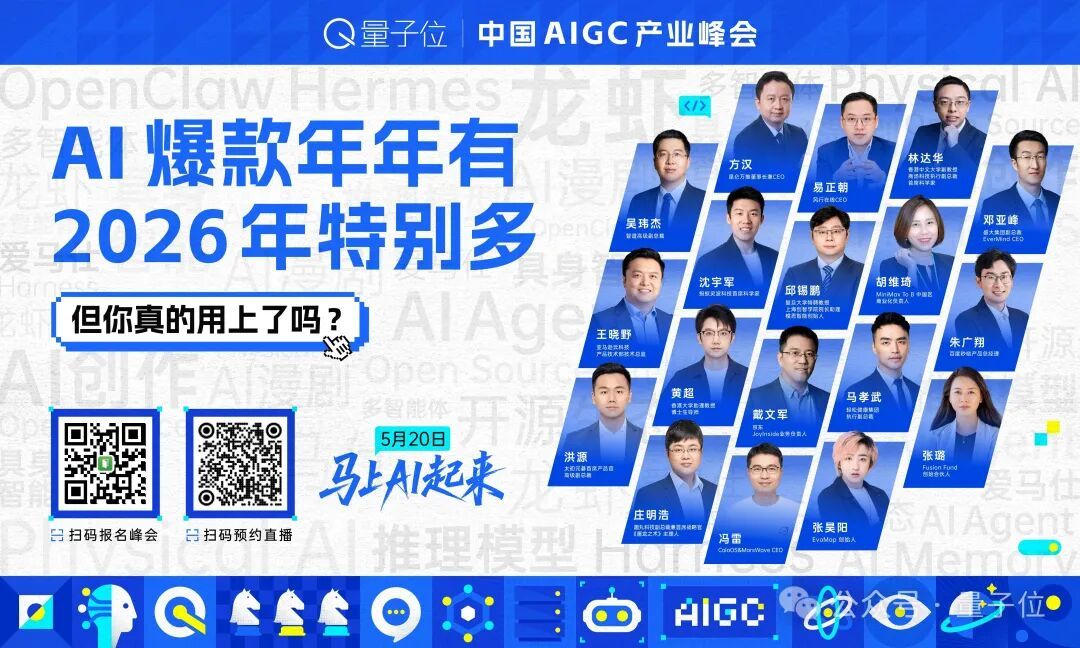
💡Get a full-day deep dive into 2026 AI trends, from Agent commercialization to the new inference-driven compute paradigm.
⚡ 30-Second TL;DR
What Changed
Focus on Agent commercialization and the transition from 'tool' to 'digital productivity system'.
Why It Matters
The summit provides a comprehensive overview of the Chinese AI market, helping practitioners understand the current state of Agent deployment and the shift in compute requirements.
What To Do Next
Register for the summit or watch the livestream to identify key gaps in your current Agent deployment strategy.
Key Points
- •Focus on Agent commercialization and the transition from 'tool' to 'digital productivity system'.
- •Discussion on multimodal models evolving into spatial intelligence and physical world interaction.
- •Shift in AI infrastructure narrative from training-driven to inference-driven.
- •Release of the 2026 China AIGC Application Landscape Report and top enterprise/product rankings.
🧠 Deep Insight
Web-grounded analysis with 17 cited sources.
🔑 Enhanced Key Takeaways
- •By February 2025, China's generative AI user base had reached 250 million, demonstrating rapid application expansion, with platforms like DeepSeek achieving 100 million user growth in just seven days.
- •AI Agents are evolving beyond simple conversational interactions into autonomous 'task execution loops' and are actively engaging in real-world operations, exemplified by the March 2025 launch of Manus, a general-purpose AI agent capable of autonomous task decomposition and multi-tool collaboration.
- •The shift in AI infrastructure from training to inference is evident in China, with inference cards accounting for 57.6% of the country's data center accelerator shipments in 2024, significantly surpassing training cards at 33%.
- •Chinese tech giants, including Alibaba, Meituan, JD.com, ByteDance, and Tencent, are actively integrating AI agents into their platforms to transform e-commerce by replacing traditional search bars with conversational commerce, with Alibaba's Qwen assistant reaching 300 million monthly active users by early 2026.
- •The 2026 China AIGC Application Landscape Report and top enterprise/product rankings will be released by the QbitAI Think Tank, continuing its tradition of providing a comprehensive and three-dimensional panoramic map of Chinese AIGC applications and market trends.
🛠️ Technical Deep Dive
- AI Agents: Evolving from basic conversational interactions to autonomous 'task execution loops' capable of self-evolution driven by long-term memory. Products like Manus demonstrate autonomous task decomposition and multi-tool collaboration. General AI assistants are becoming 'super portals,' while vertical, scenario-specific agents are experiencing high-speed growth. The trend of 'one-person companies' leverages AI agents for task automation and micro-businesses, increasing demand for cloud computing and specialized software services.
- Multimodal Models: Enable AI applications to interact with humans more empathetically and are evolving into spatial intelligence for physical world interaction. Discussions at the summit will cover the latest progress in multimodal models like MOSS and their inference optimization. Chinese models such as Zhipu AI's GLM-4 Plus and Moonshot AI's Kimi k1.5 exhibit advanced multimodal capabilities, handling text and high-resolution images across multiple languages. Embodied AI, particularly 'vision-language-action' (VLA) models, is a developing frontier for multimodal interaction in robotics, with Chinese teams making progress in targeted areas.
- AI Infrastructure (Training to Inference Shift): This paradigm shift is driven by the continuous, real-time nature of inference workloads, which contrast with occasional training. China's AI inference chip market is projected to grow at a compound annual growth rate of 94.9%, reaching 310.6 billion yuan by 2025. Inference cards constituted 57.6% of China's data center accelerator shipments in 2024. Cloud providers like Alibaba Cloud, Huawei Cloud, Baidu AI Cloud, and Tencent Cloud are accelerating the adoption of AI Inference Platform as a Service (PaaS). The shift necessitates re-engineering the entire full-stack system for AI data centers (AIDC), focusing on reliability, energy efficiency (e.g., liquid cooling, AI-powered optimization), deployment efficiency (modular construction), and forward compatibility to support future computing technologies. Domestic computing power's share in China's data center accelerator market reached 34.6% in 2024, a notable increase from previous years.
🔮 Future ImplicationsAI analysis grounded in cited sources
⏳ Timeline
📎 Sources (17)
Factual claims are grounded in the sources below. Forward-looking analysis is AI-generated interpretation.
Weekly AI Recap
Read this week's curated digest of top AI events →
👉Related Updates

AI-curated news aggregator. All content rights belong to original publishers.
Original source: 36氪 ↗