2025 Foundry Hits $320B on AI Surge
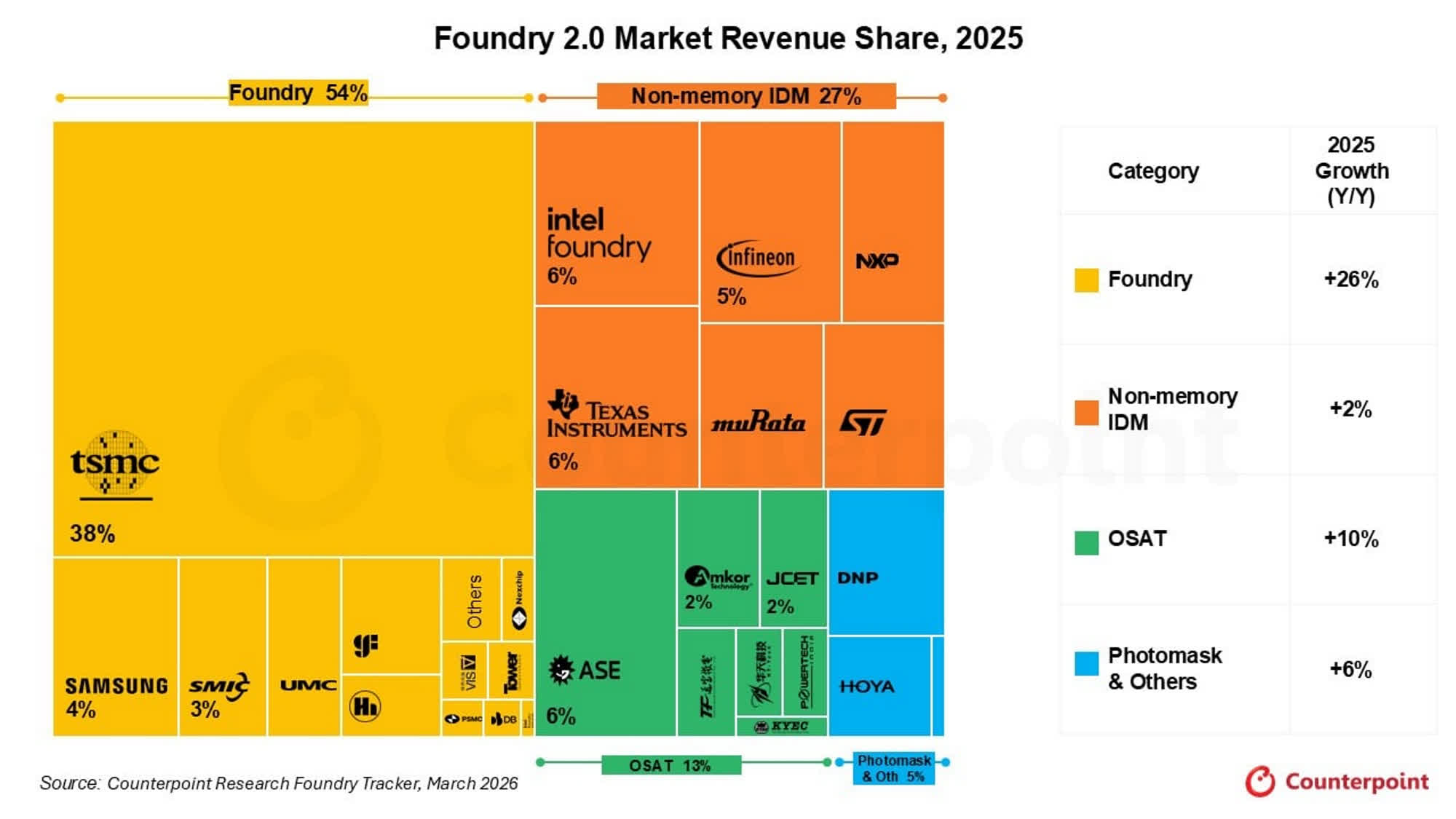
💡AI fuels $320B foundry boom—key for AI chip procurement strategy
⚡ 30-Second TL;DR
What Changed
2025 revenue reaches $320B, +16% YoY record high
Why It Matters
Signals robust AI hardware supply growth, easing chip shortages for AI training/inference. Boosts confidence in scaling AI infrastructure investments.
What To Do Next
Review Counterpoint's full Foundry 2.0 report for AI chip supply forecasts.
Key Points
- •2025 revenue reaches $320B, +16% YoY record high
- •AI accelerator chips as primary growth driver
- •'Foundry 2.0' describes evolved complex ecosystem
- •TSMC and major foundries secure huge profits
🧠 Deep Insight
AI-generated analysis for this event — not the original article.
🔑 Enhanced Key Takeaways
- •The 'Foundry 2.0' framework emphasizes the shift from traditional wafer manufacturing to a comprehensive service model that integrates advanced packaging (CoWoS), silicon photonics, and heterogeneous chiplet integration.
- •Geopolitical diversification is a major component of the 2025 revenue surge, as foundries aggressively expanded capacity in the US, Japan, and Germany to mitigate supply chain risks associated with concentration in Taiwan.
- •The 16% YoY growth is heavily skewed toward sub-7nm process nodes, with 3nm and 2nm production capacity becoming the primary bottleneck and pricing premium driver for AI-focused hyperscalers.
📊 Competitor Analysis▸ Show
| Feature | TSMC | Samsung Foundry | Intel Foundry |
|---|---|---|---|
| Leading Node | 2nm (N2) | 2nm (SF2) | 18A |
| Advanced Packaging | CoWoS / SoIC | I-Cube / H-Cube | Foveros |
| AI Market Focus | High-performance GPU/ASIC | HBM-integrated logic | High-performance CPU/AI |
🛠️ Technical Deep Dive
- Shift to Gate-All-Around (GAA) transistor architectures at 2nm nodes to improve power efficiency and performance density for AI workloads.
- Adoption of backside power delivery networks (BSPDN) to reduce IR drop and signal interference in high-frequency AI accelerators.
- Expansion of Chip-on-Wafer-on-Substrate (CoWoS) capacity to address the critical HBM (High Bandwidth Memory) integration bottleneck for generative AI training chips.
🔮 Future ImplicationsAI analysis grounded in cited sources
⏳ Timeline
Weekly AI Recap
Read this week's curated digest of top AI events →
👉Related Updates
AI-curated news aggregator. All content rights belong to original publishers.
Original source: cnBeta (Full RSS) ↗
This is a summary, not the original. Read the source, or get the weekly briefing.
The weekly digest
One email a week. Unsubscribe anytime.