🐯虎嗅•Stalecollected in 67m
2000+ Scientists Warn NSF Cuts Cede AI Lead to China
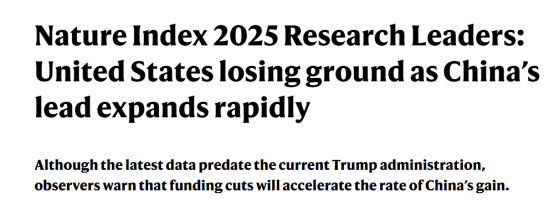
💡NSF shakeup risks US AI funding collapse vs China's $1T R&D surge—vital for researchers.
⚡ 30-Second TL;DR
What Changed
2000+ scientists including 19 Nobelists signed letter against abrupt NSB dismissal.
Why It Matters
US AI researchers face shrinking federal grants, pushing reliance on private funding or relocation. Accelerates China lead in strategic AI fields, affecting global talent flow.
What To Do Next
Check NSF's CISE directorate solicitations for AI grants before 2026 cuts.
Who should care:Researchers & Academics
Key Points
- •2000+ scientists including 19 Nobelists signed letter against abrupt NSB dismissal.
- •NSF budget proposed cut 57% for 2026; NSB oversees science policy including AI priorities.
- •China R&D hits $1T PPP parity with US, leads Nature index; dominates joint projects.
- •Experts warn policy erodes US talent retention, international collab in AI/quantum.
🧠 Deep Insight
AI-generated analysis for this event.
🔑 Enhanced Key Takeaways
- •The proposed 57% budget reduction for the NSF is linked to a broader administration strategy to reallocate federal research funds toward the newly established 'Department of Technological Sovereignty,' which prioritizes applied defense AI over fundamental scientific inquiry.
- •Internal NSF documents leaked alongside the protest reveal that the dissolution of the National Science Board (NSB) effectively removes the statutory requirement for independent, non-partisan oversight of the agency's $8 billion annual research portfolio.
- •Analysis of the Nature Index data cited by the scientists indicates that China's lead is most pronounced in 'dual-use' AI architectures—specifically those integrating large-scale neural networks with autonomous drone swarm coordination and cryptographic resilience.
🔮 Future ImplicationsAI analysis grounded in cited sources
US academic output in top-tier AI conferences will decline by 20% within 24 months.
The withdrawal of NSF funding for fundamental research will force university labs to pivot toward classified or corporate-sponsored projects, limiting open-source publication.
China will achieve parity in high-end GPU-equivalent compute capacity by Q4 2027.
Aggressive state subsidies for domestic semiconductor fabrication, combined with the loss of US-led collaborative research, accelerates China's independent hardware development cycle.
⏳ Timeline
2025-11
Administration announces intent to restructure federal science oversight agencies.
2026-02
NSF budget proposal for 2026 is submitted to Congress with significant cuts.
2026-04
Executive order issued to dissolve the National Science Board (NSB).
2026-05
Open letter signed by 2000+ scientists protesting the NSB dissolution.
📰
Weekly AI Recap
Read this week's curated digest of top AI events →
👉Related Updates

AI-curated news aggregator. All content rights belong to original publishers.
Original source: 虎嗅 ↗