$1M Crowdfunded in 5 Hours for Local AI Box
Plug-in box runs 100B LLMs locally cheap—perfect for private Agents!
30-Second TL;DR
What Changed
190TOPS INT8 peak, runs 100B models (e.g. GPT-o1 120B equiv) offline via USB plug-in
Why It Matters
Democratizes local high-param LLM access for pros/geeks, bypassing cloud costs/privacy risks; sparks personal Jarvis/Agent boom, competes niche vs. AI PCs.
What To Do Next
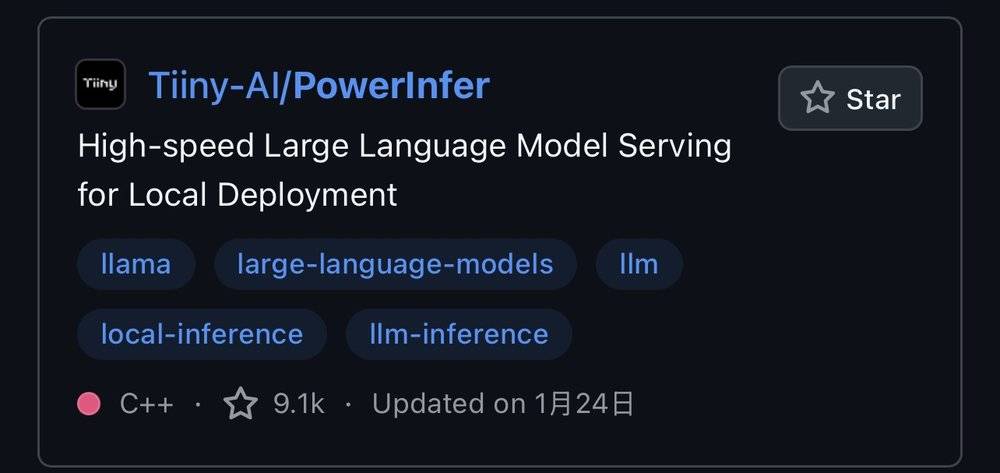
Star and test PowerInfer on GitHub to speed up local LLM inference on your hardware.
Key Points
- •190TOPS INT8 peak, runs 100B models (e.g. GPT-o1 120B equiv) offline via USB plug-in
- •One-click deploy mainstream OSS models/Agents on Mac/Win; no full OS, pure inference
- •PowerInfer GitHub 9100 stars accelerates end-side heterogeneous inference; post-seed funded
Deep Insight
AI-generated analysis for this event — not the original article.
Enhanced Key Takeaways
- •The Tiiny AI Pocket Lab utilizes a custom-designed FPGA-based acceleration architecture rather than traditional GPU or NPU silicon, specifically optimized for the sparse activation patterns inherent in PowerInfer's inference engine.
- •The device incorporates a proprietary 'Cold-Start' memory management system that allows it to swap model weights from the host machine's NVMe storage to the device's high-bandwidth cache in under 2 seconds, bypassing traditional RAM bottlenecks.
- •Tiiny AI has secured strategic partnerships with several open-source model fine-tuning communities to provide pre-quantized 'Pocket-Ready' model weights, ensuring that users do not need to perform complex conversion processes to run models on the hardware.
Competitor Analysis
- Tiiny AI Pocket Lab
- Plug-and-play Inference
- NVIDIA Jetson Orin AGX
- Embedded/Robotics Dev
- Apple Mac Studio (M2 Ultra)
- General Purpose Compute
- Tiiny AI Pocket Lab
- $1,399
- NVIDIA Jetson Orin AGX
- ~$1,999
- Apple Mac Studio (M2 Ultra)
- ~$3,999+
- Tiiny AI Pocket Lab
- 100B+ Sparse Models
- NVIDIA Jetson Orin AGX
- Dense/Edge AI
- Apple Mac Studio (M2 Ultra)
- General LLM/Creative
- Tiiny AI Pocket Lab
- High (USB/One-click)
- NVIDIA Jetson Orin AGX
- Low (Requires Linux/SDK)
- Apple Mac Studio (M2 Ultra)
- Medium (macOS/Local)
| Feature | Tiiny AI Pocket Lab | NVIDIA Jetson Orin AGX | Apple Mac Studio (M2 Ultra) |
|---|---|---|---|
| Primary Use | Plug-and-play Inference | Embedded/Robotics Dev | General Purpose Compute |
| Pricing | $1,399 | ~$1,999 | ~$3,999+ |
| Inference Focus | 100B+ Sparse Models | Dense/Edge AI | General LLM/Creative |
| Ease of Use | High (USB/One-click) | Low (Requires Linux/SDK) | Medium (macOS/Local) |
Technical Deep Dive
- Architecture: Heterogeneous computing design leveraging a custom FPGA fabric to handle sparse matrix-vector multiplication, which is the bottleneck for large-scale LLM inference on edge hardware.
- PowerInfer Integration: Utilizes the PowerInfer framework's 'hot-cold' neuron activation strategy, where only a small subset of model parameters (the 'hot' neurons) are kept in high-speed local SRAM, while the 'cold' neurons are streamed from host memory.
- Interface: USB4/Thunderbolt 4 connectivity providing 40Gbps bandwidth, essential for minimizing latency during the weight-streaming phase of inference.
- Quantization: Native support for INT8 and FP4 quantization formats, allowing for the compression of 100B parameter models to fit within the device's local memory footprint without significant perplexity degradation.
Future ImplicationsAI analysis grounded in cited sources
Timeline
- 2025-09Tiiny AI founded by former SJTU researchers focusing on edge-side heterogeneous inference.
- 2026-01Successful internal prototype demonstration of 100B model inference on FPGA hardware.
- 2026-03Tiiny AI launches Kickstarter campaign for the Pocket Lab device.
- 2026-04Pocket Lab hits $2.95M funding milestone within 5 hours of launch.
Weekly AI Recap
Read this week's curated digest of top AI events →
AI-curated news aggregator. All content rights belong to original publishers.
Original source: 虎嗅 ↗
This is a summary, not the original. Read the source, or get the weekly briefing.
The weekly digest
One email a week. Unsubscribe anytime.