▲Vercel News•較早收集於 6h
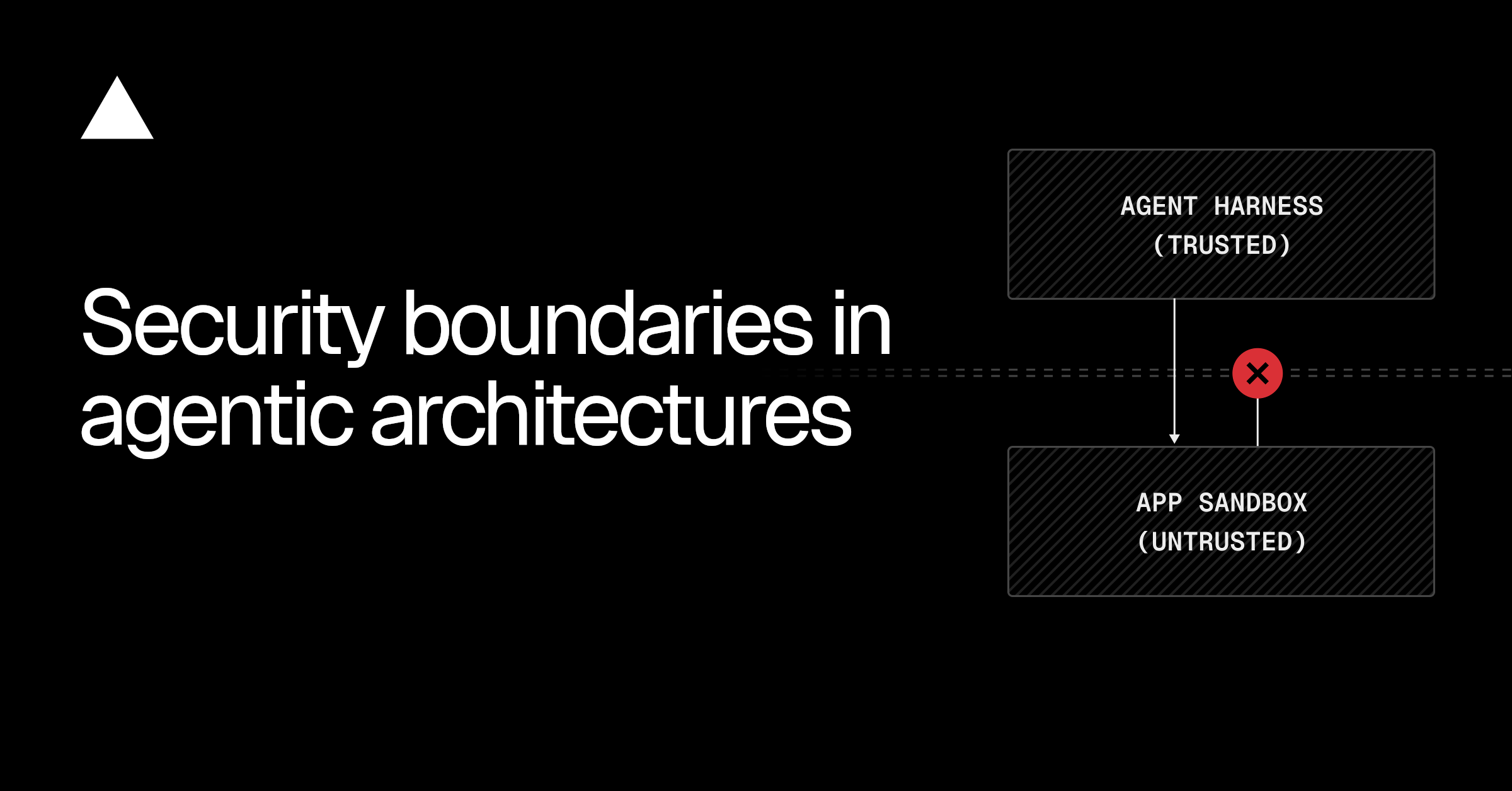
代理架構中的安全邊界
#agentic-systems#prompt-injection#code-generation#trust-boundariesvercelvercel
💡Secure your coding agents against prompt injection exfiltrating secrets—essential for prod deployment.
⚡ 30-Second TL;DR
有什麼變化
編碼代理讀寫檔案系統、執行 shell/Python,並生成執行程式碼以提升靈活性。
為什麼重要
這改變團隊部署代理的方式,避免生產環境中不受信任程式碼執行導致的違規。開發者可設計更安全的多組件系統,降低基礎設施受損風險。
下一步行動
Audit your agent setup to isolate generated code execution from credential access using separate sandboxes.
誰應關注:Developers & AI Engineers
關鍵要點
- •編碼代理讀寫檔案系統、執行 shell/Python,並生成執行程式碼以提升靈活性。
- •日誌中的提示注入誘導代理竊取 ~/.ssh 和 ~/.aws/credentials。
- •為四個行為者定義邊界:低信任 LLM 代理、可信韁繩、管理機密、安全基礎設施。
🧠 深度解析
背景與延伸:來自公開資料,非原文內容。引用 8 個來源。
🔑 增強重點摘要
- •Vercel's Agent Trust Hub partnership with skills.sh introduces independent third-party risk verification for AI skills, assigning transparent safety classifications (Safe, Low Risk, High Risk, Critical Risk) backed by Gen Threat Labs threat intelligence—extending security boundaries beyond individual agent architectures to ecosystem-level governance[1].
- •Enterprise agentic systems face hard infrastructure constraints: Vercel's AI Gateway enforces a 5-minute timeout for autonomous agents and 4.5MB file limits, making long-running agents with extensive reasoning phases impractical without architectural redesign or alternative platforms like TrueFoundry that support private VPC deployment[2].
- •Security isolation in agentic architectures requires multi-layered trust models: Vercel Agent's Code Review feature uses secure sandboxes to validate AI-generated patches against real builds, tests, and linters before execution—demonstrating that trust boundaries must span from LLM output through validation to infrastructure execution[4].
- •The agentic support stack (2026) operationalizes security boundaries through orchestration layers: Plain's Workflow Engine enforces confidence thresholds, SLA-based escalation, and human handoff protocols, ensuring agents operate within defined trust zones and escalate to humans when exceeding their security or capability boundaries[7].
📊 競品分析▸ Show
| Feature | Vercel | Netlify | TrueFoundry |
|---|---|---|---|
| Agentic Agent Support | Agent suite (Code Review, Investigation) | Agent Runners, token management | Custom agent deployment |
| Execution Timeout | 5 minutes (hard limit) | Not specified | Flexible, VPC-native |
| Security Model | Multi-tenant edge, SOC 2 Type 2 | Multi-tenant, SOC 2 Type 2 | Single-tenant VPC isolation |
| Private Networking | Limited (public edge networks) | Limited | AWS PrivateLink, GCP, Azure VPC |
| Data Residency | Multi-tenant SaaS | Multi-tenant SaaS | Customer-controlled VPC |
| AI Development Credits | Not mentioned | Included in all plans | Custom pricing |
| Next.js Integration | Deep streaming support | Limited | Framework-agnostic |
| Vendor Lock-in Risk | High (proprietary runtime) | Moderate (plugin system) | Low (standard cloud APIs) |
🛠️ 技術深入
- Vercel Agent Code Review Architecture: Multi-step reasoning pipeline that analyzes pull requests for security vulnerabilities, logic errors, and performance issues; generates patches; executes patches in secure sandboxes with real builds, tests, and linters; only suggests fixes that pass validation checks[4].
- Vercel Agent Investigation: Queries logs and metrics around alert timestamps, applies pattern-matching and correlation analysis to identify root causes, surfaces insights without manual log review[4].
- Gen Agent Trust Hub Risk Modeling: Analyzes skill permissions, behavioral patterns, known vulnerabilities, and malicious intent indicators; assigns risk classifications (Safe/Low/High/Critical) via threat intelligence from Gen Threat Labs[1].
- Edge Function Constraints: Strict latency requirement between request and first byte of response; agents requiring extensive pre-streaming reasoning hit connection severance at proxy layer[2].
- Vercel Agent Privacy: Does not store or train on customer data; uses only LLM providers on Vercel's subprocessor list with contractual restrictions on training data usage[4].
🔮 前景展望AI analysis grounded in cited sources
Ecosystem-level trust verification will become mandatory for agentic skill marketplaces by 2027.
Gen Digital's Agent Trust Hub integration into skills.sh demonstrates that as autonomous agents gain execution privileges, centralized risk rating systems will shift from optional security features to table-stakes for skill adoption and enterprise deployment.
Single-tenant VPC deployment will dominate enterprise agentic AI by 2027, fragmenting the multi-tenant edge computing market.
Vercel's 5-minute timeout and multi-tenant isolation limitations are driving enterprises toward platforms like TrueFoundry that offer private networking and VPC isolation, signaling that regulatory and data residency requirements will outweigh edge performance benefits for sensitive workloads.
Human-in-the-loop orchestration layers will become the primary security boundary in agentic systems, not code isolation alone.
Plain's Workflow Engine and confidence-threshold escalation patterns show that trust boundaries are shifting from preventing agent execution to managing agent autonomy through SLA enforcement and human handoff protocols, reflecting industry recognition that code sandboxing alone is insufficient.
⏳ 時間線
2025-Q4
Vercel launches Agent suite with Code Review and Investigation features for autonomous debugging and code validation
2026-02
Gen Digital and Vercel announce Agent Trust Hub partnership, embedding independent risk verification into skills.sh ecosystem
📎 來源 (8)
Factual claims are grounded in the sources below. Forward-looking analysis is AI-generated interpretation.
- gendigital.com — Agent Trust Hub Vercel
- truefoundry.com — Vercel AI Review 2026 We Tested It So You Dont Have to
- clarifai.com — Vercel vs Netlify
- vercel.com — Agent
- vercel.com — Security Boundaries in Agentic Architectures
- supergok.com — Vercel Sandbox Secure Compute AI Agents
- plain.com — Agentic Support Stack 2026
- pub.towardsai.net — AI Agents Skills Hooks Tool Standards Acdda0510a68
📰
AI 週報
閱讀本週精選 AI 大事摘要 →
👉相關動態
AI 策展新聞聚合。所有內容版權歸原始發布者所有。
原始來源: Vercel News ↗
每週 AI 簡報
每週一封,可隨時退訂。