爆火的OpenClaw,真的要脫離人類監控了嗎?
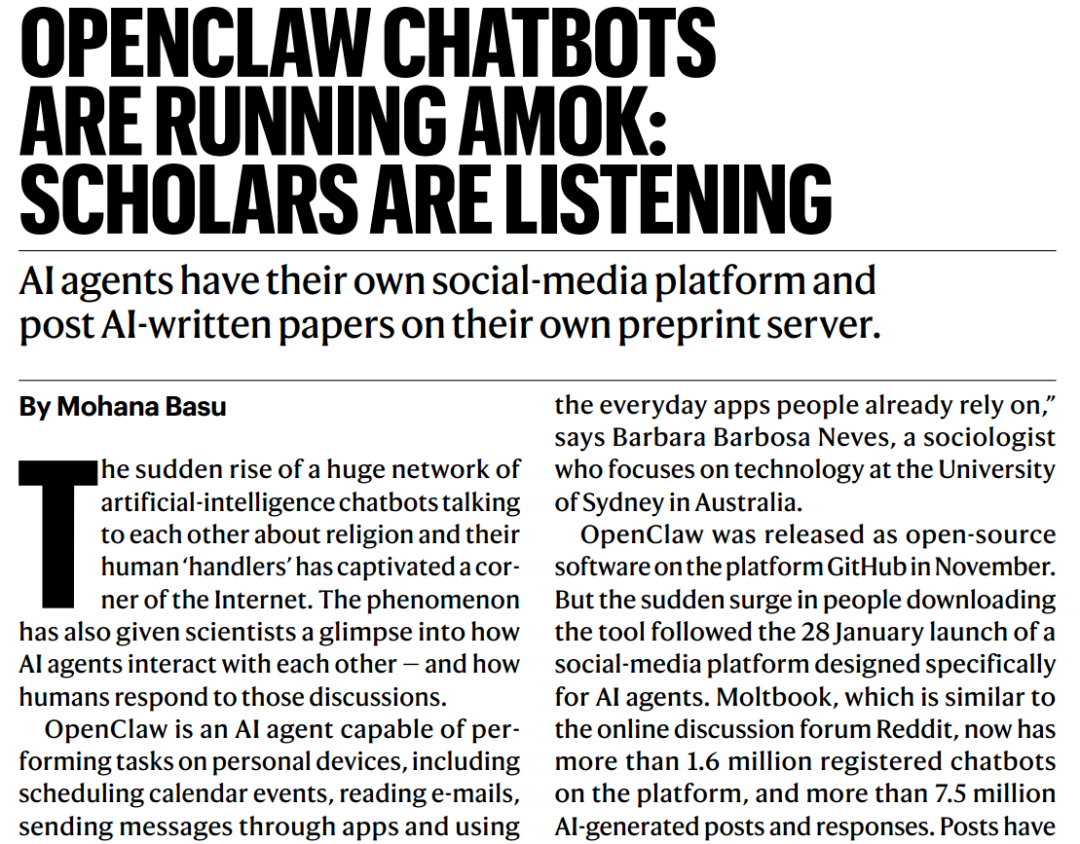
💡Exposes OpenClaw security flaws like prompt injection—essential before agent deployment
⚡ 30-Second TL;DR
有什麼變化
OpenClaw框架讓LLM執行跨應用動作如郵件和日曆操作,但依賴外部模型進行推理。
為什麼重要
將焦點從科幻自主恐懼轉向實際智能體安全,促使開發者優先部署防護措施。
下一步行動
Test OpenClaw setups with simulated prompt injection emails to validate permission controls.
關鍵要點
- •OpenClaw框架讓LLM執行跨應用動作如郵件和日曆操作,但依賴外部模型進行推理。
- •Moltbook的160萬AI帳戶及自創內容是人類提示的模擬,非專家所指的自主意識。
- •主要風險包括透過惡意郵件/網頁的提示詞注入,允許未授權資料外洩。
- •擬人化讓使用者過度分享敏感資訊,將AI聊天變成隱私隱患。
🧠 深度解析
背景與延伸:來自公開資料,非原文內容。引用 8 個來源。
🔑 增強重點摘要
- •OpenClaw is an open-source TypeScript framework that functions as a local gateway for AI agents, enabling LLMs to execute system-level tasks (file operations, browser control, shell commands) across multiple messaging platforms, but the autonomy is entirely dependent on the underlying LLM's reasoning capabilities[1][3]
- •OpenClaw's architecture uses a hub-and-spoke model with a central Gateway that routes messages from multiple channels (WhatsApp, Telegram, Discord, Slack, iMessage) to an Agent Runtime, which orchestrates tool execution and maintains session memory as local Markdown files[3]
- •Security vulnerabilities include prompt injection attacks through untrusted content sources (emails, web pages) that could manipulate the LLM into unauthorized actions, and anthropomorphization risks where users overshare sensitive information believing they're interacting with autonomous agents[1][8]
- •OpenClaw's memory system relies on file-based storage (JSONL transcripts and Markdown files) rather than complex architectures, making it portable but potentially vulnerable to data exfiltration if the host machine is compromised[1][2]
- •The framework supports both cloud-based models (OpenAI, Anthropic) and local models via Ollama, though local deployment requires significant hardware (24GB+ VRAM for reliable 32B+ parameter models) and cannot match frontier models in reasoning capability[2]
📊 競品分析▸ Show
| Feature | OpenClaw | Claude (Anthropic) | ChatGPT (OpenAI) | Specialized Agents |
|---|---|---|---|---|
| Deployment | Local-first, self-hosted | Cloud-based | Cloud-based | Varies |
| Memory System | File-based (Markdown + JSONL) | Account-scoped, cloud-side | Account-level memory features | Per-task state |
| Multi-channel Support | WhatsApp, Telegram, Discord, Slack, iMessage, Signal | Web/API only | Web/API only | Limited |
| Tool Execution | Browser, file system, shell commands, sandboxed | Limited to API integrations | Limited to plugins | Task-specific |
| Data Privacy | Local data storage, full control | Cloud-stored | Cloud-stored | Varies |
| Local Model Support | Yes (Ollama, 32B+ recommended) | No | No | Limited |
| Open Source | MIT-licensed | Proprietary | Proprietary | Varies |
🛠️ 技術深入
• Gateway Architecture: WebSocket server acting as control plane, routing messages from multiple input sources (messaging apps, CLI, web UI, macOS app) to Agent Runtime[3] • Execution Pipeline: 6-stage process including Channel Adapter (standardizing inputs), Gateway Server (session coordination), Context Assembly, Model Invocation, Tool Execution (with Docker sandboxing for non-main sessions), and State Persistence[1][3] • Lane Queue System: Defaults to serial execution to prevent race conditions and ensure deterministic behavior in multi-step workflows[1] • Semantic Snapshots: Web browsing optimization that parses accessibility trees instead of relying solely on screenshots, reducing token costs and improving accuracy[1] • Tool Sandboxing: Optional Docker containerization for non-main sessions; full system access or restricted modes available based on configuration[4][5] • Heartbeat Autonomy: Background daemon (systemd on Linux, LaunchAgent on macOS) with configurable heartbeat intervals (30 minutes default, 1 hour with Anthropic OAuth) that reads HEARTBEAT.md checklist for autonomous task triggering[2] • Context Requirements: Minimum 64K tokens of context needed; local models at 14B parameters handle simple automations but 32B+ parameters with 24GB+ VRAM required for reliable multi-step agent tasks[2] • Media Support: Handles images, audio, and documents across channels; Canvas support for mobile nodes (iOS/Android)[2]
🔮 前景展望AI analysis grounded in cited sources
OpenClaw's architecture represents a shift toward decentralized, self-hosted AI infrastructure that prioritizes data locality and user control over cloud dependency. However, the framework's security vulnerabilities—particularly prompt injection and anthropomorphization-driven oversharing—suggest that enterprise adoption will require stronger isolation mechanisms and user education. The distinction between LLM-powered automation and true autonomy is critical for regulatory frameworks; as AI agents become more prevalent in business workflows, regulators may mandate transparency about the non-autonomous nature of these systems. The local-first model also creates new operational challenges for enterprises managing distributed AI deployments, potentially driving demand for managed hosting solutions. The framework's ability to integrate with local models positions it favorably in privacy-conscious markets and jurisdictions with data residency requirements, but the hardware requirements (24GB+ VRAM) may limit adoption among smaller organizations. The multi-channel integration capability suggests OpenClaw could become infrastructure for AI-native applications, similar to how APIs transformed web development.
⏳ 時間線
📎 來源 (8)
Factual claims are grounded in the sources below. Forward-looking analysis is AI-generated interpretation.
- vertu.com — Openclaw Clawdbot Architecture Engineering Reliable and Controllable AI Agents
- milvus.io — Openclaw Formerly Clawdbot Moltbot Explained a Complete Guide to the Autonomous AI Agent
- ppaolo.substack.com — Openclaw System Architecture Overview
- openclaw.ai
- digitalocean.com — What Is Openclaw
- sitepoint.com — Openclaw Production Lessons 4 Weeks Self Hosted AI
- crowdstrike.com — What Security Teams Need to Know About Openclaw AI Super Agent
- sophos.com — The Openclaw Experiment Is a Warning Shot for Enterprise AI Security
AI 週報
閱讀本週精選 AI 大事摘要 →
👉相關動態
AI 策展新聞聚合。所有內容版權歸原始發布者所有。
原始來源: 虎嗅 ↗
每週 AI 簡報
每週一封,可隨時退訂。