來源虎嗅•較早收集於 4m
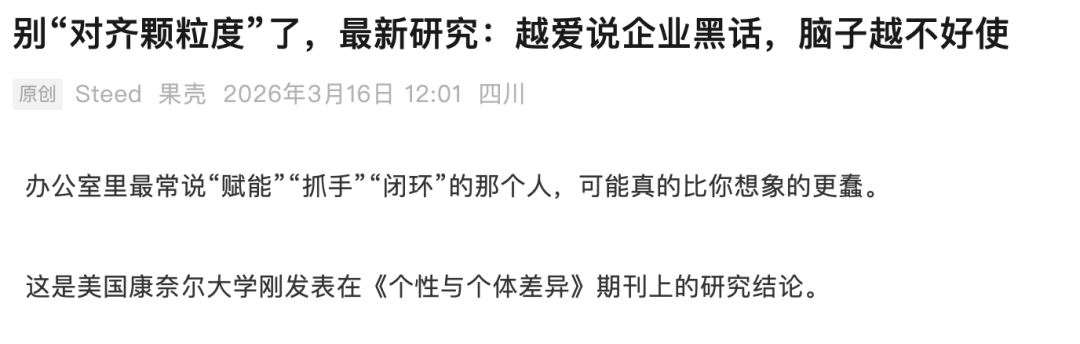
愛說黑話腦子越差?
#corporate-jargon#cognition-study#ai-commscornell-university
💡AI氾濫黑話;學會簡化否則被淘汰。(18字)
⚡ 30 秒速覽
有什麼變化
品牌偏好複雜黑話以顯深刻。
為什麼重要
AI內容生成爆發,提升人類清晰溝通技能需求。
下一步行動
用LLM審核團隊文件,偵測替換黑話,提升AI時代簡報清晰度。
誰應關注:Marketers & Content Teams
關鍵要點
- •品牌偏好複雜黑話以顯深刻。
- •康奈爾研究:黑話誤導決策。
- •AI將大量產生複雜表達,清晰解釋是差異化。
🧠 深度解析
本篇為 AI 生成分析,非原文內容。
🔑 增強重點摘要
- •Research from Cornell University, specifically involving the Dyson School of Applied Economics and Management, suggests that individuals who use jargon often do so to compensate for a lack of genuine knowledge, a phenomenon termed 'strategic obfuscation'.
- •Linguistic studies indicate that jargon-heavy communication triggers a 'fluency heuristic' in listeners, where the complexity is mistakenly interpreted as intelligence, despite empirical evidence showing it reduces message retention and trust.
- •The rise of Large Language Models (LLMs) has exacerbated this issue, as default AI training parameters often favor formal, academic, or corporate-sounding prose, leading to a 'homogenization of complexity' in digital content.
🔮 前景展望基於引用來源的 AI 分析
Plain language will become a premium 'human-verified' service tier.
As AI-generated content becomes increasingly dense and jargon-filled, businesses will market 'human-edited' or 'plain-language' content as a luxury differentiator to ensure actual consumer comprehension.
Cognitive load metrics will be integrated into SEO algorithms.
Search engines will likely prioritize content with lower Flesch-Kincaid readability scores to counteract the influx of low-value, jargon-heavy AI content.
📰
AI 週報
閱讀本週精選 AI 大事摘要 →
👉相關動態


AI 策展新聞聚合。所有內容版權歸原始發布者所有。
原始來源: 虎嗅 ↗
每週電子報
每週一封,可隨時退訂。