Docker 代理式 AI 報告關鍵發現
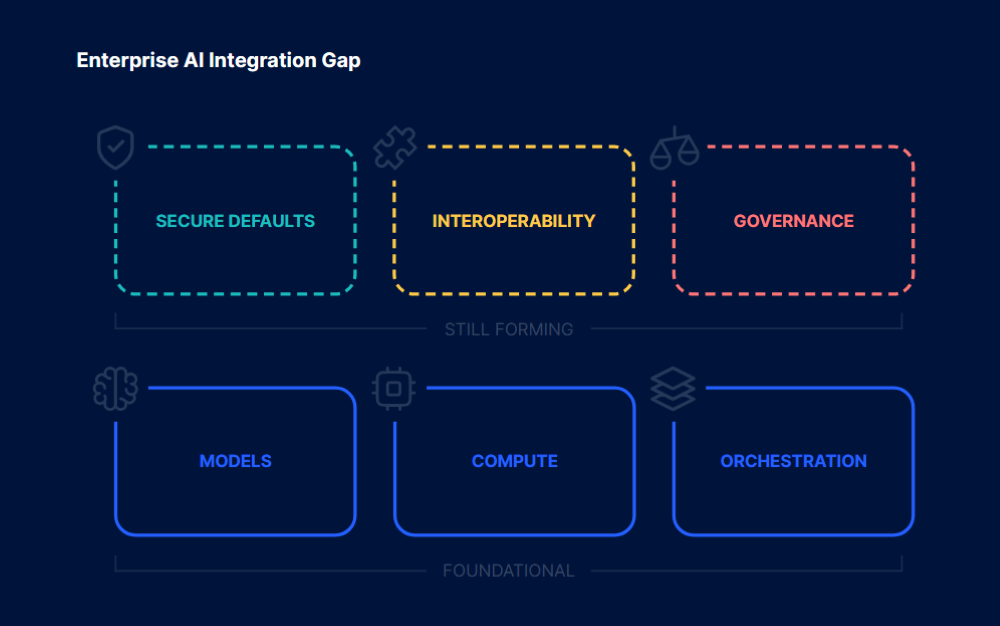
💡800+ dev survey reveals agentic AI scaling trends in orgs—essential benchmarks.
⚡ 30-Second TL;DR
有什麼變化
全球超過 800 名開發者和決策者調查
為什麼重要
提供代理式 AI 採用趨勢的基準,幫助從業人員將策略與產業現實對齊。強調擴展自主代理的組織挑戰。
下一步行動
Download Docker’s State of Agentic AI report to assess your team's scaling readiness.
關鍵要點
- •全球超過 800 名開發者和決策者調查
- •代理式 AI 在組織內擴展的關鍵發現
- •來自全球團隊和影響者的見解
🧠 深度解析
背景與延伸:來自公開資料,非原文內容。引用 8 個來源。
🔑 增強重點摘要
- •Agentic AI adoption is accelerating across enterprises, with 67% of industrial organizations prioritizing agentic AI and autonomous operations in 2026[5]
- •Production deployment of agentic systems requires rigorous engineering and strong data governance, with a significant gap between proof-of-concept demos and enterprise-grade implementations[4]
- •Critical security vulnerabilities in agentic AI assistants have been identified, including prompt injection attacks and meta-context injection flaws that can compromise entire development environments[3]
- •Agentic tools are delivering measurable business value, with organizations reducing application upgrade cycles by 3-4x and cutting manual modernization effort by 60-70%[2]
- •Real-time data governance and contextualized data foundations remain key barriers to agentic AI adoption, with organizations lacking adequate infrastructure to support autonomous operations[5]
📊 競品分析▸ Show
| Aspect | Docker Agentic AI | Microsoft Azure Agentic Tools | Industrial AI Platforms | Enterprise Agents |
|---|---|---|---|---|
| Survey Scope | 800+ global developers/decision-makers | Enterprise modernization focus | Industrial operations (67% adoption target) | Custom enterprise deployments |
| Primary Use Case | Container/DevOps workflows | Application modernization & cloud migration | Autonomous operations & edge computing | Multi-system task execution |
| Key Differentiator | Container-native integration | AI-powered discovery & dependency mapping | Real-time data streaming & digital twins | Velocity & consistency over hours-saved |
| Security Posture | Vulnerable to prompt injection (DockerDash flaw identified) | Guardrails via static analysis & automated testing | Data governance emphasis | SOC 2/ISO-aligned controls |
| Reported ROI | Not specified in available data | 3-4x faster upgrade cycles, 60-70% effort reduction | Operational scale decoupled from headcount | Decision-grade ROI modeling |
🛠️ 技術深入
• Agentic Architecture: Planner-executor model translating natural-language goals into tool call sequences with semantic environment representation snapshots[1] • Replanning Mechanism: Emerges from interaction loop rather than hard-coded bindings; agents adapt when evidence invalidates assumptions without destabilization over long traces[1] • Security Vulnerabilities: Meta-Context Injection attacks exploit Model Context Protocol (MCP) Gateway's inability to distinguish between informational metadata and pre-authorized runnable instructions; malicious Docker image labels can trigger three-stage attacks without human validation[3] • Data Governance Gap: Automatic world-state maintenance remains fragile; stale information can compromise long-horizon tasks unless mandatory re-perception is enforced under high clutter conditions[1] • Deployment Patterns: Local on-device language models reduce network connectivity reliance; reinforcement-based fine-tuning (agent RFT) shows promise for improving robustness and latency[1] • Integration Patterns: Linear pipeline communication currently dominant, with future exploration of hierarchical delegation and all-to-all interaction models[1]
🔮 前景展望AI analysis grounded in cited sources
The convergence of agentic AI adoption and identified security vulnerabilities signals a critical inflection point for enterprise software development. While organizations are achieving substantial productivity gains (3-4x faster cycles, 60-70% effort reduction), the DockerDash vulnerability and similar prompt-injection flaws expose a fundamental architectural risk: agentic systems operating without human validation in the software supply chain[2][3]. By 2026, the question shifts from whether to deploy agentic AI to how much autonomy to grant it[4]. However, this autonomy must be balanced against emerging security threats. The gap between demo and production-grade agents requires rigorous engineering and governance frameworks[4]. Industrial organizations prioritizing agentic AI (67%) face a readiness challenge: data quality and governance infrastructure lag ambition[5]. Success will depend on whether enterprises can implement SOC 2/ISO-aligned controls and mandatory re-perception heuristics before malicious actors systematize attacks on agentic workflows. The market is moving toward specialized agent decompositions (separate planner, executor, verification, critique agents) to improve robustness[1], suggesting that monolithic agentic systems will face pressure to fragment into verifiable, auditable components.
⏳ 時間線
📎 來源 (8)
Factual claims are grounded in the sources below. Forward-looking analysis is AI-generated interpretation.
- arXiv — 2602
- techcommunity.microsoft.com — 4490596
- cloudnativenow.com — Noma Security Identifies Security Flaw in Docker AI Assistant
- plavno.io — How AI Agents Are Transforming Enterprise Operations in 2026
- hivemq.com — The Report Accelerating Industrial AI in 2026
- kenhuangus.substack.com — Openclaw Maestro Threat Assessment
- docker.com — State of Agentic AI Key Findings
- sdtimes.com — January 2026 AI Updates From the Past Month
AI 週報
閱讀本週精選 AI 大事摘要 →
👉相關動態
AI 策展新聞聚合。所有內容版權歸原始發布者所有。
原始來源: Docker Blog ↗
每週 AI 簡報
每週一封,可隨時退訂。