來源Pandaily•較早收集於 3h
中國啟動 2026 年人形機器人實景訓練計畫
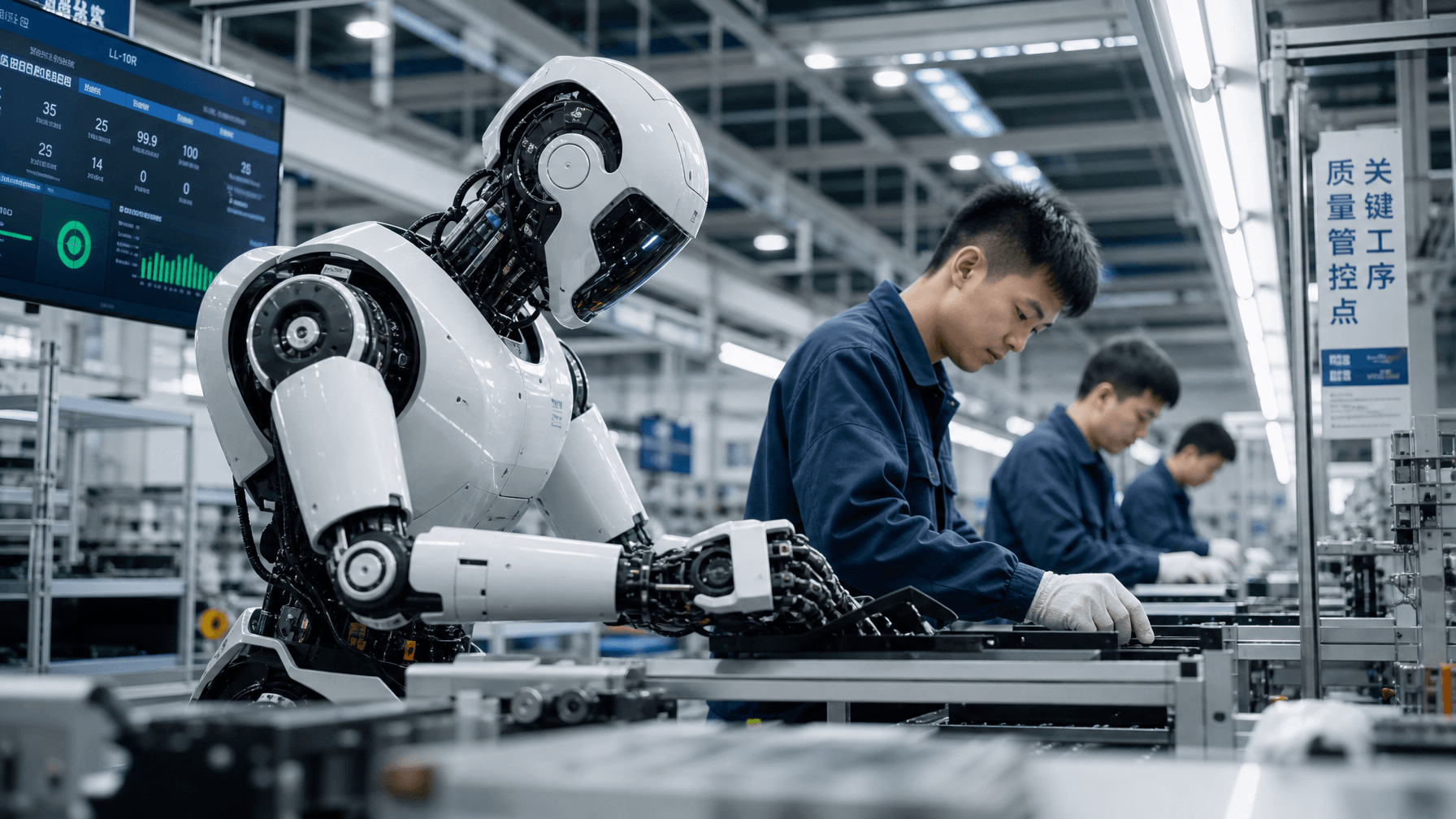
💡國家級人形機器人計畫啟動,預計將引爆具身智慧軟體與工業整合的龐大需求。
⚡ 30 秒速覽
有什麼變化
由 MIIT 與 SASAC 聯合發起,旨在擴大機器人產業規模。
為什麼重要
此政策標誌著國家級對具身智慧 (Embodied AI) 的大力推動,預計將為中國的導航、操作與電腦視覺軟體開發人員創造龐大的市場需求。
下一步行動
若您正在開發具身智慧代理,請研究中國市場所需的工業合規標準與硬體介面,為即將到來的整合機會做好準備。
誰應關注:Developers & AI Engineers
關鍵要點
- •由 MIIT 與 SASAC 聯合發起,旨在擴大機器人產業規模。
- •目標在 2026 年前於工業與服務業部署超過 1,000 台人形機器人。
- •重點開發超過 100 個高價值、真實世界的應用場景。
🧠 深度解析
背景與延伸:來自公開資料,非原文內容。引用 19 個來源。
🔑 增強重點摘要
- •The initiative, officially named the "2026 Humanoid Robot and Embodied AI Real-Scene Training Special Action," aims for humanoid robots and related products to complete application verification and routine deployment in representative real-world scenarios by the end of 2026, effectively entering an "operation mode."
- •The plan mandates provincial-level authorities to select at least 20 key scenario units covering a minimum of two out of three priority domains (industrial, service, and specialized fields), while central state-owned enterprises must identify at least 10 key scenarios within their respective industries.
- •A core component of the initiative involves forming Innovation Application Consortia, which will bring together end-users, robot manufacturers, algorithm developers, supply chain companies, and research institutions to advance scenario understanding, task planning, operational execution, human-machine collaboration, and continuous learning capabilities.
- •Financial support mechanisms, including equity investment, debt financing, and and insurance products, are outlined to provide full-chain financial services, with provincial authorities encouraged to explore local policy frameworks to accelerate development and deployment.
- •China has designated 2026 as the "first year of commercialization for humanoid robots," with retail stores selling robots and rental services already commencing in cities like Beijing, driven by national imperatives to secure dominance in emerging industries and address future labor shortages.
📊 競品分析▸ Show
Chinese Humanoid Robot Landscape (Selected Industrial Focus)
| Feature | UBTECH Walker S2 | Unitree H1/G1 | DEEP Robotics DR02 | Kepler Forerunner K2 | ZhongQing Robotics SE01 | Cyborg Robotics R01 |
|---|---|---|---|---|---|---|
| Application Focus | Industrial (automotive assembly, quality checks, material handling, logistics) | General-purpose, industrial, consumer, research | Industrial-grade, all-weather deployment, field operation | Industrial & commercial (manufacturing, logistics, research) | Primarily industrial applications | Heavy-duty industrial (high-risk, high-load environments) |
| Key Specs | 176 cm height, 43 kg weight, force-compliant drive joints, rigid-flexible coupling, autonomous battery swapping | G1: 1320x450x200mm (stand), ~35kg, 23-43 DoF, 8-core CPU, Depth Camera+3D LiDAR | 1.75 m height, 65 kg weight, 4 m/s max speed, 20 kg load capacity, full-body IP66 protection | Advanced sensor suite, robust design, 8 hours continuous operation (1 hr charge) | 170 cm height, 55 kg weight, 32 DoF, 330 N·m max joint torque, 2 m/s normal walking speed | 62 DoF, dexterous hands with 16 DoF each |
| Deployment Status | Deployed in Chinese automotive manufacturers (BYD, Nio, Zeekr), Foxconn facilities | Retail sales, used in research and various applications | Designed for durability and field operation | Mass production began late 2025, early deployments confirmed | Designed for industrial applications | Developing for high-risk, high-load industrial environments |
| Pricing | Not publicly revealed | Varies by model (G1 is affordable) | Not specified | Not specified | Not specified | Not specified |
| Benchmarks | Not specified | Not specified | Not specified | Not specified | Not specified | Not specified |
🛠️ 技術深入
- China released its first top-level standard system for humanoid robots and embodied AI in March 2026, designed to cover the entire industrial chain and full life cycle of humanoid robots.
- This standard system is structured around six core sections: basic commonalities, brain-like and intelligent computing, limbs and components, complete machines and systems, applications, and safety and ethics.
- The "brain-like and intelligent computing" standards specifically cover critical specifications for embodied intelligence's "brain and cerebellum" and intelligent computing, regulating the entire data lifecycle, model training, and deployment processes.
- Innovation centers for embodied intelligence and humanoid robotics, established in Beijing and Shanghai, are driving the development of open-source reference platforms such as the "Qinglong" and "Tiangong" robots, and the "Kaiwu" operating system.
- The Ministry of Industry and Information Technology (MIIT) intends to elevate key technologies, including large models, integrated joints, and computing chips, through mechanisms like open challenges and major national science and technology projects.
- A pioneering national "digital ID" system for humanoid robots was unveiled in May 2026, assigning each machine a 29-digit identity code to enable end-to-end traceability from manufacturing and sales to daily usage and recycling, with a strict "no code, no market access" rule.
🔮 前景展望基於引用來源的 AI 分析
China will significantly accelerate the commercialization and widespread adoption of humanoid robots in industrial and service sectors.
The initiative's ambitious targets, strong government backing, outlined financial support mechanisms, and focus on real-world application scenarios indicate a concerted effort to move beyond prototypes to mass deployment and market penetration.
China will establish itself as a global leader in humanoid robot standardization and ethical governance.
The rapid development and implementation of a comprehensive national standard system and a digital ID system for traceability demonstrate a proactive approach to shaping the industry's regulatory and ethical framework.
The integration of large language models (LLMs) and embodied AI will be a key driver for enhanced humanoid robot capabilities.
MIIT explicitly prioritizes breakthroughs in large models and the development of "brain-like and intelligent computing" standards, indicating a strategic focus on advanced AI for improving robot intelligence and autonomy.
⏳ 時間線
2023-11
MIIT publishes guidelines for humanoid robot development, aiming for mass production by 2025.
2024-11
Beijing Robot Industry Innovation and Development Action Plan (2023-2025) sets goals for high-tech robots and applications.
2025-04
China's first national standards for humanoid robot technical requirements are officially approved for development.
2025-12
MIIT establishes the Humanoid Robot and Embodied Intelligence Standardization Technical Committee.
2026-03
China releases its first top-level standard system for humanoid robots and embodied AI.
2026-05
China unveils a national "digital ID" system for humanoid robots to enable traceability and safe governance.
📎 來源 (19)
Factual claims are grounded in the sources below. Forward-looking analysis is AI-generated interpretation.
📰
AI 週報
閱讀本週精選 AI 大事摘要 →
👉相關動態


AI 策展新聞聚合。所有內容版權歸原始發布者所有。
原始來源: Pandaily ↗
每週電子報
每週一封,可隨時退訂。