來源钛媒体•較早收集於 32m
為何 StepFun 堅持開發 AI Agent 手機?
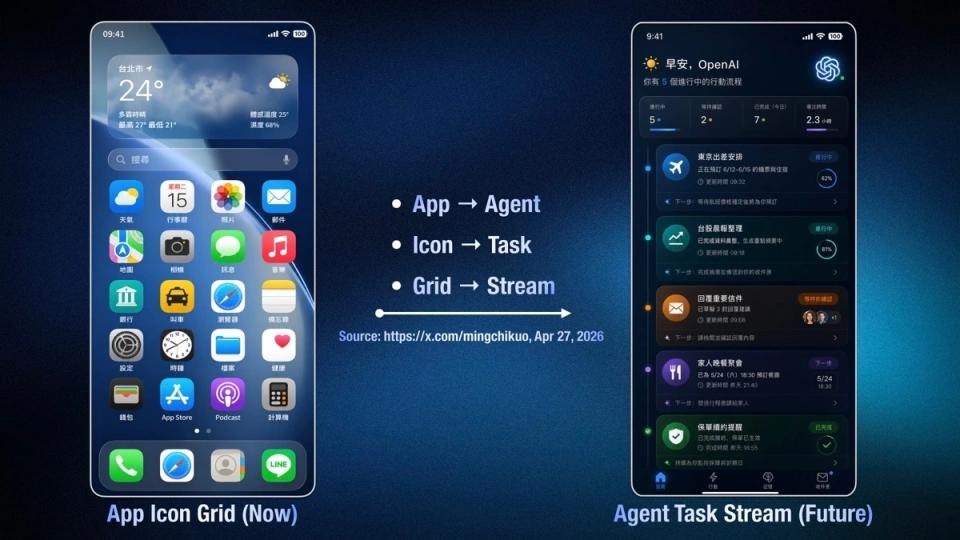
#ai-agents#mobile-os#hardware-integrationstepfun-ai-agent-phonestepfun
💡了解為何 StepFun 押注 AI Agent 手機,以及這將如何改變行動作業系統的未來。
⚡ 30 秒速覽
有什麼變化
StepFun 優先考慮在行動硬體中整合 AI Agent
為什麼重要
此舉標誌著向「AI 原生」硬體的轉變,即作業系統圍繞 Agent 而非應用程式構建,可能顛覆當前的行動生態系統。
下一步行動
探索 StepFun 的 API 文件,了解如何構建可以在行動原生環境中運行的 Agent 工作流。
誰應關注:Developers & AI Engineers
關鍵要點
- •StepFun 優先考慮在行動硬體中整合 AI Agent
- •該戰略涉及深度系統整合的高難度路徑
- •致力於透過自主 Agent 重新定義行動用戶體驗
🧠 深度解析
本篇為 AI 生成分析,非原文內容。
🔑 增強重點摘要
- •StepFun's strategy leverages its proprietary 'Step' series large language models, which are specifically optimized for low-latency inference on mobile NPU architectures.
- •The company has established strategic partnerships with major Chinese smartphone OEMs to integrate its agent-based OS layer directly into the system kernel, bypassing traditional app-based AI limitations.
- •StepFun is focusing on 'intent-driven' interaction models, allowing the AI agent to execute multi-step tasks across different third-party applications without requiring user intervention for each step.
- •The initiative is part of a broader shift in the Chinese AI market where model providers are moving from cloud-only SaaS models to 'on-device + cloud' hybrid architectures to address data privacy and connectivity concerns.
- •StepFun's agent framework utilizes a proprietary 'Action-Chain' technology that translates natural language commands into specific API calls within the mobile operating system's sandbox environment.
📊 競品分析▸ Show
| Feature | StepFun (Agent OS) | Apple (Intelligence) | Google (Gemini Nano) |
|---|---|---|---|
| Integration Level | Deep System/Kernel | OS-Level | OS/App-Level |
| Primary Focus | Autonomous Agent Tasks | Privacy/Personal Context | Search/Productivity |
| Model Architecture | Proprietary Step Series | Hybrid (On-device/Cloud) | Gemini Nano/Pro |
| Market Strategy | OEM Partnerships | Vertical Integration | Ecosystem Integration |
🛠️ 技術深入
- Model Architecture: Utilizes a Mixture-of-Experts (MoE) approach to balance high-performance reasoning with low-power on-device execution.
- Inference Optimization: Employs 4-bit quantization techniques specifically tuned for mobile NPUs to maintain high token-per-second rates.
- Agent Framework: Implements a ReAct (Reasoning + Acting) loop that operates within a restricted sandbox to ensure system security while allowing cross-app automation.
- Context Window: Optimized for long-term memory storage on-device, allowing the agent to retain user preferences and historical interaction data without cloud synchronization.
🔮 前景展望基於引用來源的 AI 分析
StepFun will transition to a hardware-agnostic licensing model for its Agent OS.
The high cost of deep system integration makes a pure hardware-manufacturing path unsustainable, forcing a shift toward software licensing for multiple OEM partners.
On-device AI agent performance will become the primary differentiator for mid-range smartphones by 2027.
As cloud-based AI becomes commoditized, the ability to execute complex, private tasks locally will drive consumer purchasing decisions in the mid-tier market.
⏳ 時間線
2023-04
StepFun (Beijing) Technology Co., Ltd. is founded by former Microsoft executives.
2024-01
StepFun releases its first series of large language models, focusing on high-reasoning capabilities.
2024-05
Company secures significant Series A funding to accelerate R&D in multimodal AI and agentic systems.
2025-03
StepFun announces the 'Step-Agent' framework, signaling a strategic pivot toward autonomous mobile interaction.
2026-02
First pilot programs for AI-agent integrated mobile devices are launched in collaboration with domestic smartphone manufacturers.
📰
AI 週報
閱讀本週精選 AI 大事摘要 →
👉相關動態



AI 策展新聞聚合。所有內容版權歸原始發布者所有。
原始來源: 钛媒体 ↗
每週電子報
每週一封,可隨時退訂。