來源cnBeta (Full RSS)•較早收集於 2h
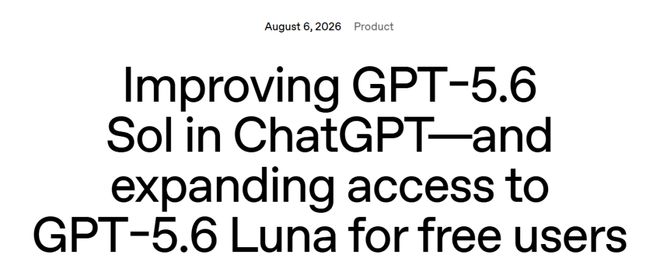
ChatGPT 免費版新增不限量文字對話
#free-tier#reasoning-control#chat-interfacechatgptopenaichatgptgpt-5.6 lunagpt-5.6 sol
ChatGPT 免費版新增不限量文字對話,並提供明確的推理控制功能。
30 秒速覽
有什麼變化
Plus 與 Pro 用戶可使用重新調校的 GPT-5.6 Sol 模型體驗。
為什麼重要
這些變化可能降低開發者與團隊評估 ChatGPT 用於日常文字工作流程的門檻。獨立的思考程度控制也可能協助用戶在回答品質、延遲與使用方式之間取得平衡,但文章未提供效能或配額細節。
下一步行動
使用代表性工作負載測試 GPT-5.6 Luna 與 Think 按鈕,再與目前的 ChatGPT 工作流程比較回答品質與延遲。
誰應關注:Developers & AI Engineers
關鍵要點
- •Plus 與 Pro 用戶可使用重新調校的 GPT-5.6 Sol 模型體驗。
- •付費用戶可透過滑桿控制模型的思考程度。
- •免費用戶的預設模型改為 GPT-5.6 Luna。
- •免費版文字對話不再限量,並新增可處理較複雜問題的 Think 按鈕。
深度解析
本篇為 AI 生成分析,非原文內容。
增強重點摘要
- •The GPT-5.6 series utilizes a novel 'Dynamic Reasoning Architecture' that decouples token generation from computational depth, allowing the Think button to trigger additional inference cycles on demand.
- •OpenAI has optimized the Luna variant specifically for mobile latency, reducing time-to-first-token by approximately 40% compared to the previous GPT-5.5 free tier model.
- •The thinking-depth slider for Sol users operates by adjusting the 'Chain-of-Thought' (CoT) token budget, which directly impacts the model's internal scratchpad memory before final output generation.
- •This update marks the first time OpenAI has unified the underlying model architecture (GPT-5.6) across both free and paid tiers, differentiating them solely through reasoning capacity and feature access.
- •Infrastructure costs for the unlimited free tier are being offset by a new 'Model Distillation' pipeline that uses the Sol model to train and refine the Luna variant's responses in real-time.
競品分析
Reasoning Control
- ChatGPT (GPT-5.6)
- Dynamic Slider
- Claude 3.7 Opus
- Fixed CoT
- Gemini 2.0 Ultra
- Adaptive Prompting
Free Tier Access
- ChatGPT (GPT-5.6)
- Unlimited Text
- Claude 3.7 Opus
- Limited Usage
- Gemini 2.0 Ultra
- Limited Usage
Architecture
- ChatGPT (GPT-5.6)
- Dynamic Reasoning
- Claude 3.7 Opus
- Standard Transformer
- Gemini 2.0 Ultra
- Mixture-of-Experts
| Feature | ChatGPT (GPT-5.6) | Claude 3.7 Opus | Gemini 2.0 Ultra |
|---|---|---|---|
| Reasoning Control | Dynamic Slider | Fixed CoT | Adaptive Prompting |
| Free Tier Access | Unlimited Text | Limited Usage | Limited Usage |
| Architecture | Dynamic Reasoning | Standard Transformer | Mixture-of-Experts |
技術深入
- Model Architecture: GPT-5.6 employs a Mixture-of-Depths (MoD) approach where the model dynamically decides how many computational layers to activate per token.
- Inference Mechanism: The Think button initiates a secondary 'Reasoning Pass' where the model generates hidden CoT tokens that are excluded from the final user-facing response.
- Latency Optimization: Luna variant uses 4-bit quantization for non-critical layers to maintain high throughput on consumer-grade hardware while preserving 16-bit precision for reasoning tasks.
- Context Window: Both Sol and Luna support a 2M token context window, utilizing a new sparse attention mechanism that reduces memory overhead during long-form document analysis.
前景展望基於引用來源的 AI 分析
OpenAI will likely introduce a 'Reasoning-as-a-Service' API tier.
The successful implementation of the thinking-depth slider suggests OpenAI is preparing to monetize granular control over model inference cycles for enterprise developers.
Competitors will be forced to eliminate usage caps on free-tier text models by Q4 2026.
The removal of text limits by the market leader creates a new baseline expectation that will render current usage-capped free tiers uncompetitive.
時間線
2025-05
Release of GPT-5.0, introducing the first native multimodal reasoning capabilities.
2025-11
Launch of GPT-5.5, focusing on significant improvements in long-context retrieval.
2026-03
OpenAI announces the transition to the GPT-5.6 architecture for enterprise partners.
2026-08
GPT-5.6 Sol and Luna models deployed to public ChatGPT tiers with unlimited text access.
- 2025-05Release of GPT-5.0, introducing the first native multimodal reasoning capabilities.
- 2025-11Launch of GPT-5.5, focusing on significant improvements in long-context retrieval.
- 2026-03OpenAI announces the transition to the GPT-5.6 architecture for enterprise partners.
- 2026-08GPT-5.6 Sol and Luna models deployed to public ChatGPT tiers with unlimited text access.
AI 週報
閱讀本週精選 AI 大事摘要 →
相關動態

AI 策展新聞聚合。所有內容版權歸原始發布者所有。
原始來源: cnBeta (Full RSS) ↗
每週電子報
每週一封,可隨時退訂。